Xiangqi
Chinese chess: chariots, cannons and a river between two palaces.
The chess of China, played on the points of a board split by a river, with a palace at each end where the generals live. Chariots sweep the lines, horses can be tripped, elephants never cross the water and cannons take by leaping over a piece. You play red against the computer at three strengths, and every day brings a game that opens with a classic line, the same for everyone.
- Category
- Cards & Board
- Modes
- Easy · Medium · Hard · Daily
- Controls
- Mouse · Touch · Keyboard
Loading…
How to play
Tap one of your red pieces and the points it can reach light up; tap one of them to move there. Pieces stand on the points where the lines cross. The general steps one point along a line and never leaves his palace, and the advisors step diagonally inside it. The elephant moves two points diagonally, never across the river, and not when the point between is taken. The horse moves one point straight and one diagonally, and is blocked when the point next to it is taken. The chariot moves any distance along a line. The cannon moves like the chariot but captures only by jumping over exactly one piece. Soldiers step forward, and sideways too once they have crossed the river. The two generals may never face each other on an open file. Checkmate the black general to win: a side left with no legal move loses, in check or not. Perpetual check loses; any other position repeated three times is a draw, and so are 30 moves each without a capture and a game that reaches 100 moves each. A win scores 100 plus two points for every move under 60; a loss scores two for each piece you took.
What is Xiangqi?
Xiangqi (象棋, said roughly "shyang-chee") is the chess of China, and with Vietnam and Taiwan, where it is played just the same, one of the most played board games in the world. It comes from the same family of war games that began in India more than a thousand years ago, but it took its own shape in China: the pieces stand on the points where the lines cross rather than in squares, a river splits the board in two, and each general lives in a palace he can never leave.
Here you play the red pieces against the computer at three strengths, and every day brings a Daily game that opens with a classic line, the same for everyone.
How to play
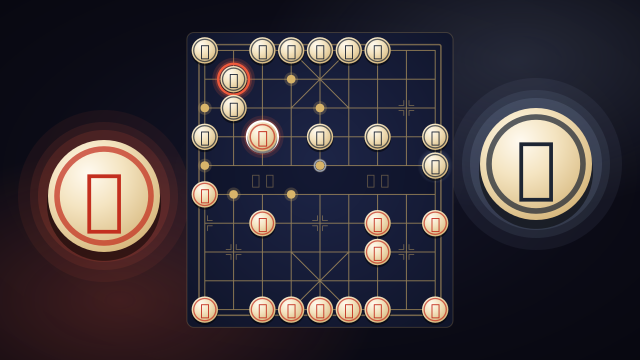
- The board. Nine lines by ten, with a river across the middle and a palace of nine points at each end, marked by two diagonals. Pieces stand on the points, not in the squares.
- Picking a move. Tap one of your pieces and the points it can reach light up: a dot for a free point, a ring around a piece you can take. Tap one and the piece goes there. The status line tells you how the piece you picked moves.
- General (帥 / 將). One point along a line, never out of the palace.
- Advisors (仕 / 士). One point diagonally, never out of the palace either.
- Elephants (相 / 象). Two points diagonally, never across the river. If the point in between is taken, that way is closed.
- Horses (傌 / 馬). One point straight, then one diagonally outwards. If the point next to the horse in that direction is taken, it cannot go that way (a "hobbled leg").
- Chariots (俥 / 車). Any distance along a line, like the rook in chess.
- Cannons (炮 / 砲). Move like a chariot, but take only by jumping over exactly one piece of either side on the way.
- Soldiers (兵 / 卒). One point forward. Once across the river they may step sideways too. They never move back and never promote.
- The generals never meet. The two generals may not stand on the same file with nothing between them, so a move that would open the file between them is not allowed.
- Winning. Checkmate the black general. A side with no legal move loses, even when it is not in check.
- Draws and repetitions. Perpetual check loses: if a position comes up for the third time and one side gave check with every one of its moves since, that side loses. Any other third repetition is a draw, and so are 30 moves each without a capture, a board where neither side has an attacking piece left, and a game that reaches 100 moves each.
- Score. A win scores 100 plus two points for every move under 60. A draw scores 50, a loss two for each of the computer's pieces you took.
Strategy tips
- Bring a cannon to the middle. The favourite first move of masters puts a cannon on the central file, aiming at the enemy general through the soldier in front of him. Meet the same threat with a horse that guards that soldier.
- Get the chariots out. A chariot is worth about two horses. Move it off its corner early, onto an open file or the river bank, where it controls a whole line.
- Mind the horse's leg. Before you count on a horse, look at the point next to it: one piece there and a pair of its moves is gone. The same goes for the elephant's eye.
- Keep your guards. Advisors and elephants seldom attack, but a general without them can fall to a single horse and cannon. Trade them only once the attackers are gone.
- Cross the river. A soldier across the river is worth twice as much: it can step sideways and press on the palace. Two soldiers side by side near the palace often win an ending on their own.
- Use the flying general. Your general controls his file like a chariot: the enemy general may never step onto it. In the ending that is often the last thread of a mating net.
FAQ
Is Xiangqi free to play?
Yes. Like every game on Play, it runs free in your browser, with no download and no account needed.
I cannot read Chinese. How do I tell the pieces apart?
You do not need to: tap a piece and the status line names it and tells you how it moves, and the lit points show exactly where it can go. The characters differ a little between the sides, red having 帥 仕 相 傌 俥 炮 兵 and black 將 士 象 馬 車 砲 卒, but the general, advisors, elephants, horses, chariots, cannons and soldiers start on the same points on both sides.
Why can my horse not go there?
Its leg is blocked: a horse moves one point straight and then one diagonally, and a piece on that first point stops it. Unlike the knight in chess, a horse can be hemmed in.
Is stalemate a draw?
No. In xiangqi a side with no legal move loses, whether its general is in check or not.
What happens when the same position keeps coming back?
On the third time the game ends. If one side gave check with every move since the position first came up, that side loses: perpetual check is not allowed. Otherwise it is a draw. The full tournament rules also forbid chasing an unprotected piece forever; here a chase simply counts as a draw, so a result never hangs on a referee's judgement.
Can a game go on forever?
No. 30 moves each without a capture is a draw, and so is a game that reaches 100 moves each.
What is the Daily game?
Every day everyone plays the same game against the medium computer, starting from the same classic opening already on the board, so scores compare directly on the leaderboard.