Nine Men's Morris
Three in a line takes a piece.
The old board game of mills, made for your phone: nine pieces each, three squares, and a rival at three levels, or a friend on the same screen. Line up three to take a piece; win by leaving your rival with two pieces, or with nowhere to go.
- Category
- Cards & Board
- Modes
- Solo
- Controls
- Mouse · Touch

Loading…
How to play
Take turns placing your nine pieces on the empty points. Three of your pieces on one line form a mill, and a mill lets you take one of the rival's pieces, never one from a mill unless every piece is in one. Once all pieces are placed, slide a piece along a line to a free neighbouring point. A player down to three pieces may fly to any free point. You win when your rival has only two pieces left or cannot move. Forty moves without a capture end in a draw.
What is Nine Men's Morris?
Nine Men's Morris is one of the oldest board games still played, scratched into Roman steps and medieval cloisters long before chess reached Europe. Two players, nine pieces each, three nested squares and twenty-four points: line up three of your pieces and you take one of your opponent's. Lose all but two, or get boxed in with nowhere to move, and the game is over.
This version is made for a phone held upright. Your pieces still in hand wait below the board and your rival's above it, so the placing phase reads at a glance. Play a rival at three levels, from one that learns with you to one that looks five moves ahead, or pass the phone to a friend and play each other on the same screen.
How to play
Tap a free point to place a piece. Once both of you have placed all nine, tap one of your glowing pieces and then a highlighted neighbouring point to slide it there.
- Mills. Three of your pieces on one line, along a side of a square or across the middle lines, form a mill.
- Captures. Every new mill lets you take one rival piece. Pieces in a mill are protected, unless every one of the rival's pieces is in a mill.
- Moving. After placing, pieces slide along the lines to a free neighbouring point. Moving a piece out of a mill and back closes the mill again.
- Flying. A player down to three pieces may fly a piece to any free point.
- Winning. You win when your rival has only two pieces left, or cannot make a move. Forty moves in a row without a capture end in a draw.
Strategy tips
- Do not rush mills while placing. A mill now can leave pieces stranded later; spread out and keep options on several lines.
- Take the crossroads. The middle points of the middle square touch four lines and give your pieces the most freedom.
- Block before you build. When the rival has two in a line with the third point free, cover it, unless your own mill closes first.
- Build a swing mill. A piece that can slide back and forth between two mills takes a piece on every move.
- Count mobility in the endgame. Sometimes the win is not a capture but a board where the rival simply cannot move.
FAQ
Is Nine Men's Morris free to play?
Yes. Like every game on Play, it runs free in your browser, with no download and no account needed.
Can I take a piece that sits in a mill?
Only when every one of the rival's pieces is in a mill. Otherwise you must choose a piece outside them; the board lights up only the pieces you may take.
What does flying mean?
Once a player has only three pieces left, that player's pieces are no longer bound to the lines and may jump to any free point. It gives the weaker side a fighting chance.
Can two people play on one phone?
Yes. Choose Two players and pass the phone each turn; the board says whose turn it is and lights up only that player's pieces.
How strong is the hard rival?
It searches five moves ahead with a reading of material, open mills and blocked pieces. In measured play it beats the medium rival more often than not.
More like this

Chess
1v1Cards & Board
Sixty-four squares. Six rivals. One quiet night.
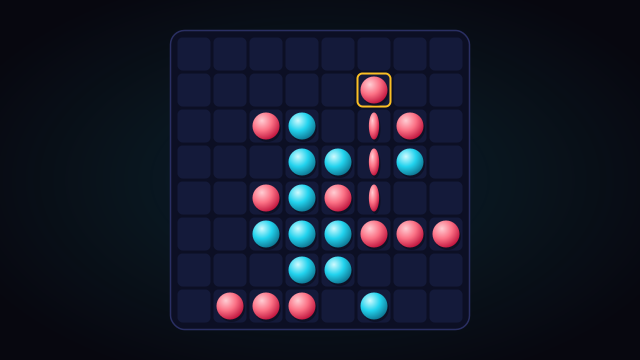
Reversi
Cards & Board
Outflank, flip, take the corners.
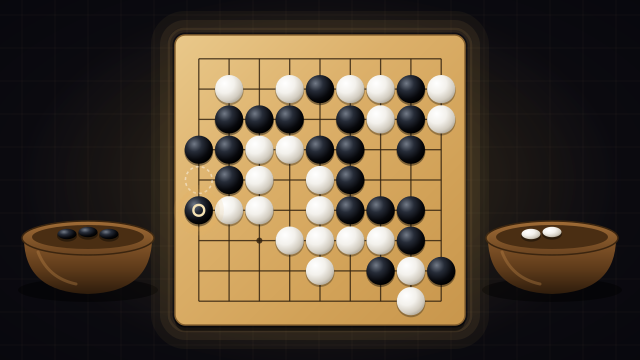
Go
Cards & Board
Black and white stones on a nine by nine board: surround more of it than the computer does.
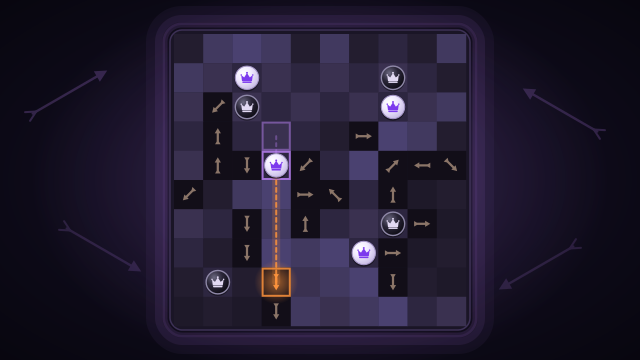
Amazons
Cards & Board
Move like a queen, shoot an arrow, burn a square: wall the board in until the computer has no move left.