Go
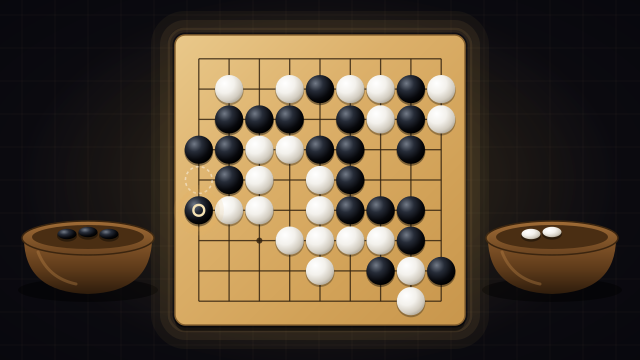
Black and white stones on a nine by nine board: surround more of it than the computer does.
Go is the game of surrounding. Two players take turns putting black and white stones on the points of a grid, and whoever walls off more of the board wins. Played in China for well over two thousand years as weiqi, in Korea as baduk and in Japan as igo, it has rules you can learn in five minutes and a depth nobody has reached the bottom of. This is the nine by nine board, where a whole game takes about ten minutes. You play Black against an easy, medium or hard computer, and every day brings a Daily game that opens the same way for everyone.
- Category
- Cards & Board
- Modes
- Easy · Medium · Hard · Daily
- Controls
- Mouse · Touch · Keyboard
Loading…
How to play
You play Black and move first, then you and the computer take turns. Tap a point to see your stone there, and tap it again to put it down; with a mouse a click is enough. Stones never move once they are down. The empty points next to a stone, or next to a chain of stones touching along the lines, are its liberties: fill the last one and the stones are captured and leave the board. A stone that would have no liberty is not allowed unless it captures, and no move may bring back a position the board has already had, which settles every ko. When nothing is left to gain, pass; two passes in a row end the game. The board is then counted: stones that cannot live are lifted, and each side scores its stones plus the empty points it alone surrounds. White adds 7.5 points of komi for moving second, so there are no draws. If you see the count differently, play on and settle it on the board. A win scores 100 plus the margin, a loss scores the points you held, and each undo costs 5 points.
What is Go?
Go is one of the oldest board games still played today. Two players take turns putting black and white stones on the points where the lines of a grid cross, and the one who surrounds more of the board wins. China has played it for well over two thousand years as weiqi, Korea as baduk and Japan as igo, and until 2016 it was the last great classic game in which the best humans still beat every program.
The rules fit on a postcard, yet strong players study for a lifetime. Here you play on the nine by nine board, the size every player learns on: a whole game takes about ten minutes, and every lesson of the big board is already there. You play Black against an easy, medium or hard computer, and a Daily game opens the same way for everyone.
How to play
- The goal. Surround more of the board than your opponent. At the end each side counts its stones plus the empty points it alone surrounds.
- Placing stones. Black moves first, then the turns alternate. A stone goes on any empty point and never moves again. Tap a point to see your stone there and tap it again to place it; with a mouse a click is enough.
- Liberties. The empty points next to a stone, along the lines, are its liberties. Stones of one colour that touch along the lines form a chain and share their liberties.
- Capturing. Fill the last liberty of a chain and it is captured: every stone of it leaves the board. A chain with a single liberty left is in atari, and the board warns you when yours is.
- No suicide. You may not play a stone that would leave its own chain without a liberty, unless the move captures something and so frees a liberty.
- Ko. No move may bring back a position the board has already had. So after a single stone is taken in a ko, it cannot be taken back at once: play somewhere else first.
- Passing and the end. When nothing is left to gain, pass. Two passes in a row end the game.
- Counting. Stones that cannot live are counted dead and lifted, then each side scores its stones plus the empty points only it surrounds. Points between both sides count for nobody. If you see the count differently, play on and settle it on the board.
- Komi. White adds 7.5 points for moving second. The half point means a game is never drawn.
- Score. A win scores 100 plus the margin's whole points. A loss scores the points of the board you held, so a close loss beats a heavy one. Each undo costs 5 points.
Strategy tips
- Corners first, then sides, then the middle. Walls of stones surround more ground near the edges, where the board helps. On the small board the middle point is also a strong first move.
- Count liberties in every fight. The chain with more liberties usually wins a race to capture. Before you attack, count yours and theirs.
- Keep your stones connected. Two weak groups are worse than one strong one. A diagonal step or a one-point jump is usually safe; a cut lets your opponent attack both sides.
- Make two eyes. A group lives for good when it has two separate empty points inside it that the opponent can never fill. One eye is not enough.
- Do not follow every move. Sometimes the best answer to a threat is a bigger move elsewhere. Ask what each side loses if you ignore it.
FAQ
Is Go free to play?
Yes. Like every game on Play, it runs free in your browser, with no download and no account needed.
Is Go the same as weiqi and baduk?
Yes. Weiqi is its Chinese name, baduk its Korean one and igo the Japanese one; Go comes from the Japanese. The rules are the same everywhere, apart from small differences in how the end is counted.
Why a nine by nine board?
The full board is nineteen by nineteen and a game there can last hours. The small board keeps every idea of the game, from capturing to life and death, in about ten minutes, which is why teachers start beginners on it.
What is komi, and why 7.5?
Moving first is an advantage, so White receives extra points at the end. With area counting the usual komi is 7.5; the half point means one side always wins.
How are dead stones decided?
When both sides pass, the game plays out the position many times from a fixed seed and lifts the stones that keep being captured, unless they plainly live with two eyes. Nobody marks them by hand, so the count is the same for everyone. If you disagree, choose Play on and settle it on the board.
When does the computer pass?
When you pass, it passes too if the count would give it the game. Otherwise it keeps playing, but only where something is still undecided, and it passes once every point is settled.
Can I take a move back?
Yes: Undo takes back your last move together with the computer's answer. Each undo costs 5 points of your result, and the computer answers the same position the same way every time.
What is the Daily game?
Every day everyone plays the same game against the medium computer, starting from two stones the day picks. The computer answers the same moves the same way, so the scores compare directly on the leaderboard.
More like this

Chess
1v1Cards & Board
Sixty-four squares. Six rivals. One quiet night.

Nine Men's Morris
Cards & Board
Three in a line takes a piece.
Reversi
Cards & Board
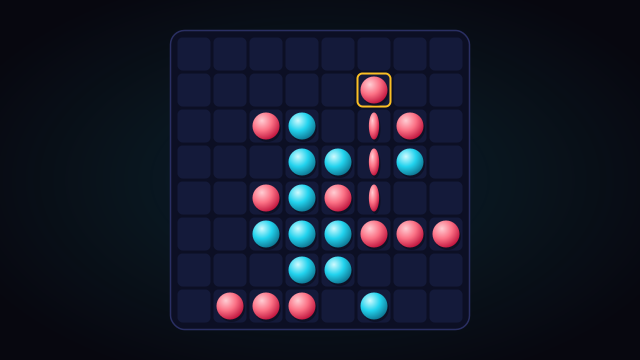
Outflank, flip, take the corners.
Amazons
Cards & Board
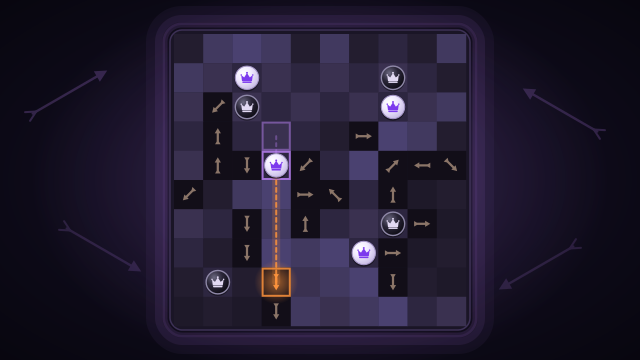
Move like a queen, shoot an arrow, burn a square: wall the board in until the computer has no move left.