Amazons
Move like a queen, shoot an arrow, burn a square: wall the board in until the computer has no move left.
The abstract strategy game Walter Zamkauskas invented in Argentina in 1988, a cousin of Go played with chess queens. Each side has four amazons. On your turn one of them moves like a queen in chess, then shoots an arrow from where it lands, also like a queen, and the square the arrow hits burns for the rest of the game. Nothing is ever captured: the board simply shrinks, and the player who cannot move on their turn loses. Wall off more of the board than the computer and it runs out of moves first. Play an easy computer on a quick eight by eight board, or a medium or hard one on the standard ten by ten, and every day brings a Daily game that is the same for everyone.
- Category
- Cards & Board
- Modes
- Easy · Medium · Hard · Daily
- Controls
- Mouse · Touch · Keyboard
Loading…
How to play
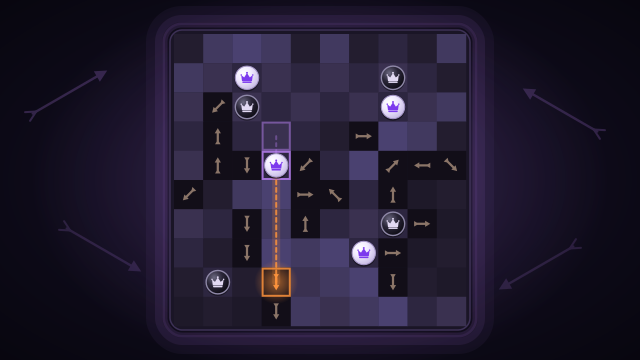
You play white and move first. A turn has two steps. First tap one of your amazons and the squares it can reach light up: it moves like a queen in chess, any number of empty squares along a row, a column or a diagonal, and never over an amazon or a burnt square. Tap one of them and the amazon goes there. Then the squares its arrow can reach light up in orange: the arrow flies like a queen too, from where the amazon now stands, and may cross or hit the square it just left. Tap one to shoot, and that square burns for good. Until the arrow flies, Undo takes the amazon back. Nothing is captured; a player who cannot move on their turn loses. Once the arrows have walled the board into regions that each hold amazons of one side only, nobody can reach anybody any more, so the game counts the moves each side has left in its own regions and ends there: the side to move loses unless it has more moves left than the other. A win scores 100 plus your margin, the moves you had left over the computer's; a loss scores the moves you had left.
What is Amazons?
Amazons is an abstract strategy game for two players, invented in 1988 by Walter Zamkauskas of Argentina and first published in Spanish in 1992. It belongs to the same family as Go: you win by owning more of the board than your opponent. But there are no stones to place and nothing is ever captured. Each side has four amazons that move like queens in chess, and every move ends with an arrow that burns a square for good. The board shrinks turn by turn until one side has nowhere left to go.
Programmers love it too: with 2,176 possible moves in the opening position alone, it is a regular event at the Computer Olympiad, where game-playing programs compete. Here you play it against the computer: an easy one on a quick eight by eight board, a medium or hard one on the standard ten by ten, and a Daily game that is the same for everyone.
How to play
- Your amazons. You play white and move first. Each side has four amazons; on ten by ten they start on a4, d1, g1 and j4 for white and a7, d10, g10 and j7 for black.
- Step one: move. Tap one of your amazons and the squares it can reach light up. It moves like a queen in chess: any number of empty squares along a row, a column or a diagonal. It never jumps over another amazon or a burnt square. Tap a square to move there.
- Step two: shoot. From where it landed, the amazon shoots an arrow, which also flies like a queen. The squares it can reach light up in orange; tap one. The arrow may fly over the square the amazon just left, or land on it.
- Burnt for good. The square the arrow hits is burnt for the rest of the game. Nothing can stand on it or cross it.
- Changed your mind? Until the arrow flies, Undo takes the amazon back to where it was.
- Nothing is captured. The only way to hurt the other side is to take away its room.
- The end. A player who cannot move on their turn loses. Long before that, the arrows split the board into regions; once every region holds the amazons of one side only, nobody can reach anybody any more. The game then counts how many moves each side can still make in its own regions and stops. The side to move runs out first, and loses, unless it has more moves left than the other.
- Score. A win scores 100 plus your margin: the moves you had left over the computer's. A loss scores one point for each move you had left.
- Territory. The Territory button shades every square by who can reach it first. The numbers in the header count those squares for each side.
Strategy tips
- Keep your amazons free. An amazon walled into a corner early is a quarter of your army gone. Before you shoot, check that each of your amazons still has open lines.
- Shoot to block, not just to fill. The best arrows cut the computer's amazons off from open space, or close the door on a region you will own.
- Head for the open areas. Early in the game, move toward the middle and the large empty parts of the board. Squares near your amazons are squares you will get to first.
- Count, then seal. When a region is clearly yours, close it with an arrow and leave it alone. You can fill it later; the computer cannot get in.
- Watch for narrow regions. A region shaped like a corridor with dead ends can hold fewer moves than it has squares, because an amazon that walks into a dead end cannot come back. Wide regions are worth more than thin ones.
FAQ
Is Amazons free to play?
Yes. Like every game on Play, it runs free in your browser, with no download and no account needed.
Why does the game end before the board is full?
Because once the two sides are walled apart, the result is settled: each side can only fill its own squares, one burnt square a move. Playing those moves out would only take time, so the game counts them and ends there, much as players over a real board stop once the count is clear.
How are the moves left counted?
For each region the computer works out the longest run of moves your amazons can make there. Usually that is one move per empty square, since an amazon can step to a neighbouring square and shoot the arrow back where it came from. Corridors and dead ends can hold fewer.
Can a game end in a draw?
No. Someone always runs out of moves first.
Why is the easy computer on a smaller board?
On eight by eight a game lasts about twenty of your turns instead of thirty, which makes it a good way to learn the shapes before moving up to the full board.
What is the Daily game?
Every day everyone plays the same game against the medium computer on ten by ten, from the same opening: your first move and the computer's answer are already on the board. The computer answers the same moves the same way, so the scores compare directly on the leaderboard.