Ultimate Tic-Tac-Toe
Nine games of tic-tac-toe in one, and every square you take sends the computer somewhere.
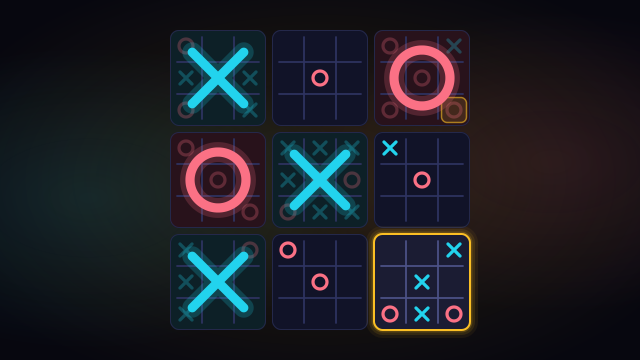
Tic-tac-toe grown up: nine small boards sit inside one big board. Win a small board with three in a row and it becomes your mark on the big one; win three small boards in a row to win the game. The catch is that the square you pick inside a small board decides where the computer must play next, so every move is two moves at once. Play an easy, medium or hard computer, and every day brings a Daily game that opens the same way for everyone.
- Category
- Cards & Board
- Modes
- Easy · Medium · Hard · Daily
- Controls
- Mouse · Touch · Keyboard
Loading…
How to play
You are X and the computer is O. Your first mark can go in any square of any board. After that, the square a mark takes inside its small board sends the other side to the small board in the same spot of the big board: a mark in a top right square sends to the top right board, which lights up. Three in a row inside a small board win it, and nobody plays there again. A small board that fills up with no line is drawn and counts for nobody. Sent to a board that is already won or full, you may play in any open board. Three small boards in a row, across, down or diagonal, win the game. Once neither side can make three in a row any more, the game is a draw. A win scores 100 points plus one for every one of your marks under 40; a draw scores 50.
What is Ultimate Tic-Tac-Toe?
Ultimate Tic-Tac-Toe is tic-tac-toe played on nine boards at once. Nine small boards sit inside a big three by three grid. Win a small board with three in a row and it counts as your mark on the big board; win three small boards in a row and the game is yours.
One rule turns a children's game into a real strategy game: the square you pick inside a small board decides which board the other side must play in next. A move in the top right square of any board sends your opponent to the top right board. So every mark is two decisions at once, where you play and where you send. Here you play the computer at three levels, and every day brings a Daily game that opens the same way for everyone.
How to play
You are X and the computer is O. Tap an empty square to place your mark.
- The first mark can go in any square of any board.
- Sending. After that, the square a mark takes inside its small board sends the other side to the board in the same spot of the big grid. That board lights up in gold on your turn, and in rose while the computer thinks there.
- Winning a small board. Three in a row inside a small board, across, down or diagonal, win it. A big X or O covers it, and nobody plays there again.
- Drawn boards. A small board that fills up with no line is drawn and counts for nobody.
- Free moves. Sent to a board that is already won or full, you may play in any open board. Every open board lights up.
- Winning the game. Three small boards in a row on the big grid win the game.
- Draws. As soon as neither side can make three in a row any more, the game is a draw.
- Score. A win scores 100 points plus one for every one of your marks under 40, so a quicker win scores more. A draw scores 50, a loss nothing.
Strategy tips
- Look where you send. Before you take a square, look at the board it sends the computer to. If the computer can win that board, or win the game there, pick another square.
- Do not hand out free moves. Sending the computer to a board that is already won or full lets it play anywhere at all, and it will play where it hurts you most.
- The centre board counts most. It lies on four lines of the big grid, a corner board on three, an edge board on two. The centre square of every small board sends to it, so take those squares with care early on.
- A small board is worth what it does on the big one. Letting the computer have a board that blocks none of your lines can be the price of sending it somewhere harmless.
- Make two threats at once. Two small boards you could each win next, on two different lines, are hard to stop: the computer can only be in one place at a time.
FAQ
Is Ultimate Tic-Tac-Toe free to play?
Yes. Like every game on Play, it runs free in your browser, with no download and no account needed.
Where does the game come from?
Nobody knows who first drew nine boards inside a big one. The game was passed around by students and mathematicians, and in 2013 the teacher and writer Ben Orlin, who had watched mathematicians play it at a picnic, described it on his blog Math with Bad Drawings; the post made it famous online. It also goes by super tic-tac-toe, meta tic-tac-toe and ultimate noughts and crosses.
What happens when I am sent to a board that is already won or full?
You get a free move: you may play in any small board that is still open. That is why sending the other side to a closed board is usually a gift.
Does a drawn small board count for anyone?
No. A small board that fills up with no line is closed and counts for neither side, so it blocks every line of the big grid it lies on. Some house rules count it for both players; this game does not.
Who moves first?
You do, as X, and the first move is a real advantage. In a variant where play goes on inside boards that are already decided, the first player has been proven to win with perfect play. Under the rules played here, nobody has yet worked out who wins.
How strong is the computer?
The easy computer often plays like a beginner: good tic-tac-toe inside its own board, with little thought for where it sends you. The medium one never sends you to a board where you win the game at once, but it still slips now and then. The hard one weighs thousands of possible games before every mark.
What is the Daily game?
Every day the game opens from the same four marks, two of yours and two of the computer's, and you play the medium computer from there. It answers the same moves the same way, so everyone's results compare directly on the Daily leaderboard.