Tablut
Viking chess from Lapland: the king runs for the edge while sixteen attackers close in.
The tafl game Carl Linnaeus watched the Sámi play in Lapland in 1732, the best known of the board games people call Viking chess. A king and eight defenders start in the middle of a nine by nine board, and sixteen attackers wait in four groups along the edges. Every piece moves like a rook, and a piece is taken when two enemies close in on it from either side. Lead the king to any square of the edge, or take the attackers and hunt him down. Play an easy, medium or hard computer, and every day brings a Daily game that is the same for everyone.
- Category
- Cards & Board
- Modes
- Easy · Medium · Hard · Daily
- Controls
- Mouse · Touch · Keyboard
Loading…
How to play
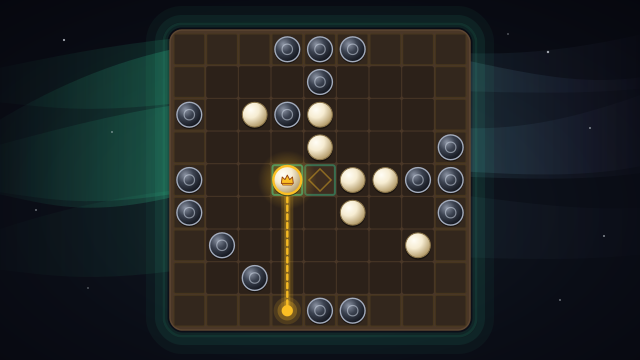
The king's side moves first. Tap one of your pieces and the squares it can reach light up; tap one of them to move there. Every piece, the king too, moves any number of empty squares in a straight line, like a rook in chess, and never jumps. Only the king may stop on the throne in the middle, but any piece may pass over it while it is empty. Your move takes an enemy piece when it closes it in between two of yours in a row or a column, never diagonally; the king takes part, and the throne counts as an enemy too: to the attackers always, to the defenders only while it is empty. Moving in between two enemies is safe. The king escapes, and his side wins, the moment he reaches any square of the edge. Away from the throne two attackers take him like any other piece; on the throne it takes all four sides, and beside it the other three. The attackers also win by closing a ring round the king and every defender. A side with no move left loses, the third time the same position comes up the king's side loses, and after 80 moves each the game is a draw. A win scores 100 plus two points for every move under 40, a draw 50, and a loss three points for each piece you took.
What is Tablut?
Tablut is the Sámi member of the tafl family, the board games of the Viking age that people now call Viking chess. Every other tafl game had to be pieced together from broken boards and a few lines in the sagas, but Tablut was written down: in 1732 the young Carl Linnaeus crossed Lapland, watched the game being played on an embroidered reindeer hide, and copied the board and the rules into his diary. The king of the Swedes sits in the middle with eight defenders; sixteen Muscovites wait at the edges.
For two centuries an English translation got one rule badly wrong and made the king far too hard to catch. Here you play the game as Linnaeus wrote it, in the reading the World Tafl Federation uses at its championships: an easy, medium or hard computer, on either side, and a Daily game that is the same for everyone.
How to play
- The goal. The king's side wins when the king reaches any square of the edge. The attackers win by taking him.
- Moving. The king's side moves first. Every piece, the king too, moves any number of empty squares along a row or a column, like a rook in chess. Nothing ever jumps.
- The throne. Only the king may stop on the square in the middle. Any piece may pass over it while it is empty, and the king may go back to it.
- Taking pieces. Close an enemy piece in between two of yours in a line, never diagonally, and it leaves the board. Only the piece that moves makes the capture, so stepping in between two enemies is safe. One move can take up to three pieces.
- The king fights too. He takes pieces like any defender, moving or as the piece on the far side.
- The throne as an enemy. The throne counts against the attackers always, and against the defenders only while it is empty.
- Taking the king. Away from the throne two attackers in a line take him, like any other piece. On the throne it takes attackers on all four sides, and beside it on the other three.
- Raichi and tuichu. When the king sees the edge down an open road, Linnaeus' players called "raichi", like check; with two open roads, "tuichu", because one move cannot close both. The board draws the king's open roads in gold.
- Other endings. The attackers also win by closing a ring round the king and every defender. A side with no move left loses. If the same position comes up for the third time, the king's side loses, so the king cannot shuffle forever. After 80 moves each the game is a draw.
- Score. A win scores 100 plus two points for every move under 40. A draw scores 50, and a loss three points for each piece you took.
Strategy tips
- Make space early. At the start the king is boxed in by his own defenders. Move them out to open lines for him before the attackers organise.
- Threaten two edges at once. One open road can be blocked; two cannot. Look for a square from which the king would see the edge in two directions.
- Keep the king company. Away from the throne two attackers are enough to take him. A defender beside the king closes that side to them.
- As the attackers, think in diagonals. Pieces standing diagonally next to each other form a wall the king cannot slip through, since nothing moves diagonally. Build the wall before you chase the king.
- Do not feed the defenders. An attacker standing next to a defender with an empty square behind it is a capture waiting to happen. Count your pieces: losing too many leaves holes in the ring.
FAQ
Is Tablut free to play?
Yes. Like every game on Play, it runs free in your browser, with no download and no account needed.
Is Tablut really Viking chess?
It is a tafl game, the family the Vikings played across Scandinavia, Britain and Ireland, and "Viking chess" is the name people use for all of them today. Tablut itself is the version the Sámi of Lapland were still playing when Linnaeus visited in 1732, and the only one whose rules came down to us in writing.
Why does the king win on any edge square, not only in the corners?
Because that is what Linnaeus wrote. Corner escapes belong to the larger hnefatafl boards rebuilt in the twentieth century, partly to make up for the mistranslated rule that the king always needs four attackers around him. With the king taken by two attackers, as in the original, the edge rule gives an even game.
How is the king taken?
Like any other piece, by two attackers on opposite sides, as long as he is away from the throne. On the throne he needs attackers on all four sides, and beside it on the three sides that are not the throne.
Can a game go on forever?
No. The third time the same position comes up, the king's side loses, and after 80 moves each the game ends in a draw. Most games are decided in 20 to 40 moves.
Which side should I play?
You defend the king by default, the side most players learn first. Pick the attackers with the side buttons to hunt him instead: their game is slower and more about building walls.
What is the Daily game?
Every day everyone plays the same game against the medium computer, and the day decides which side you play. The computer answers the same moves the same way, so the scores compare directly on the leaderboard.