Surakarta
The capture game of Java: race your pieces round the corner loops and land on the enemy.
Surakarta is a capture game from Java, named after the city of Surakarta. It is played on a grid of six by six points with two circuits running over it, each joined at the corners by four loops that swing out past the edge of the board. Each side starts with twelve pieces on its two nearest rows. A piece steps one point in any direction, diagonals included, but it can only capture by running along a circuit, round at least one loop, onto an enemy piece, with every point on the way empty. Take every enemy piece to win. Play an easy, medium or hard computer, and every day brings a Daily game that is the same for everyone.
- Category
- Cards & Board
- Modes
- Easy · Medium · Hard · Daily
- Controls
- Mouse · Touch · Keyboard
Loading…
How to play
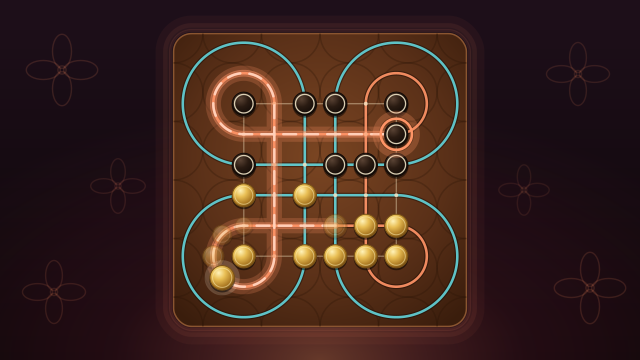
You play the brass pieces at the bottom and move first; the computer plays dark wood. On your turn, move one piece. A step goes to a neighbouring point in any of the eight directions, and that point must be empty. A capture runs along one of the two coloured circuits, the inner one with the small loops or the outer one with the big loops, in either direction, over any number of empty points and round at least one loop, and lands on the first piece it meets: if that piece is the computer's, it is taken. A capture never jumps over a piece, and the loops are used only for captures. Capturing is never compulsory. Tap a piece to see its moves: lit points for steps, and a glowing path round the loops to each piece it can capture. You win by taking all twelve of the computer's pieces. If 50 moves in a row pass without a capture, the game ends and the side with more pieces wins; equal counts are a draw. A win scores 100 plus four points for each of your pieces still on the board, a draw 50, and a loss two points for each piece you took.
What is Surakarta?
Surakarta is a capture game for two from Java, named after the city of Surakarta in Central Java. In Indonesia it is simply called permainan, "the game", and in Java also dam-daman. Little is known of its history: it was played with shells against pebbles, it was first published in France in 1970 under the name Surakarta, and the American game designer Sid Sackson wrote it up as "Roundabouts". Its way of capturing, a run around the loops at the corners of the board, is not known from any other recorded board game, and today it is also played between computer programs at the annual Computer Olympiad.
Here you play the brass pieces against the computer: an easy, medium or hard computer, and a Daily game that is the same for everyone.
How to play
- The board. Six by six points joined by lines. Two circuits run over it: the inner circuit, in terracotta, along the second line from each edge, and the outer circuit, in teal, along the two middle lines. At each corner a loop joins the end of a row to the end of a column: four small loops for the inner circuit, four big ones for the outer.
- The start. Each side has twelve pieces on the two rows nearest it. Your brass pieces are at the bottom and you move first.
- Steps. On your turn you move one piece. A step goes one point in any of the eight directions, diagonals included, to an empty point.
- Captures. A capture runs along a circuit, either way round, over any number of empty points, and must go round at least one loop. It ends on the first piece it meets: if that is an enemy piece, it is taken and your piece takes its place.
- Nothing in the way. A capture never jumps over a piece, yours or the computer's. It may pass the same empty point twice, its own starting point included, since that is empty once the piece has left.
- Optional. Capturing is never compulsory. The loops are used only for captures, never for a plain move.
- Seeing your moves. Tap a piece: the points it can step to light up, and each capture shows as a glowing path along its circuit and round its loops to a ringed enemy piece. Pieces that can capture glow before you choose.
- The end. You win by taking all twelve of the computer's pieces. If 50 moves in a row pass without a capture, the game ends and the side with more pieces wins; an equal count is a draw.
- Score. A win scores 100 plus four points for each of your pieces still on the board. A draw scores 50, and a loss two points for each piece you took.
Strategy tips
- Look along the circuits, not across the board. A piece that seems far away may be one loop from yours. Before every move, follow each circuit your pieces stand on and see who meets whom.
- Every capture can be answered on the same circuit. After you take, your piece stands where the enemy stood, on the same circuit. Check that no enemy piece can now run back along it and take you.
- Block with your own pieces. A piece of yours on a circuit shields everything behind it on that line. Placing a blocker is often better than running away.
- Use the corners. The four corner points lie on no circuit, so nothing can ever capture there. They make a safe parking place, but a piece in a corner cannot attack either.
- The crossings are strong. Where a row and a column of the same circuit cross, a piece can set off four ways. Pieces there both attack and defend more.
- Open lines late, not early. Every step that empties a point on a circuit opens a path for both sides. Count which side benefits before you move a blocker.
FAQ
Is Surakarta free to play?
Yes. Like every game on Play, it runs free in your browser, with no download and no account needed.
Where does Surakarta come from?
From Java, in Indonesia, and it takes its name from the city of Surakarta. Very little is written about its history. It became known in the West after it was published in France in 1970.
Do I have to capture when I can?
No. Capturing is always optional. Sometimes keeping a piece where it blocks a circuit is worth more than taking.
Can a capture go round more than one loop?
Yes. A capture needs at least one loop, but it may go round as many as the empty points allow, even all the way round the circuit. The glowing path shows the route your piece will run.
How does the game end if nobody can win?
If 50 moves in a row, yours and the computer's together, pass without a capture, the game stops and the side with more pieces wins. With equal pieces it is a draw. Players who agree to stop a stuck game settle it the same way.
What is the Daily game?
Every day everyone plays the medium computer, and the computer answers the same moves the same way for everyone that day, so the scores compare directly on the leaderboard.