Snakes and Ladders
Roll the die, climb the ladders, dodge the snakes, first to 100.
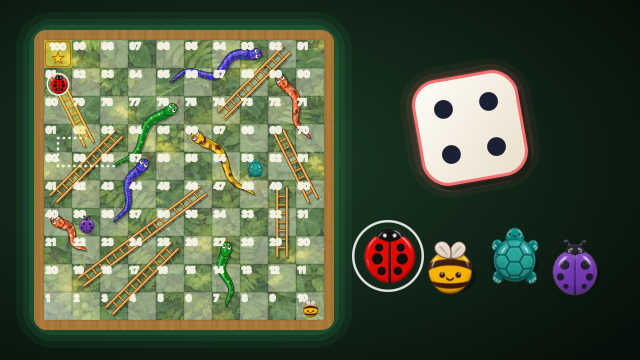
The old Indian race game, Moksha Patam, on a hundred-square board: roll one die, hop along the numbered squares, climb every ladder you stop at the foot of and slide down every snake whose head you land on. Race one, two or three computer players to square 100, where you need the exact roll. Three painted boards: the Garden, full of ladders; the Jungle; and the Temple, with more snakes and a longer climb. Every day brings a Daily game with the same rolls for everyone.
- Category
- Cards & Board
- Modes
- Easy · Medium · Hard · Daily
- Controls
- Mouse · Touch · Keyboard
Loading…
How to play
Choose how many computer players join you, then tap the die to roll. Your token, the ladybug, hops that many squares along the board: left to right on the bottom row, then right to left on the next, winding up to 100. Stop at the foot of a ladder and you climb to its top; stop on a snake's head and you slide down to its tail. Tokens never block or capture each other. You need the exact roll to land on 100: a bigger roll walks up to 100 and bounces back the squares left over. The game ends when you reach 100, or when every computer player has got there first. You score 30 points for every player you finish ahead of, 10 more for first place, and 1 point for every turn under the board's par, up to 20.
What is Snakes and Ladders?
Snakes and Ladders is a race game from India, played there for centuries as Moksha Patam or Gyan Chaupar. In the old boards the ladders stood for virtues and the snakes for vices, and the square at the top was liberation. British families took it home in the 1890s, and it has been one of the first board games children learn ever since.
Here you race a ladybug token against one, two or three computer players on three painted boards, and every day brings a Daily game in which everyone gets the same rolls.
How to play
- The goal. Be the first to reach square 100.
- The board. A hundred squares in ten rows. Square 1 is in the bottom left corner; the numbers run left to right along the bottom row, then right to left along the next, winding up the board to 100 in the top left corner.
- Rolling. Tap the die and your token hops that many squares along the numbers. Your first roll brings you onto the board: a 3 puts you on square 3. You do not need a six to start.
- Ladders. Stop on the square at the foot of a ladder and you climb straight to the square at its top.
- Snakes. Stop on the square with a snake's head and you slide down to the square at its tail.
- Sharing squares. Tokens never block or capture each other. Any number of them can stand on the same square.
- The exact roll. You must land on 100 exactly. A roll that would take you past it walks up to 100 and bounces back the squares left over: from 97, a 5 goes 98, 99, 100, 99, 98. A snake or ladder where you stop still counts.
- Turns. You roll first, then each computer player in turn. A six does not give another roll.
- The end. The game ends when you reach 100, or when every computer player has got there before you.
- Score. 30 points for every player you finish ahead of, 10 more for first place, and 1 point for every turn you finish under the board's par, up to 20.
The three boards
- The Garden (easy). Ten ladders, four short snakes. A game takes about 22 turns on average.
- The Jungle (medium). Seven ladders and seven snakes, about 32 turns. The Daily is played here.
- The Temple (hard). Six ladders and ten snakes, some of them long, about 46 turns.
Tips
- Enjoy the luck. There are no choices to make once you roll: the die decides everything, for you and for the computer players alike. That is the charm of the game, and why children and grown-ups play it as equals.
- Pick your table. With one rival you win about half your games; with three, about one in four, but a win against three is worth 100 points before any speed bonus.
- Pick your board. The Garden is quick and kind, the Temple long and full of snakes. The par, and so the speed bonus, follows each board's own length.
- Watch the last row. From 94 upwards you need an exact roll, and a roll too big bounces you back, sometimes onto a snake.
FAQ
Is Snakes and Ladders free to play?
Yes. Like every game on Play, it runs free in your browser, with no download and no account needed.
Is it really all luck?
Yes. Every move is decided by the die: there is never a choice to make. The computer players roll by the same rules with the same die, and they never cheat.
Do I need a six to get onto the board?
No. Your first roll brings your token straight onto that square. Some families play that a six is needed to start; this game does not.
What happens if I roll past 100?
Your token walks up to 100 and bounces back the squares left over. You need the exact number to land on 100, as in most house rules.
Can a token land on another token?
Yes, and nothing happens: tokens share squares freely. There are no captures in Snakes and Ladders.
What is the Daily game?
Every day everyone plays the Jungle board with the same rolls for the day, for you and for each computer player, in the same order. You still choose how many computer players join you.
How is the score worked out?
You earn 30 points for every player you finish ahead of and 10 more for first place. If you reach 100, you also earn 1 point for every turn under the board's par (22 in the Garden, 32 in the Jungle, 46 in the Temple), up to 20.
More like this

Backgammon
Cards & Board
The dice say how far. You decide where.
Long Nardy
Cards & Board
Fifteen checkers each, one way round and no hitting: block, race and bear off.
Dominoes
Cards & Board
Match the ends and be first to play out.
Mexican Train
Cards & Board
Build the longest train from the station and empty your hand first.