Long Nardy
Fifteen checkers each, one way round and no hitting: block, race and bear off.
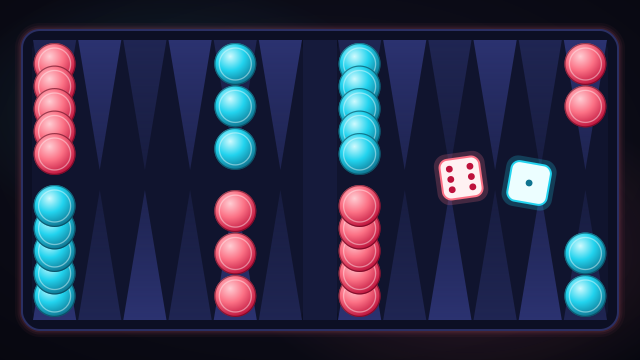
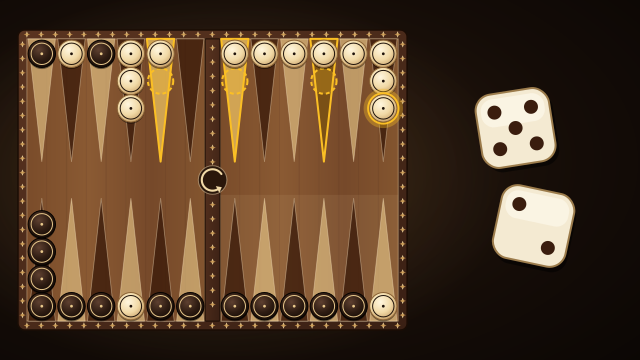
Long Nardy is the backgammon of Russia and the Caucasus, played on the same board of twenty-four points but in a game of its own. Both sides start with all fifteen checkers on one point, the head, in opposite corners, and race the same way round the whole board. There is no hitting: a single checker holds a point, so the game is about building walls in front of the computer's checkers while keeping your own on the move. Only one checker may leave the head each turn, and no wall of six may trap every checker the computer has. Play an easy, medium or hard computer, and every day brings a game with the same dice for everyone.
- Category
- Cards & Board
- Modes
- Easy · Medium · Hard · Daily
- Controls
- Mouse · Touch · Keyboard
Loading…
How to play
Tap the dice to roll, then move one checker by each number, or one checker by both. Doubles play four times. Your fifteen checkers start on your head, the top right point, and travel anticlockwise: right to left along the top, then left to right along the bottom into your home, the bottom right quarter. The computer's start in the bottom left corner and go the same way round to its home in the top left. A point holding even one checker is closed to the other side, for landing and for stopping on the way. Only one checker may leave the head in a turn; on your first turn a roll of 6-6, 4-4 or 3-3 lets two leave it. You may not hold six points in a row unless at least one of the computer's checkers is already past them. Play as many dice as you can; if only one of two numbers can be played, play the larger. Once all fifteen checkers are home, bear them off: the exact number, or a larger one from your farthest point back. Tap a checker and the points it can reach glow; Undo takes a step back until you tap Done. The first to bear off all fifteen wins. A win scores 100, a mars (the computer bore off none) 200, plus 1 for every 4 pips the computer still had to go; a loss scores 2 for each checker you bore off.
What is Long Nardy?
Long Nardy (in Russian dlinnye nardy, often just nardy or narde) is one of the best-loved board games of Russia and the Caucasus, played everywhere from Moscow to Baku, Yerevan and Tbilisi. It uses the same board, fifteen checkers and two dice as backgammon, but it is a different game: both players run the same way round the board, nobody is ever hit, and the struggle is all about blocking. Greece plays a close cousin called fevga.
Here you play the rules Backgammon Galore gives for Narde, the ones nardy players learn in the Caucasus and in Russia, against the computer at three strengths, and every day brings a Daily game in which everyone gets the same dice.
How to play
- The goal. Bring all fifteen of your checkers round the board into your home and bear them off before the computer does. You play the pale boxwood checkers, the computer the dark ebony ones.
- The start. All fifteen checkers of each side start on one point, the head: yours on the top right point, the computer's on the bottom left. One die each decides who starts; the higher throws both dice for the first turn.
- The way round. Both sides travel anticlockwise. Yours go right to left along the top, then left to right along the bottom, into your home: the bottom right quarter. The computer's go the same way round, from the bottom left into its home at the top left. The arrow on the bar shows the way.
- Moving. Move one checker by each number on the dice, or one checker by both. Doubles are played four times. You must play as many numbers as you can; if only one of two numbers can be played, play the larger.
- No hitting. A point with even one checker on it belongs to that side: the other side can neither land there nor stop there on the way of a combined move.
- The head rule. Only one checker may leave the head in a turn. The exception: on your first turn, a 6-6, 4-4 or 3-3 lets two checkers leave the head (one checker alone could not play those rolls, because the computer's head is in the way).
- The six-block rule. You may not hold six points in a row unless at least one of the computer's checkers has already passed them. A wall of six that would trap every one of its checkers is forbidden, and the same rule binds the computer.
- Bearing off. Once all fifteen of your checkers are home, bear them off with the exact number, or with a larger number from your farthest point back.
- Winning. The first to bear off all fifteen checkers wins. If the loser has not borne off a single checker, it is a mars and counts double.
- Score. A win scores 100, a mars 200, plus 1 point for every 4 pips the computer still had to go. A loss scores 2 for each checker you bore off.
Strategy tips
- Leave the head every turn. Only one checker may leave it a turn, so a turn without a checker off the head is a turn lost for good.
- Spread out. A single checker holds a point, so checkers spread over many points block more and give you more ways to play each roll than a few tall stacks.
- Block the computer's way out. Points just in front of its head, in the bottom left quarter, slow its whole army down. Five in a row is a strong wall; six is only allowed once one of its checkers is past.
- Mind your own path. The computer blocks too. Keep checkers on both sides of its walls, so a bad roll does not freeze your whole game.
- Watch the pips. The numbers in the header count how far each side still has to go. Ahead in the race, run home; behind, hold your blocks longer.
- Avoid the mars. If the race is lost, bring checkers home and bear off at least one: it halves the defeat.
FAQ
Is Long Nardy free to play?
Yes. Like every game on Play, it runs free in your browser, with no download and no account needed.
How is it different from backgammon?
In backgammon the two sides move in opposite directions, single checkers can be hit and sent back, and there is a bar. In Long Nardy both sides run the same way, all checkers start on one point, nothing is ever hit, and a single checker is enough to block a point.
Why can only one checker leave the head?
It is the rule that shapes the opening: you have to bring your army out one checker at a time, and that makes blocking the other side's head so strong. The only exception is the first roll of 6-6, 4-4 or 3-3, which a single checker could not play.
What exactly is forbidden about six points in a row?
Holding six points in a row with every opposing checker behind them would trap the other side completely, so it is not allowed. As soon as one of the computer's checkers is past the wall, the wall is legal. When a move is forbidden for this reason, the point is crossed in red.
Can the game end in a draw?
No. The first to bear off all fifteen checkers wins. Some tournament rules call a draw when the second player bears off its last checker in its answering turn; this game, like the classical rules, does not.
What is the Daily game?
Every day everyone plays the same game against the medium computer: the dice fall the same way, for you and for the computer, in the same order, so scores compare directly on the leaderboard.