Shut the Box
Roll two dice, flip down the tiles, leave as little open as you can.
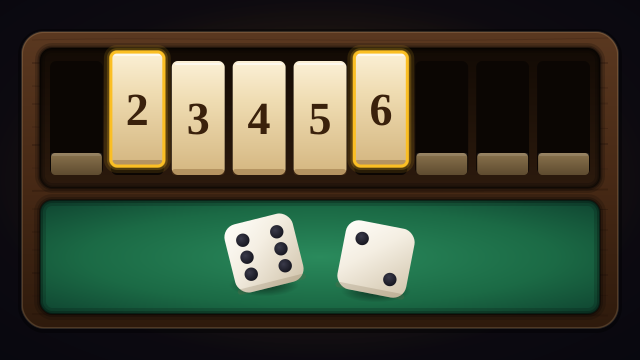
The old pub dice game with a wooden box of tiles numbered 1 to 9. Roll two dice and shut any open tiles that add up to the roll: a 7 can shut the 7, the 6 and 1, or the 4, 2 and 1. Keep rolling until no open tiles fit the roll; whatever is left open counts against you, and shutting every tile is the perfect round. Once the 7, 8 and 9 are down you may roll a single die. Play five rounds against the computer at easy, medium or hard (a box of twelve tiles), and every day brings a match with the same dice for everyone.
- Category
- Cards & Board
- Modes
- Easy · Medium · Hard · Daily
- Controls
- Mouse · Touch · Keyboard
Loading…
How to play
Tap Roll to throw two dice. Then tap open tiles that add up to the roll: one tile, two or more. As you tap, the tiles that can still complete the roll glow and the others dim; tap Shut to flip them down, or Clear to start the choice again. Roll again and keep going. When no open tiles add up to a roll, your box is over and the tiles left open are added up. Once every tile above 6 is shut you may roll one die instead of two. A match is five rounds: you play a box, then the computer plays one. Each round scores 100 minus the tiles you left open, so shutting the box scores 100; the lower total left open over the match wins, and winning adds 50 points, a draw 25. On easy a brass dot marks the best tiles to shut.
What is Shut the Box?
Shut the Box is a dice game played on a wooden box with a row of hinged tiles numbered 1 to 9. It has been a fixture of English pubs for generations, and sailors, fishermen and family tables across Europe have played it for at least two centuries under names like Klappenspiel in Germany, Fermer la boîte or Trac in France and Cierra la caja in Spain. The rules fit in one breath, yet every roll asks a small question: which tiles do you shut?
Here you play a match of five rounds against the computer at three strengths, from a pub beginner to an opponent that weighs every choice by its odds, and every day brings a Daily match in which everyone gets the same dice.
How to play
- The box. Tiles 1 to 9 start open. On hard the box has twelve tiles, 1 to 12.
- A roll. Throw two dice and shut any open tiles that add up to the total: one tile, two, three or more. A roll of 7 can shut the 7, or the 6 and 1, or the 4 and 3, or the 4, 2 and 1.
- Picking tiles. Tap tiles to pick them. The tiles that can still complete the roll glow and the others dim; when your picks add up, tap Shut and they flip down.
- Keep going. Roll again and shut again. When a roll comes up that no open tiles add up to, your box is over.
- One die. Once every tile above 6 is shut, you may roll a single die instead of two.
- The count. The tiles left open are added up and count against you. Shutting every tile is called shutting the box, the perfect round.
- The match. Five rounds. In each one you play a box, then the computer plays one. The lower total left open over the five rounds wins.
- Score. Each round is worth 100 minus the tiles you left open, so shutting the box is worth 100. Winning the match adds 50 points and a draw 25.
Strategy tips
- Shut the high tiles first. The 9, 8 and 7 can only go with big rolls, while the small tiles help you make almost any total later. With a 9 on the first roll, shutting the 9 leaves a box that ends with about 7 points open on average; shutting the 4 and 5 instead, about 15.
- Use as few tiles as you can. A 7 that shuts the 7 keeps the 1, 2, 4, 3 and 6 free for the rolls to come.
- Roll one die late, not early. With the high tiles gone, one die is the better roll once the tiles left add up to 6 or less (and also with 1, 2 and 4 left). With more than that open, keep both dice: a single die can never make more than 6.
- Keep small tiles in reserve. The 1 and 2 are your fixers: they turn awkward totals into something that fits.
- Know the odds. Played as well as possible, a box of nine leaves about 11 points open and is shut about one time in ten. The box of twelve leaves about 35 open, and shutting it is a rare feat.
FAQ
Is Shut the Box free to play?
Yes. Like every game on Play, it runs free in your browser, with no download and no account needed.
Why does the computer sometimes leave less open than I do?
Each side has its own dice, so luck plays a big part in a single round. Over five rounds the better choices tell, and the hard computer never makes a careless one.
What do the levels change?
The easy computer shuts the two numbers its dice show whenever it can, a common beginner habit, and never tries the single die. The medium computer follows the pub regular's rule: the highest tiles first, one die once 6 or less is left. The hard computer plays the box of twelve by exact odds, and in the last round it plays for the best chance of finishing ahead of you.
What does the brass dot mean?
On easy, a brass dot marks the tiles that give the best expected result for the roll, and the status line says whether one die or two is the better roll. Follow it or not: the choice is yours.
What is the Daily match?
Every day everyone plays the same match against the medium computer: the same roll of the same box shows the same dice for every player, so the scores compare directly on the leaderboard.
More like this
Backgammon
Cards & Board
The dice say how far. You decide where.
Long Nardy
Cards & Board
Fifteen checkers each, one way round and no hitting: block, race and bear off.
Dominoes
Cards & Board
Match the ends and be first to play out.
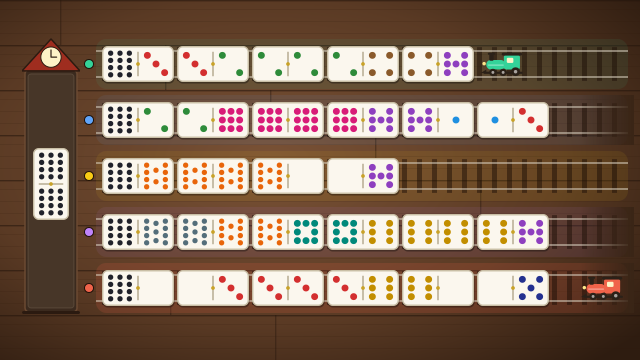
Mexican Train
Cards & Board
Build the longest train from the station and empty your hand first.