Shogi
Japanese chess, where every piece you capture joins your army.
The chess of Japan, played on a nine by nine board with five-sided wooden pieces that point at their owner. Pieces promote when they reach the far three ranks, and every piece you capture can be dropped back onto the board as your own, so a game never runs dry. You play first against the computer at three strengths; the pieces carry western letters beside the kanji while you learn, and every day brings a game against the same computer for everyone.
- Category
- Cards & Board
- Modes
- Easy · Medium · Hard · Daily
- Controls
- Mouse · Touch · Keyboard
Loading…
How to play
Tap one of your pieces and the squares it can reach light up; tap one of them to move there. Tap a piece on your stand to drop it on an empty square instead of moving. The king steps one square any way. The rook moves any distance along a rank or file, the bishop any distance diagonally. The gold steps one square any way but diagonally back; the silver one square diagonally or straight forward. The knight jumps two squares forward and one aside, the lance moves any distance straight forward, the pawn one square forward. A piece that moves into, within or out of the far three ranks may promote: pawn, lance, knight and silver then move as a gold, the bishop adds the king's straight steps and the rook its diagonal ones; a pawn or lance on the last rank and a knight on the last two must promote. Captured pieces change sides and wait in your hand: drop one on any empty square, never where it could never move, never a second unpromoted pawn on a file, and never a pawn that gives mate. Checkmate the computer's king to win. The same position four times is a draw unless one side gave check every move, and then that side loses; a game reaching 128 moves each is a draw. A win scores 100 plus two points for every move under 80.
What is Shogi?
Shogi (将棋, "the board game of generals") is the chess of Japan, played there by millions and followed like a sport, with professional title matches on television. It comes from the same family of war games as chess and xiangqi, but it has a twist all its own: a piece you capture is not gone. It changes sides, waits in your hand, and on a later turn you may drop it back onto the board as your own. The board never empties, attacks come from anywhere, and a game can turn in a single move.
Here you play first, from the bottom, against the computer at three strengths, and every day brings a Daily game against the same computer for everyone.
How to play
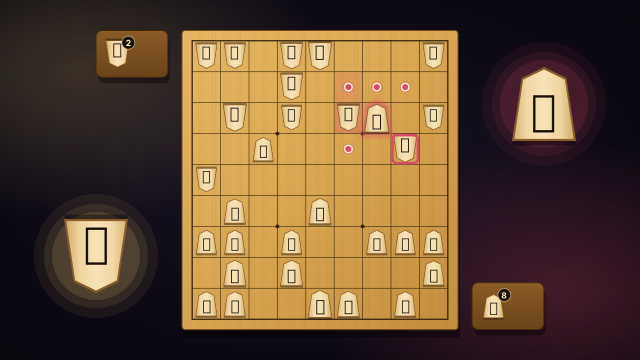
- The board and the pieces. Nine by nine squares. The pieces are flat, five-sided wooden tiles with their name in kanji, and they point at the opponent: yours point up, the computer's point down. Both sides have the same set. While you learn, a small western letter on each piece tells you what it is (you can turn the letters off in the help).
- Picking a move. Tap one of your pieces and the squares it can reach light up: a dot for a free square, a ring around a piece you can take. Tap one and the piece goes there. The status line tells you how the piece you picked moves, and the help (the question mark at the top) shows every piece with a little diagram.
- King (玉 / 王, K). One square in any direction.
- Rook (飛, R). Any distance along a rank or a file. Bishop (角, B). Any distance diagonally.
- Gold general (金, G). One square in any direction except diagonally backwards. Silver general (銀, S). One square diagonally, or one straight forward.
- Knight (桂, N). Two squares forward and one to the side, jumping over anything; it only goes forward. Lance (香, L). Any distance straight forward. Pawn (歩, P). One square straight forward, and it captures the same way.
- Promotion. The far three ranks are the promotion zone. A piece that moves into it, within it or out of it may turn over and promote: pawn, lance, knight and silver then move like a gold; the bishop becomes a dragon horse (馬), adding one step straight; the rook becomes a dragon king (龍), adding one step diagonally. When promoting is optional, a small dialog asks you: promote or keep. A pawn or lance on the last rank and a knight on the last two ranks must promote. Golds and kings never promote.
- Drops. A captured piece goes to your stand, unpromoted. Instead of moving, you may tap it there and drop it on any empty square, with three limits: never where it could never move again (a pawn or lance on the last rank, a knight on the last two), never a second unpromoted pawn on a file that already has one of yours (nifu), and never a pawn drop that mates at once (uchifuzume). A drop in the promotion zone does not promote at once; the piece may promote on a later move.
- Winning. Checkmate the computer's king: attack it so that no move saves it. A side with no legal move at all loses.
- Repetition. When the same position (the board, both hands and the side to move) comes up a fourth time, the game ends. If one side gave check with every one of its moves along the way, that side loses: perpetual check is not allowed. Otherwise it is a draw (sennichite). A game that reaches 128 moves each is also a draw.
- Score. A win scores 100 plus two points for every move under 80 you needed. A draw scores 50; a loss two points for each piece you took, at most 40.
Strategy tips
- Castle your king. Before you attack, tuck the king to one side behind golds and silvers. A king left in the middle is easy prey once the pieces in hand start to fall.
- Count the hands, not only the board. A captured piece is worth more than it was: it can land anywhere. Trading your bishop for a gold can be fine, but giving away pieces for nothing hands your opponent ammunition.
- Promote the big pieces. A dragon or a horse in the enemy camp is a monster. Open a file for your rook with a pawn push and break through.
- Use pawn drops. A pawn dropped in front of an enemy piece, or onto the head of its king's guard, costs you little and gains a tempo. Keep one pawn in hand when you can.
- Mate from the hand. Many mates end with a gold dropped in front of the king (the "head gold"), guarded by a pawn or another piece. Look for it whenever you hold a gold.
- Mind the knight. Knights only go forward and cannot come back; one jumped too far is often lost. But a knight in hand forks two pieces from anywhere.
FAQ
Is Shogi free to play?
Yes. Like every game on Play, it runs free in your browser, with no download and no account needed.
I cannot read Japanese. How do I tell the pieces apart?
Each piece also shows a small western letter (K, R, B, G, S, N, L, P, with a + once promoted), and tapping a piece names it and explains its move. The help shows every piece with a diagram. Once you know the kanji you can turn the letters off there.
Why are some kanji red?
Red marks a promoted piece, as on many real sets, where the back of the piece is written in red. A promoted pawn is a tokin (と), and the promoted lance, knight and silver show the short forms 杏, 圭 and 全.
Why can I not drop a pawn there?
One of three rules stops it: you already have an unpromoted pawn on that file, the pawn would stand on the last rank where it could never move, or the drop would checkmate at once. A pawn that walks up to give mate is fine; only a dropped one is not.
What happens when the same position keeps coming back?
On the fourth time the game ends. If one side gave check with every move since the position first came up, that side loses. Otherwise it is a draw.
What is the Daily game?
Every day everyone plays against the medium computer seeded by the date, so the same moves meet the same answers and scores compare directly on the leaderboard.
Which rules does this follow?
The standard rules of the Japan Shogi Association, as published in English by the Federation of European Shogi Associations (the Laws of Shogi). Two simplifications suit a casual game: a sennichite draw ends the game instead of being replayed, and a game that reaches 128 moves each is drawn, standing in for the rarely needed entering-king counts.