Senet
Four throwing sticks, thirty houses and the waters of the afterlife.
The race game of ancient Egypt, played for some three thousand years and buried with pharaohs, Tutankhamun among them, played here by the rules Timothy Kendall reconstructed. Throw four sticks and race your five blue faience spools along the thirty houses of the board against the computer's red jasper cones. Land on a lone enemy piece to swap places with it, keep your pieces in pairs so they cannot be touched, build a wall of three that nothing can pass, stop on the House of Beauty and beware the House of Water. Play an easy, medium or hard computer, and every day brings a game with the same throws for everyone.
- Category
- Cards & Board
- Modes
- Easy · Medium · Hard · Daily
- Controls
- Mouse · Touch · Keyboard
Loading…
How to play
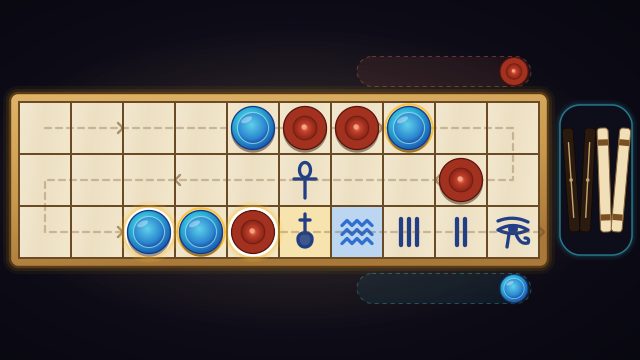
Tap the sticks to throw. Each of the four sticks has a light face and a dark face: count the light faces up, 1 to 4, and all four dark counts 5. Move one piece exactly that far along the way, left to right on the top row, back along the middle row and on along the bottom; the faint line shows it. You must move when you can. If no piece can go forward, one must go back that far instead (pieces on the last houses never go back); if none can move at all, the turn passes. A 1, 4 or 5 played forward gives you another throw; a 2 or a 3 ends your turn. A piece never lands on one of your own. Landing on a lone piece of the computer swaps the two: it goes to the house you came from. Two pieces side by side protect each other, and three or more in a row form a wall the other side cannot pass. Every piece must stop exactly on house 26, the House of Beauty; from there a 5 bears it off, a 2, 3 or 4 takes it to house 28, 29 or 30, and a 1 drops it into house 27, the House of Water, which sends it back to house 15, the House of Rebirth, or to the first free house before it. A piece on house 28 leaves only with a 3, on 29 only with a 2, on 30 only with a 1. Pieces on houses 26, 28, 29 and 30 are safe. You start on houses 1, 3, 5, 7 and 9 and throw first; the first to bear off all five pieces wins. A win scores 100 plus 10 for every piece the computer still had on the board; a loss scores 5 for each piece you bore off.
What is Senet?
Senet is the race game of ancient Egypt and one of the oldest board games known. Boards and paintings of it go back to before 3000 BC, and Egyptians kept playing it until Roman times. Its name means “passing”. Over the centuries the game came to stand for the soul's passage through the afterlife: the queen Nefertari is painted playing it in her tomb, and Tutankhamun was buried with several boards. The board has thirty squares, called houses, in three rows of ten, and the last houses carry signs: the water, the good and the beautiful, the gods.
No ancient text gives the rules, so every modern game is a reconstruction. Here you play Timothy Kendall's rules, published in 1978 and used by most modern sets, against the computer at three strengths, and every day brings a Daily game in which everyone gets the same throws.
How to play
- The goal. Race your five pieces along all thirty houses and off the board before the computer does. You play the blue faience spools, the computer the red jasper cones.
- The start. The pieces begin set out alternately on the first ten houses: yours on 1, 3, 5, 7 and 9, the computer's on 2, 4, 6, 8 and 10. You throw first.
- The way. Left to right along the top row, back right to left along the middle row, then left to right along the bottom row and off. The faint line on the board shows it.
- The sticks. Four throwing sticks, each with a light face and a dark face. Count the light faces up: 1 to 4. All four dark counts 5. A 2 comes up most often, a 4 or a 5 only once in sixteen throws each.
- Moving. Move one piece exactly as many houses as you threw. When you can move, you must. If no piece can go forward, one must go back as many houses instead, and pieces on the last houses never go back. If nothing can move at all, the turn passes.
- Extra throws. A 1, 4 or 5 played forward gives you another throw. A 2 or a 3, or a move back, ends your turn.
- Swapping. A piece never lands on one of your own. Land on a lone piece of the computer and the two swap places: it goes to the house you came from.
- Pairs and walls. Two of your pieces on neighbouring houses protect each other: the computer cannot land on either. Three or more in a row form a wall that the computer cannot pass at all, forward or back.
- The House of Beauty (26). Every piece must stop on it with an exact throw; nothing jumps past it.
- The House of Water (27). From 26, a 1 drops your piece into the water. It goes back to house 15, the House of Rebirth, or to the first free house before it if 15 is taken.
- The last houses. From 26, a 2, 3 or 4 takes the piece to house 28, 29 or 30, and a 5 bears it off at once. A piece on house 28 leaves only with a 3, on 29 only with a 2, on 30 only with a 1. Nothing else moves it. Pieces on houses 26, 28, 29 and 30 are safe from swaps.
- Score. A win scores 100 plus 10 for every piece the computer still had on the board. A loss scores 5 for each of your pieces that you bore off.
Strategy tips
- Travel in pairs. A lone piece within five houses in front of an enemy piece can be swapped back; a pair cannot be touched.
- Build walls. Three pieces in a row stop every enemy piece behind them. A wall can force the computer to move backwards and lose its extra throws.
- Keep a piece free. If none of your pieces can move forward, one has to go back. Keep a piece or two with room to run so every throw has a good use.
- Hold the House of Beauty. Nothing passes house 26 and nobody can land on a piece standing there, so a piece of yours on it holds up every enemy piece behind it.
- Mind the water. A piece on 26 that throws a 1 with no other move falls into the water. Keep another piece able to use a 1 while one of yours waits on the House of Beauty.
- Spread the last houses. Pieces on 28, 29 and 30 need a 3, a 2 and a 1. Waiting on different houses means more throws bring a piece home.
FAQ
Is Senet free to play?
Yes. Like every game on Play, it runs free in your browser, with no download and no account needed.
How old is Senet?
The oldest boards and paintings date from before 3000 BC, at the very start of Egyptian history, and the game was still played under the Romans, some three thousand years later. It spread to the Levant and to Cyprus as well.
How do we know the rules?
We do not, not fully. No rulebook survives, only boards, paintings, game boxes and religious texts. Scholars have proposed reconstructions: Gustave Jéquier in the twentieth century, then R. C. Bell and Timothy Kendall, whose 1978 rules are the ones most played today and the ones used here. Where even Kendall's rules leave room, this game makes the safe houses 26, 28, 29 and 30, and sends a piece that falls into the water back to house 15.
What do the signs on the board mean?
They are the ones found on ancient boards. House 15 carries the ankh, the sign of life. House 26 carries nefer, “good” or “beautiful”. House 27 shows water. Houses 28 and 29 carry three and two strokes, and house 30 here the eye of Horus.
Why are pieces swapped instead of taken?
In Kendall's rules nothing ever leaves the board early: a piece that is hit simply changes places with the piece that hit it, losing as many houses as the hitter gains.
How many pieces are there, and who starts?
Five each, as on many New Kingdom boards; Kendall also gives a game with seven. You always start and throw first, from houses 1, 3, 5, 7 and 9.
What is the Daily game?
Every day everyone plays the same game against the medium computer: the sticks fall the same way, for you and for the computer, in the same order, so scores compare directly on the leaderboard.
More like this
Backgammon
Cards & Board
The dice say how far. You decide where.
Long Nardy
Cards & Board
Fifteen checkers each, one way round and no hitting: block, race and bear off.
Dominoes
Cards & Board
Match the ends and be first to play out.
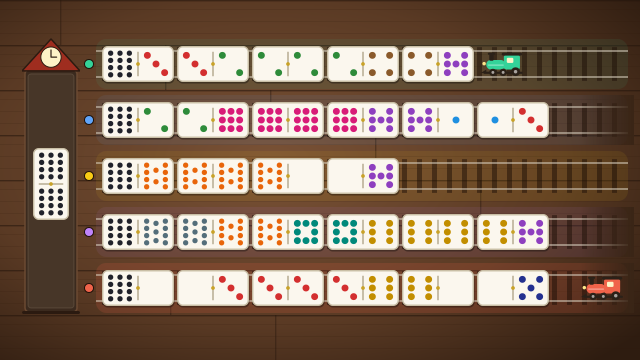
Mexican Train
Cards & Board
Build the longest train from the station and empty your hand first.