Sea Battle
Ten ships, a 10 by 10 sea, and you fire first.
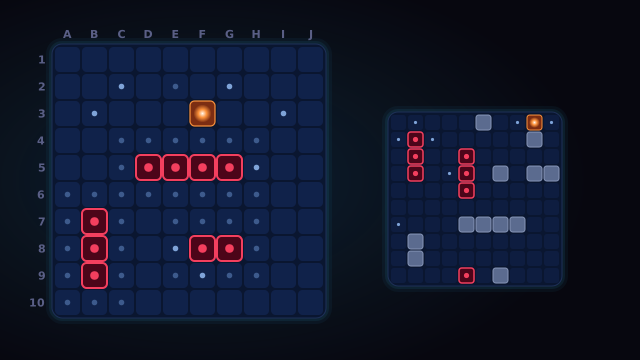
The game from the back of the maths notebook: your fleet against the computer’s on a 10 by 10 sea. Ten ships that never touch, from the four-square battleship to four one-square boats. You take turns firing, a hit fires again, and the first to sink the whole fleet across the water wins. Three rivals, from one that fires at random to one that weighs every square.
- Category
- Cards & Board
- Modes
- Easy · Medium · Hard
- Controls
- Mouse · Touch
Loading…
How to play
Your fleet is placed at random; until your first shot you can place it again. Tap a square of the computer’s sea to fire. Water hands the turn over; a hit fires again. A ship is sunk when every square of it is hit, and the water around it is marked for you, since ships never touch. The first to sink the other’s whole fleet wins. A win scores 100 points plus one for every shot under 100.
What is Sea Battle?
Sea Battle is the game from the back of every maths notebook: two fleets hidden on squared paper, two players calling out squares, "B7!", "Water!", until one fleet is at the bottom of the sea. Here you play it against the computer, on a 10 by 10 sea, with the fleet Romanian classrooms use: one battleship of four squares, two cruisers of three, three destroyers of two and four boats of one.
Ships are straight and never touch, not even at a corner, which is what makes the game a puzzle as much as a gamble: every hit and every sunk ship tells you where the others cannot be.
How to play
Your fleet is placed at random. Until your first shot you can place it again as many times as you like.
- Fire. Tap a square of the computer's sea.
- Water. A miss hands the turn to the computer.
- Hit. A hit fires again, so a good streak can sink a ship in one turn.
- Sunk. A ship sinks when every square of it is hit. The water around it is marked for you, since no other ship can touch it.
- Winning. The first to sink the other's whole fleet wins.
- Score. A win scores 100 points plus one for every shot under 100, so a perfect 20-shot game scores 180.
Strategy tips
- Follow up every hit. A hit is a ship; try the squares beside it until you find its direction, then follow the line.
- Use the corners. Ships never touch, so the four corner squares of any hit are always water. The game marks them, and they narrow your search.
- Hunt on a pattern. Until the small boats are found, spread your shots; once only longer ships remain, a checkerboard pattern finds them in half the shots.
- Sink, then think. A sunk ship clears its whole outline, which often leaves gaps too small for the ships still afloat.
- Pick your rival. The easy computer fires at random, the medium one hunts and follows up hits, the hard one weighs every square on the sea.
FAQ
Is Sea Battle free to play?
Yes. Like every game on Play, it runs free in your browser, with no download and no account needed.
Which ships are in the fleet?
Ten ships: one of four squares, two of three, three of two and four of one, twenty squares in all. They are straight and never touch, not even at a corner.
Can I place my own ships?
Your fleet is placed at random, and you can place it again before your first shot as many times as you like, until you like the layout.
Does a hit give me another shot?
Yes. Every hit, and every sunk ship, gives you another shot. The computer plays by the same rule.
How is my score counted?
A win scores 100 points plus one for every shot under 100 you needed; a loss scores nothing. Each rival level has its own leaderboard.
More like this
Backgammon
Cards & Board
The dice say how far. You decide where.
Long Nardy
Cards & Board
Fifteen checkers each, one way round and no hitting: block, race and bear off.
Dominoes
Cards & Board
Match the ends and be first to play out.
Mexican Train
Cards & Board
Build the longest train from the station and empty your hand first.