Lines of Action
A piece moves as far as its line has pieces. Join all of yours into one group first.
Lines of Action is a connection game for two, invented by Claude Soucie and published by Sid Sackson in A Gamut of Games in 1969. It is played on an eight by eight board. Each side has twelve pieces, which start along the edges: black on the top and bottom rows, white on the left and right columns, the corners empty. A piece moves in a straight line, across, up and down or diagonally, exactly as many squares as there are pieces on that line. It may jump over its own pieces but never over an enemy, and it captures by landing on one. The first side to bring all its pieces together into one group wins. Play an easy, medium or hard computer, and every day brings a Daily game that is the same for everyone.
- Category
- Cards & Board
- Modes
- Easy · Medium · Hard · Daily
- Controls
- Mouse · Touch · Keyboard
Loading…
How to play
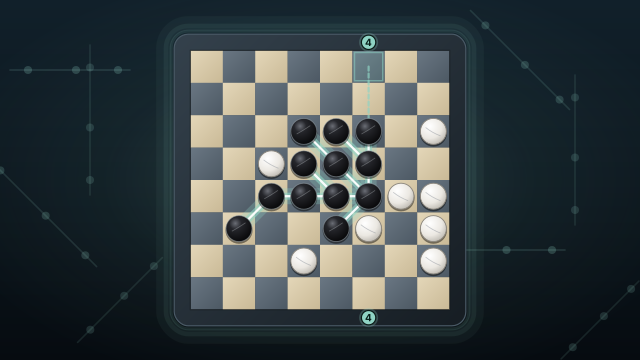
You play the black onyx pieces and move first; the computer plays white marble. On your turn, move one piece in a straight line: along its row, its column or either diagonal. It must go exactly as many squares as there are pieces, yours and the computer's, on the whole line it moves along, counting itself and the pieces behind it. It may jump over your own pieces but not over the computer's, and it may land on an empty square or on a computer piece, which is captured and leaves the board. Tap a piece: the squares it can reach light up, and a number at both ends of each of its lines shows the count, which is how far it goes that way. Your goal is to join all your pieces into one group, where every piece touches another along a side or a corner. If one move joins both sides at once, the game is a draw. If you have no move, you pass. A win scores 100 plus one point for each of your moves under 50, a draw 50, and a loss two points for each piece in your biggest group.
What is Lines of Action?
Lines of Action is a connection game for two players, invented by the American designer Claude Soucie and first published by Sid Sackson in his book A Gamut of Games in 1969. It needs nothing more than a checkerboard and twelve pieces a side, yet it plays like nothing else: there is no fixed way for a piece to move, because how far it goes depends on how many pieces stand on its line. It was recommended by the Spiel des Jahres jury in 1988, it is played at the Mind Sports Olympiad, and computer programs have competed at it at the Computer Olympiad for decades.
Here you play the black onyx pieces against the computer: an easy, medium or hard computer, and a Daily game that is the same for everyone.
How to play
- The board. Eight by eight squares. Your twelve black pieces start on the top and bottom rows, the computer's twelve white pieces on the left and right columns. The four corners start empty. You move first.
- Moving. On your turn you move one piece in a straight line: along its row, its column or one of its two diagonals.
- How far. The piece moves exactly as many squares as there are pieces on the whole line it moves along: yours and the computer's, the moving piece itself, and the pieces behind it too. A piece alone on a line moves one square; on a line with four pieces it moves four.
- Jumping. A piece may jump over your own pieces on the way, but never over an enemy piece.
- Capturing. A piece may land on an empty square or on an enemy piece, which is captured and taken off the board. It can never land on a piece of its own colour.
- Seeing your moves. Tap a piece. The squares it can reach light up, a dot for a move and a ring for a capture. At both ends of each of its four lines a number shows how many pieces stand on that line, which is how far it goes that way; a dim number means that way is shut. On easy the lines themselves are drawn too, with a mark on every square the move passes.
- Winning. You win when all your pieces form one group: every piece touching another along a side or at a corner. A side reduced to a single piece counts as joined.
- Captures can backfire. If your capture leaves the computer's remaining pieces all in one group, the computer wins. If one move joins both sides at once, the game is a draw, as in the original 1969 rules and most tournaments today.
- No move. A side that has no legal move passes. If neither side has joined after 100 moves each, the game is a draw.
- Score. A win scores 100 plus one point for each of your moves under 50, so a quicker win scores more. A draw scores 50, and a loss two points for each piece in your biggest group.
Strategy tips
- Head for the middle. Pieces on the edge move less and join less. Bring them towards the centre, where the groups meet.
- Count before you plan. Every move changes the counts on the lines it leaves and the lines it lands on, for both sides. A piece that cannot reach a square now may reach it after one other move.
- Do not capture lightly. Every capture removes an enemy piece, and fewer pieces are easier to join. Capture to break a link or to stop a threat, not just because you can.
- Block the stragglers. The computer's loose pieces must come back to its group. Stand in their way: a piece of yours on their line stops them jumping past.
- Build solid shapes. A two by two block of your pieces is hard to break apart and links in every direction. Joined groups that touch at many points are safer than a long thin chain.
- Watch the last link. When you are down to two groups, look for the single move that joins them, and check that the computer cannot answer by cutting your line.
FAQ
Is Lines of Action free to play?
Yes. Like every game on Play, it runs free in your browser, with no download and no account needed.
Who invented Lines of Action?
Claude Soucie, an American game designer. Sid Sackson published the rules in A Gamut of Games in 1969, which made the game known.
Can a piece jump over other pieces?
Over your own pieces, yes. Over the computer's pieces, never: an enemy piece in the way blocks that direction, although the piece may still land on an enemy at the very end of its move and capture it.
What happens if a move joins both sides at once?
It is a draw. This happens only with a capture, when taking the piece completes your group and also leaves the computer's remaining pieces in one group. Some editions give the game to the player who moved, but the draw rule is the one most tournaments use.
Does a single piece count as a group?
Yes. If a side is reduced to one piece, all of its pieces are joined, so that side wins. This is why capturing too much can hand the game to your opponent.
What is the Daily game?
Every day everyone plays the medium computer, and it answers the same moves the same way for everyone that day, so the scores compare directly on the leaderboard.