Liar's Dice
Five dice under your cup: raise the bid on the whole table, or call it a lie.
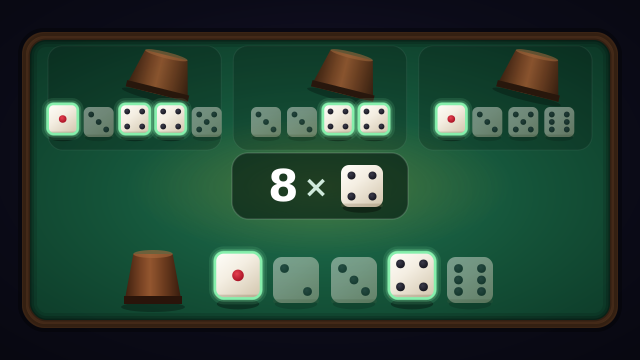
The bluffing dice game that South America plays as Dudo, for you and three computer players. Everyone has five dice under a cup and sees only their own. In turn, each player raises the bid on how many dice of one face are on the whole table, with ones counting as any face, or calls the last bid a lie. Then every cup is lifted: if the dice are there, the caller loses a die; if not, the bidder does. Lose all five and you are out; the last player with dice wins. Play an easy, medium or hard computer, and every day brings new throws, the same for everyone.
- Category
- Cards & Board
- Modes
- Easy · Medium · Hard · Daily
- Controls
- Mouse · Touch · Keyboard
Loading…
How to play
Each of the four players has five dice under a cup. Every round all the dice are thrown at once, and you see only your own. The player who opens the round makes a bid: at least so many dice of one face on the whole table, every cup counted, such as four fives. Ones are wild: they count as the face of any bid, so a bid names a face from two to six. In turn round the table, each player must raise the bid, with more dice of any face or the same number of a higher face, or call the bid before them a lie. A call lifts every cup and the dice of that face are counted, ones included. If there are at least as many as the bid said, it stands and the caller loses a die; if there are fewer, the bidder loses one. The loser opens the next round, or the next player when that was the loser's last die. A player with no dice left is out. Your game ends when you lose your last die, or when you are the last one with dice. Your score: 300 for the win, 200 for second place, 100 for third, and when you win, 20 more for every die you still hold.
What is Liar's Dice?
Liar's Dice is the bluffing dice game that South America plays as Dudo, known in many other places under many other names. Each player has five dice and a cup to hide them; nobody sees anyone else's dice, and every bid is a guess about the whole table. You can tell the truth, stretch it or lie outright, and the only question is whether the next player believes you.
Here you play the common single-hand game with ones wild, as Wikipedia's article on Liar's dice gives it, against three computer players. The computer comes in three strengths, and every day brings new throws, the same for everyone.
How to play
- The throw. Every round all the dice still in play are thrown at once under the cups. You see your own five; the others stay hidden until someone calls.
- The bid. A bid says that at least so many dice of one face lie on the whole table, every cup counted: "four fives". Ones are wild and count as the face of any bid, so you bid on twos to sixes, never on ones.
- Raising. In turn round the table, each player must raise the bid: more dice of any face (five twos beats four fives), or the same number of a higher face (four sixes beats four fives). The opener of a round may bid anything.
- Calling. Instead of raising, you may call the bid in front of you a lie. Every cup is lifted and the dice of that face are counted, ones included.
- Who loses a die. If there are at least as many as the bid said, the bid stands and the caller loses a die. If there are fewer, the bidder loses one. The loser opens the next round, or the next player when that was the loser's last die.
- The end. A player with no dice left is out, and the last player with dice wins. Your own game ends when you lose your last die.
- Score. 300 for the win, 200 for second place, 100 for third, and when you win, 20 more for every die you still hold.
Strategy tips
- Expect a third. Of the dice you cannot see, about one in three counts for any face you name: the face itself or a one. Add the dice of your own that count, and you have the honest middle of the bidding.
- Count your ones twice. Your ones count for every face, so they make any bid safer for you. The badge on each face in the picker shows how many of your dice count for it.
- Read the bids. A player who names a face often holds some of it. A bid on a face you hold none of is a common bluff, and it can steer the others onto a face that is not there.
- Call when the raise is worse. Calling loses a die when the bid is true; raising loses one only if your new bid is false and the next player calls it. Call when the bid in front of you looks less likely than your best raise.
- Fewer dice, closer numbers. As dice leave the table, every bid comes closer to the truth: three dice of a face among eight is a big claim.
FAQ
Is Liar's Dice free to play?
Yes. Like every game on Play, it runs free in your browser, with no download and no account needed.
Can the computer see my dice?
No. It knows only its own dice, how many dice every cup holds and the bids made in the round. It reasons from the chance that a bid is true and bluffs now and then, and the hard computer also reads the other players' bids.
Why can't I bid on ones?
In this rule, ones are always wild: they count as the face of whatever is bid. A bid on ones would make no sense, so bids name a face from two to six.
Is there an exact call or a one-die round?
Some tables add a call that the bid is exactly right, or a special round when a player is down to one die. They are played differently from table to table, so this game keeps to the plain rules: raise or call, and the loser of the call loses a die.
Why does the game end when I am out?
The others would play on without you, and their game no longer changes your place. You finish one place behind the players still in when you lose your last die.
What are today's throws?
Every day everyone gets the same throws against the same computer, round by round and cup by cup, so scores compare directly on the leaderboard.
More like this
Backgammon
Cards & Board
The dice say how far. You decide where.
Long Nardy
Cards & Board
Fifteen checkers each, one way round and no hitting: block, race and bear off.
Dominoes
Cards & Board
Match the ends and be first to play out.
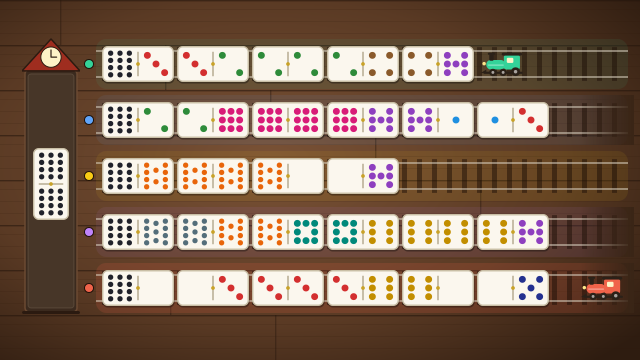
Mexican Train
Cards & Board
Build the longest train from the station and empty your hand first.