Konane
Jump and capture on every move. The first player who cannot move loses.
Kōnane is the traditional Hawaiian game of jumping stones, played on a board of cups carved in wood or lava rock, the papamu. The board starts full, black basalt and white coral stones alternating. Black opens by lifting one of its stones from the centre or a corner, white lifts one of its own next to the hole, and from then on every move is a jump: a stone jumps over an enemy stone next to it into the empty cup beyond and captures it, and it may keep jumping in the same straight line. There is no move without a capture, and the first player who cannot move loses. Play an easy computer on a six by six board, or a medium or hard one on eight by eight, and every day brings a Daily game that is the same for everyone.
- Category
- Cards & Board
- Modes
- Easy · Medium · Hard · Daily
- Controls
- Mouse · Touch · Keyboard
Loading…
How to play
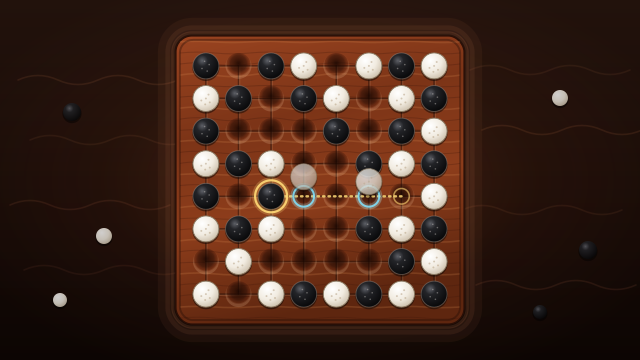
You play the black basalt stones; the computer plays white coral. The board starts full. Open the game by tapping one of your pulsing stones, in the centre or a corner, to lift it off; the computer then lifts one of its stones next to the hole. From then on, on your turn, jump: a stone of yours jumps along its row or column over a white stone right next to it into the empty cup just beyond, and the white stone is captured. If the next cup in the same line holds another white stone with an empty cup behind it, you may jump again, and so on, but you never turn and you may stop after any jump. Every move must capture, so you can only move a stone that has a jump. Stones that can jump wear a gold ring; tap one and the cups it can land in light up, a number marking a multiple jump. The first player with no jump left loses. A win scores 100 plus 5 points for each move you still have when the computer is stuck, up to 10 of them; a loss scores 2 points for each stone you captured.
What is Kōnane?
Kōnane is a traditional Hawaiian strategy game for two players, sometimes called Hawaiian checkers. It was played long before Europeans reached the islands, on boards called papamu: rows of small cups carved into a slab of lava rock or a plank of wood, filled with black stones of basalt and white stones of coral. Boards came in many sizes; eight by eight is the one most played today.
The rules fit in a few lines, yet the game is deep: every move must capture, and the first player who cannot move loses. Mathematicians who study combinatorial games have analysed Kōnane for exactly that reason.
Here you play the black basalt stones against the computer: an easy computer on a six by six board, a medium or hard one on eight by eight, and a Daily game that is the same for everyone.
How to play
- The board. At the start every cup holds a stone, black and white alternating like the squares of a checkerboard.
- The opening. You open by lifting one of your own stones off the board, from one of the two centre cups or one of the two corners that hold black. The computer then lifts one of its white stones from a cup next to the hole, along a row or a column. Now there are two empty cups.
- Jumping. From then on every move is a jump. One of your stones jumps along its row or its column over a white stone right next to it, into the empty cup just beyond. The white stone it jumped is captured and leaves the board.
- Multiple jumps. After a jump, if the next cup in the same straight line holds another white stone with an empty cup behind it, the stone may jump again, and again. It never turns a corner, and it may stop after any jump: a longer jump is a choice, not a duty.
- Every move captures. There is no plain step to an empty cup and no passing. A stone without a jump cannot move.
- The end. Players take turns until one of them has no jump. That player loses. There are no draws.
- Seeing your moves. On your turn every stone that can jump wears a gold ring. Tap one: the cups it can land in light up, the stones it would take are ringed in blue, and a number marks how many stones a multiple jump takes. The header shows how many moves each side has right now.
- Score. A win scores 100 points plus 5 for each move you still have when the computer is stuck, up to 10 of them, so a win with room to spare scores more. A loss scores 2 points for each stone you captured.
Strategy tips
- Count moves, not stones. The stones on the board matter less than the jumps each side can make. Every move you make changes that count for both of you, so before you jump, look at what it opens for the computer.
- Do not open lines for the other side. Every capture leaves two empty cups behind: where your stone started and where the captured stone stood. Each new hole can become a landing cup for the computer.
- Keep moves in reserve. A jump that you can make now and that the computer cannot take away is worth keeping for later. Near the end, the player with spare moves wins.
- Edges and corners are safe. A stone on the edge can only be jumped along the edge, and a stone in a corner can never be jumped at all. Stones there are hard to capture, though they also have fewer jumps of their own.
- Choose the length of your jump. A double jump takes two stones, but it also moves your stone further and may leave it where it can be captured. Sometimes the single jump is stronger.
- Starve the last move. When the computer is down to one or two jumps, look for a move that takes away the stone that would make them, or fills the cup it would land in.
FAQ
Is Kōnane free to play?
Yes. Like every game on Play, it runs free in your browser, with no download and no account needed.
Where does Kōnane come from?
From Hawaii, where it was played for centuries before contact with Europeans. Papamu carved in lava rock can still be seen at historic sites on the islands.
Can a stone change direction during a multiple jump?
No. All the jumps of one move go in the same straight line, along a row or along a column. Diagonal jumps are not allowed either.
Do I have to take every stone I can in one move?
No. A multiple jump is optional: you may stop after any jump, even when the line goes on.
Why is the easy board smaller?
A six by six board makes a shorter game that is easier to read, so it is a good place to learn how moves open and close. Medium, hard and the Daily game use the eight by eight board.
What is the Daily game?
Every day everyone plays the medium computer on the eight by eight board, and it answers the same moves the same way for everyone that day, so the scores compare directly on the leaderboard.