Hex
Join your two sides before the computer joins its own.
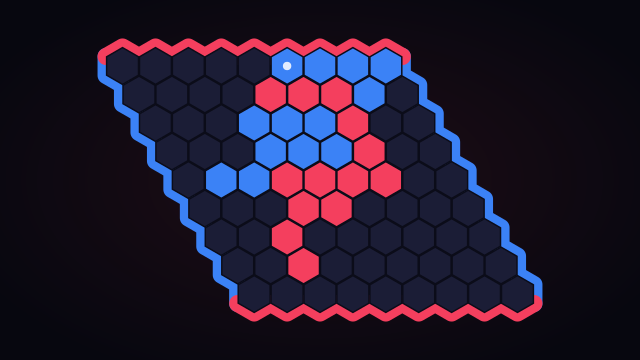
A classic connection game on a board of hexagons. You are red and own two opposite sides of the rhombus; the computer is blue and owns the other two. Take turns claiming cells, and the first to join its two sides with an unbroken chain wins. A cell touches six others, so a chain can always slip around, and a full board always has a winner. Play the computer on a 7 by 7, 9 by 9 or 11 by 11 board, where it moves first.
- Category
- Cards & Board
- Modes
- Easy 7×7 · Medium 9×9 · Hard 11×11
- Controls
- Mouse · Touch
Loading…
How to play
Tap an empty cell to claim it in red; the computer then claims one in blue. Join the two red sides of the board with an unbroken chain of red cells before blue joins its two sides. Chains run through the six neighbours of each cell. Two of your cells with two empty cells between them form a bridge: if the computer takes one of the two, take the other and they stay joined. A win scores 100 points plus one for every cell under twice the board's side you needed.
What is Hex?
Hex is a classic connection game for two, played here against the computer. The board is a rhombus of hexagonal cells. You are red and own two opposite sides; the computer is blue and owns the other two. Players take turns claiming one empty cell each, and the first to join its two sides with an unbroken chain of its own cells wins.
Because every cell touches six others, a chain can always find a way around, and a full board always has exactly one winner: Hex never ends in a draw. Boards come in three sizes, 7 by 7, 9 by 9 and 11 by 11, each with a stronger computer, and on the largest one the computer moves first.
How to play
Tap an empty cell to claim it in red. The computer answers with a blue cell.
- Your sides. The red band marks your two sides, the blue band the computer's. The small white dot shows the last cell taken.
- Chains. A chain runs through touching cells, and each cell touches up to six others.
- Winning. Join your two sides with one unbroken red chain before blue joins its own.
- Score. A win scores 100 points plus one for every cell under twice the board's side you needed; a loss scores 0.
Strategy tips
- Start in the middle. Central cells reach both of your sides and get in the way of both of the computer's.
- Build bridges. Two of your cells with two empty cells between them cannot be cut: if one empty cell is taken, take the other.
- Block from a distance. A blocking cell placed right next to an enemy chain is easy to go around; block a few cells ahead instead.
- Mind the edges. A cell on the second row from your side is already safe: it touches two edge cells, and the computer can take only one.
- Think in both directions. The best cells often extend your chain and cut the computer's at the same time.
FAQ
Is Hex free to play?
Yes. Like every game on Play, it runs free in your browser, with no download and no account needed.
Can a game of Hex end in a draw?
No. A full board always contains a winning chain for exactly one side, so every game has a winner.
Who moves first?
You do on the easy and medium boards. On the hard board the computer opens, and the first move is worth a lot in Hex, so that board is the real test.
How strong is the computer?
The easy computer looks one move ahead and sometimes picks a weaker cell; the medium one also sees bridges; the hard one looks two moves ahead and plays first.
How is my score counted?
A win is worth 100 points plus one point for every cell under twice the board's side that you used, so a short, direct chain scores more. Higher is better.