Royal Game of Ur
Pyramid dice, five rosettes and a 4,500-year-old race home.
The race game of ancient Mesopotamia, found in the royal tombs of Ur, played by the rules Irving Finkel of the British Museum read on a Babylonian clay tablet. Throw four pyramid dice and race your seven pieces along your own path, through the shared middle row, where the computer can send your pieces back to the start and you can send back its own, and off the far end. Land on a rosette to throw again; on the central rosette nobody can touch you. Play an easy, medium or hard computer, and every day brings a game with the same throws for everyone.
- Category
- Cards & Board
- Modes
- Easy · Medium · Hard · Daily
- Controls
- Mouse · Touch · Keyboard
Loading…
How to play
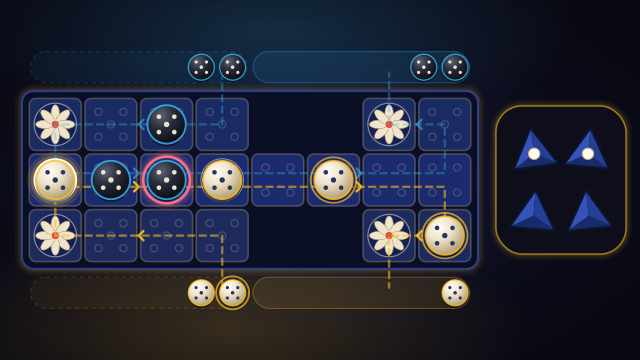
Tap the dice to throw. Each of the four pyramid dice counts one when it lands with a white tip on top, so a throw is 0 to 4, and 2 comes up most often. Move one piece exactly that far: either a new piece comes on at the start of your path, or a piece on the board moves on. Your path runs along your own row, through the eight shared squares of the middle row and back into your row to leave the board; the dashed line shows it. A piece never lands on one of your own. Landing on one of the computer's pieces in the middle row sends it back to the start, and the computer can do the same to yours, except on the central rosette, where a piece is safe. Every rosette you land on gives you another throw. A piece leaves the board only with the exact throw: from the last rosette it needs a 1. If no move fits your throw, the turn passes. The first to bring all seven pieces home wins. A win scores 100 plus 10 for every piece the computer still had to bring home; a loss scores 5 for each of your pieces home.
What is the Royal Game of Ur?
The Royal Game of Ur is a race game for two from ancient Mesopotamia. Between 1922 and 1934 Sir Leonard Woolley dug up five of its boards in the Royal Cemetery at Ur, in today's southern Iraq; the finest, inlaid with shell, red limestone and lapis lazuli, is in the British Museum and dates from about 2600 to 2400 BC. People played it across the Middle East for well over two thousand years, and its rules survive because a Babylonian scribe, Itti-Marduk-balāṭu, wrote them down on a clay tablet around 177 BC. Irving Finkel, a curator at the British Museum, read that tablet and pieced the game back together.
Here you play the ivory pieces by Finkel's rules against the computer at three strengths, and every day brings a Daily game in which everyone gets the same throws.
How to play
- The goal. Bring all seven of your pieces along your path and off the board before the computer does.
- The dice. Four pyramid-shaped dice, each with two of its four tips marked in white. Every die that lands with a white tip on top counts one, so a throw is 0 to 4: a 2 comes up six times in sixteen, a 1 or a 3 four times each, a 0 or a 4 once each.
- Moving. Move one piece exactly as many squares as you threw: a new piece comes on at the start of your path, or a piece already on the board moves on. When you can move, you must.
- Your path. Four squares along your own row, eight through the shared middle row, two more back in your own row, then off the board. The dashed line on the board shows it; the computer's path is its mirror image.
- Taking. A piece never lands on one of your own. Landing on one of the computer's pieces in the middle row sends it back to the start, and the computer can do the same to yours.
- Rosettes. Landing on any of the five rosettes gives you another throw. The central rosette in the middle row is also safe: nobody can land on a piece standing there.
- Bearing off. A piece leaves the board only with the exact throw: a 1 from the last rosette, a 2 from the square before it, and so on.
- No move. If you throw a 0, or no piece can use the throw, the turn passes.
- Score. A win scores 100 plus 10 for every piece the computer still had to bring home. A loss scores 5 for each of your pieces that made it home.
Strategy tips
- Hold the central rosette. A piece there is safe, keeps the computer from landing on it, and threatens everything that passes within four squares in front of it. Leave it only for a good reason.
- Count the odds. A piece one, two or three squares in front of an enemy piece is in danger, and two squares is the worst: a 2 is the most likely throw. Four squares ahead is far safer, since a 4 comes up only once in sixteen.
- Hit the pieces that have come furthest. Sending back a piece near the end of the middle row costs the computer far more than one that has only just come on.
- Use the rosettes. Each one is a free throw, and a throw of 4 brings a new piece straight onto your first rosette.
- Keep pieces in reserve. Pieces waiting beside the board and on your own squares are safe, and they give you a choice when the throw is awkward. Do not crowd every piece into the middle row at once.
- Mind the way out. A piece on the last rosette needs exactly a 1 to leave, so keep other pieces free to move and an awkward throw is never wasted.
FAQ
Is the Royal Game of Ur free to play?
Yes. Like every game on Play, it runs free in your browser, with no download and no account needed.
How old is the Royal Game of Ur?
The boards from the Royal Cemetery at Ur date from about 2600 to 2400 BC, some 4,500 years ago. The game spread across the Middle East, with boards found as far away as Crete and Sri Lanka, and the Jewish community of Kochi, in India, still played a version of it until the 1950s.
How do we know the rules?
A Babylonian clay tablet from around 177 BC, written by the scribe Itti-Marduk-balāṭu, describes how the game was played. Irving Finkel of the British Museum translated it in the 1980s and reconstructed the rules you play here. Other rule sets exist, such as R. C. Bell's older version with five pieces each, or the longer routes proposed by H. J. R. Murray and James Masters.
Why do some squares have rosettes?
They are the rosettes of the original board: one at the end of each player's row, one on each player's row in the small block, and one in the middle of the shared row. All five give another throw, and the central one also shelters a piece from being taken.
Can a piece go past the end with a big throw?
No. A piece leaves the board only with the exact throw it needs. If nothing else can use the throw, it is lost and the turn passes.
Who throws first?
You do, in every game. In Finkel's rules both players throw to decide who starts; here you always begin. The first player's edge in this game is small.
What is the Daily game?
Every day everyone plays the same game against the medium computer: the dice fall the same way, for you and for the computer, in the same order, so scores compare directly on the leaderboard.
More like this
Backgammon
Cards & Board
The dice say how far. You decide where.
Long Nardy
Cards & Board
Fifteen checkers each, one way round and no hitting: block, race and bear off.
Dominoes
Cards & Board
Match the ends and be first to play out.
Mexican Train
Cards & Board
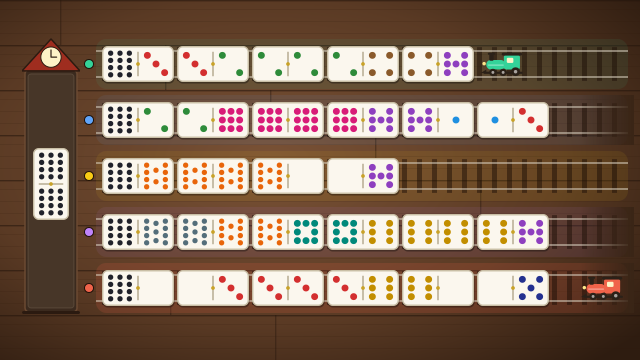
Build the longest train from the station and empty your hand first.