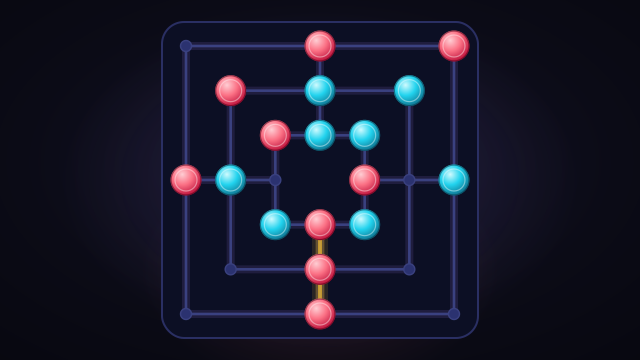
Fox and Geese
The old farmyard hunt: a flock of geese tries to pen in a fox that jumps them one by one.
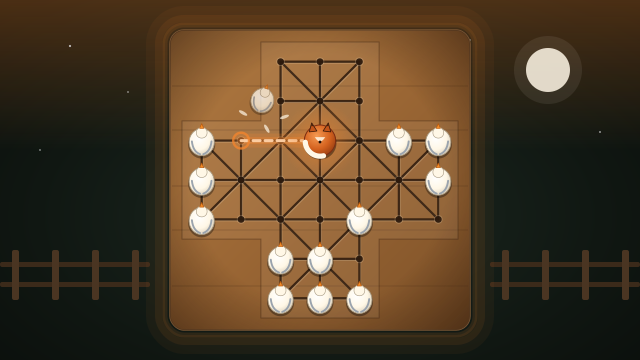
One of the oldest hunt games in Europe, played on the same cross of 33 points as peg solitaire. Thirteen geese start at the bottom of the board and can only step up or sideways; the fox stands alone in the middle, steps any way it likes and takes a goose by jumping over it, several in one turn when it can. The geese win by penning the fox in, the fox by thinning the flock or slipping past it. Lead the geese, the harder and more strategic side, or play the fox against an easy, medium or hard computer, and every day brings a Daily game that is the same for everyone.
- Category
- Cards & Board
- Modes
- Easy · Medium · Hard · Daily
- Controls
- Mouse · Touch · Keyboard
Loading…
How to play
The geese move first. Tap one of your pieces and the points it can reach light up; tap one to move there. A goose steps one point along a line: up, up a diagonal or sideways, never back, and never jumps. The fox steps one point along any line in any direction, or jumps over a goose next to it onto the empty point straight beyond and takes it. From where it lands it may jump again in the same turn, as often as it can, and it may stop whenever it likes: jumping is never compulsory. Diagonal lines run only through every other point. The geese win by penning the fox in so that it cannot move. The fox wins when only eight geese are left, when it gets below every goose (geese never step back, so they could never pen it in again), when the geese cannot move, or when it is still free after 60 turns each. You lead the geese unless you pick the fox; on hard, the computer leads seventeen geese against your fox. A win scores 100 plus two points for every turn under 40, and a loss one point for each turn you lasted, up to 45.
What is Fox and Geese?
Fox and Geese is one of the oldest hunt games in Europe. One side has a single fox, the other a whole flock of geese, and the two want completely different things: the geese close in, the fox picks them off. Fox games have been played across Europe since the Middle Ages, and the Norse sagas already mention one, halatafl.
The board is the cross of 33 points that peg solitaire uses. Here thirteen geese face the fox and may only step up or sideways, the common modern rule that makes them move as a flock. Lead the geese or play the fox against an easy, medium or hard computer, and every day there is a Daily game that is the same for everyone.
How to play
- The goal. The geese win by penning the fox in so that it cannot move. The fox wins by thinning the flock, by slipping past it, or by holding out.
- The board. Every point is joined to its neighbours along its row and its column, and every other point, the centre among them, along the diagonals too. Pieces only ever move along these lines.
- The geese. They move first. A goose steps one point along a line: up, up a diagonal or sideways, never back. Geese never jump and never take.
- The fox. It steps one point along any line, in any direction. Or it jumps over a goose next to it onto the empty point straight beyond, and the goose is taken.
- Chains of jumps. From where it lands the fox may jump again in the same turn, as often as it can, and it may stop whenever it likes: jumping is never compulsory. To stop, tap the fox.
- How the fox wins. When only eight geese are left; when it stands lower on the board than every goose, since geese never step back and could never pen it in again; when the geese have no move; or when it is still free after 60 turns each. There are no draws.
- Seventeen geese. When you play the fox on hard, the computer's flock also fills the four outer points of the middle row: the old larger flock for players who find thirteen too few.
- Score. A win scores 100 plus two points for every turn under 40. A loss scores one point for each turn you lasted, up to 45.
Strategy tips
- Keep every goose backed. A goose that faces the fox with an empty point behind it is a goose waiting to be jumped. Before you step forward, fill the gap behind.
- Advance from the edges. A goose on the edge of the board cannot be jumped from the side. Close the wings first, then push the middle.
- Never let the fox through. Once the fox is below every goose the game is over, so keep your lowest row whole until the fox is penned in above it.
- Mind the diagonals. Points with diagonal lines give the fox more ways to jump. Be most careful when a goose stands on one of them.
- As the fox, make two threats at once. One goose move can close only one gap. Look for a point from which you could jump two different geese.
- As the fox, play for time when you must. The geese have 60 turns to pen you in. Staying in open ground and waiting for a loose goose is a real plan.
FAQ
Is Fox and Geese free to play?
Yes. Like every game on Play, it runs free in your browser, with no download and no account needed.
Which side is stronger?
It depends on the rules. Many old sources reckon thirteen geese too few and the fox too strong, which is why larger flocks of 15, 17 or 18 geese appear in later rule books. Here the computer's levels are set so that you can win on either side, and the geese are the harder, more strategic side to play.
Why can the geese not move backwards?
It is the most common rule today, and it makes every goose move count: a goose that steps forward has committed itself. It also keeps the geese from shuffling to and fro forever while the fox waits.
Does the fox have to jump?
No. Jumping is never compulsory, and in a chain of jumps the fox may stop after any of them. A goose left where the fox could take it may still be bait.
Why does the fox win once it gets past the flock?
Because the geese can never step back. A fox standing lower on the board than every goose has its own row and the rows below it to itself for the rest of the game, so it can never be penned in.
What happens after 60 turns?
The fox has held out and wins. The geese have to pen it in within 60 turns each, so the flock must keep moving forward rather than wait.
What is the Daily game?
Every day everyone plays the geese against the same medium fox. The computer answers the same moves the same way, so the scores compare directly on the leaderboard.