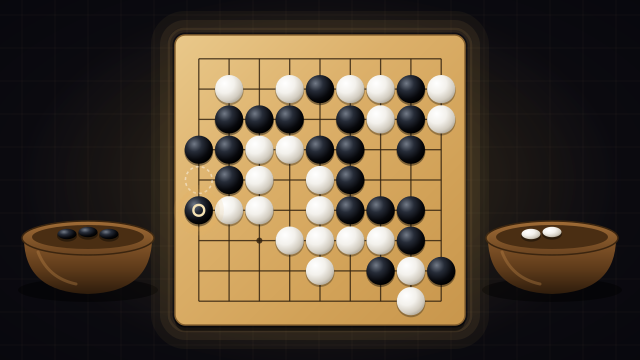
Five in a Row
Fifteen by fifteen. First to five wins.
The pen-and-paper classic, also known as gomoku: you and the computer take turns placing stones on a 15 by 15 board, and the first to line up five of their own, across, down or on a diagonal, wins. You place the first stone. Three rivals, from one that plays loosely to one that sees a forced win coming.
- Category
- Cards & Board
- Modes
- Easy · Medium · Hard
- Controls
- Mouse · Touch

Loading…
How to play
Tap an empty point to place your stone; the computer answers. Five or more of your stones in an unbroken line, across, down or diagonal, win. A full board with no line is a draw. Watch the open threes: three in a row with both ends free becomes an open four, and an open four cannot be stopped. A win scores 100 points plus one for every one of your stones under 50.
What is Five in a Row?
Five in a Row is the game generations have played on squared paper in the back of a notebook, known around the world as gomoku. Two players take turns placing a stone on an empty point of a 15 by 15 board, and the first to line up five of their own, across, down or on a diagonal, wins.
The rules fit in one sentence, but the game runs deep: every stone both builds your own lines and blocks the other side's, and the winning moves are the ones that make two threats at once. Here you play the computer at three levels, and you always place the first stone.
How to play
Tap an empty point to place your stone; the computer answers with its own.
- Five wins. Five or more of your stones in an unbroken line, across, down or diagonal, win the game.
- Open three. Three in a row with both ends free. Left alone, it becomes an open four.
- Open four. Four in a row with both ends free: it makes five next turn whatever the other side does.
- Draw. A full board with no line of five is a draw.
- Score. A win scores 100 points plus one for every one of your stones under 50; a draw scores 50.
Strategy tips
- Start in the middle. Lines need room on both sides; the edge of the board blocks half your chances.
- Answer every open three. If you leave one, it turns into an open four and the game is over.
- Build two threats at once. A four and an open three together, or two open threes, cannot both be stopped with one stone.
- Attack to defend. A four of your own forces the computer to answer it, which buys you the tempo to fix your defence.
- Keep your stones connected. Stones that sit near one another can join several lines later; scattered stones rarely become a threat.
FAQ
Is Five in a Row free to play?
Yes. Like every game on Play, it runs free in your browser, with no download and no account needed.
Is this the same as gomoku?
Yes, in its free style: five or more in a row wins, on a 15 by 15 board, with no restrictions on the first player's moves.
Who moves first?
You do. The first stone is a real advantage in Five in a Row, which is why even the hard computer can be beaten.
Does six in a row count?
Yes. Five or more of your stones in an unbroken line win.
How is my score counted?
A win scores 100 points plus one for every one of your stones under 50, so a quick win scores more; a draw scores 50 and a loss nothing. Each rival level has its own leaderboard.