Ten Thousand
Six dice, one rule: know when to stop.
The classic six-dice game of pushing your luck, also known as Farkle, Zilch or 10,000. Throw the dice, set aside the ones that score, then throw the rest for more or bank what the turn has made. A throw with nothing that scores wipes out the whole turn, and setting aside all six brings them back for a fresh throw. Race the computer to 10,000 points at easy, medium or hard, and every day brings a game with the same throws for everyone.
- Category
- Cards & Board
- Modes
- Easy · Medium · Hard · Daily
- Controls
- Mouse · Touch · Keyboard
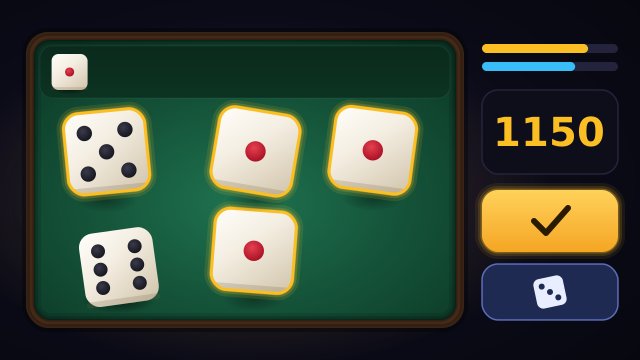
Loading…
How to play
Tap Roll to throw the six dice. From each throw you must set aside at least one scoring die: tap the dice to lift them. The table: a 1 is 100, a 5 is 50; three of a kind is 100 times the face (three 4s are 400), three 1s are 1,000; each die beyond three doubles it (four 4s 800, five 4s 1,600); a straight 1 to 6 or three different pairs is 1,500. Dice from different throws never combine. Then roll the dice left for more, or bank the turn's points into your score. A throw where nothing scores is a bust: the turn's points are lost and the dice pass. Set aside all six and you have hot dice: all six come back and the turn goes on. The first to 10,000 wins; you start, so when you get there the computer has one last turn to pass you. A win scores 100 plus one point for every 100 you won by (at most 200); a loss scores 4 for every 1,000 you banked.
What is Ten Thousand?
Ten Thousand is a dice game for two or more players that comes down to one question asked again and again: stop now, or throw once more? Six dice, a short scoring table and a race to 10,000 points. Families have played it for generations under many names: Zehntausend in Germany, Dix mille or 5000 in France, Zece mii in Romania, Diez mil in Spain and Latin America, and Zilch, Greed, Hot Dice or Farkle in the English-speaking world, where boxed sets and apps have made it famous.
Here you play against the computer at three strengths, from a bold beginner to an opponent that weighs every throw by its odds, and every day brings a Daily game in which everyone gets the same throws.
How to play
- The goal. Be the first to bank 10,000 points.
- A turn. Throw the six dice. From the throw, set aside at least one die that scores. Then either throw the dice that are left to add more, or bank: the points of the turn go onto your score and the dice pass.
- The table. A single 1 scores 100 and a single 5 scores 50. Three of a kind score 100 times the face (three 2s are 200, three 6s are 600), and three 1s score 1,000. Each die beyond three doubles that: four 3s are 600, five 3s are 1,200, six 3s are 2,400, and four 1s are 2,000. A straight from 1 to 6 scores 1,500, and so do three different pairs.
- One throw at a time. Combinations count only within one throw: a 5 you set aside now and two 5s you throw later are never three of a kind.
- Every die must count. A lone 2, 3, 4 or 6 scores nothing and stays with the dice you throw again.
- A bust. If a throw has nothing that scores, the turn ends and every point it had made is lost.
- Hot dice. Set aside all six dice and you get all six back: throw them again, and the turn goes on with its points safe until the next throw.
- The end. You throw first. When you bank your way to 10,000, the computer gets one last turn to pass your total, so both sides have had the same number of turns. If the computer gets there first, the game ends at once.
- Score. A win scores 100 plus one point for every 100 you won by, at most 200. A loss scores 4 for every 1,000 you banked.
Strategy tips
- Know the odds of a bust. Throwing six dice, nothing scores only 2.3% of the time. With five dice it is 7.7%, with four 15.7%, with three 27.8%, with two 44.4% and with one die 66.7%.
- Never bank with six dice in hand. After hot dice, or at the start of a turn, the risk is so small that throwing again is almost always right.
- Keep fewer dice. From a throw of 1, 5 and four dice that score nothing, keep only the 1 and throw five dice rather than four: the 50 you give up is worth far less than the extra die, and the turn is then worth about 400 on average instead of 310.
- Bank by the dice left. As a rule of thumb, with one or two dice left bank from about 300, with three from about 450, with four from about 1,000, and with five keep going until the turn is worth a few thousand.
- Watch the race at the end. On the computer's last chance it will keep throwing until it passes you, so every extra 100 you bank on your final turn is a real obstacle.
- Big combinations change the plan. Three pairs or a straight use all six dice and give you hot dice as well as 1,500, so take them whole.
FAQ
Is Ten Thousand free to play?
Yes. Like every game on Play, it runs free in your browser, with no download and no account needed.
Is this the same game as Farkle?
It is the same family. Farkle is the name used by several boxed sets and apps for this traditional game; Ten Thousand, Zilch and Greed are older folk names for it. The rules vary from table to table, mostly in what the big combinations are worth, and this page uses one common table, written out above.
Why do four of a kind score double?
In this table each die beyond three doubles the three of a kind, a rule many families play by. Other tables give four of a kind a flat 1,000 or score three pairs at 750. The scoring is the same for you and for the computer.
Do I need a minimum score to get on the board?
No. Some groups only let a player start once a single turn makes 500 or 750 points; here any turn can be banked, however small.
Is it fair that I always start?
The computer always gets the same number of turns as you. When you reach 10,000 first, it has one last turn to pass you, and if it reaches the target first the game stops there, before you would have had an extra turn.
What is the Daily game?
Every day everyone plays the same game against the medium computer: the same throw of the same turn, yours or the computer's, shows the same faces for every player, so the scores compare directly on the leaderboard.
More like this
Backgammon
Cards & Board
The dice say how far. You decide where.
Long Nardy
Cards & Board
Fifteen checkers each, one way round and no hitting: block, race and bear off.
Dominoes
Cards & Board
Match the ends and be first to play out.
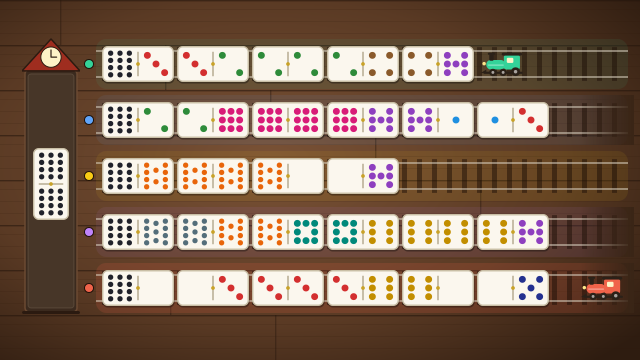
Mexican Train
Cards & Board
Build the longest train from the station and empty your hand first.