Escoba
Make 15 with the table, sweep it clean, and keep an eye on the sevens.
Spain's favourite fishing game, the Escoba del 15, played with the 40-card Spanish pack against the computer. Four cards lie face up on the table and you each hold three. Play a card and take any table cards that make exactly 15 with it; take them all and you score an escoba. Each hand pays a point for every escoba, the most cards, the most coins, the siete de velo and the most sevens, and the first to 15 wins the match. Play an easy, medium or hard computer, and every day brings new deals, the same for everyone.
- Category
- Cards & Board
- Modes
- Easy · Medium · Hard · Daily
- Controls
- Mouse · Touch
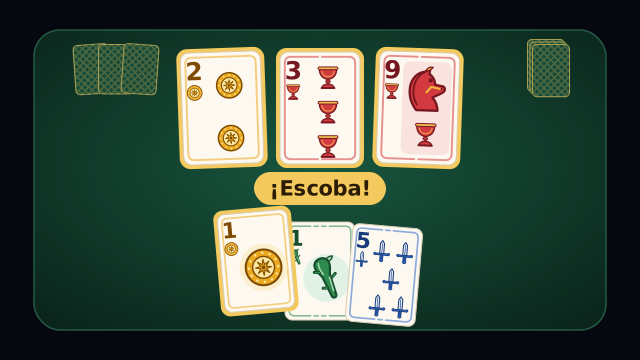
Loading…
How to play
Tap a card in your hand: the game marks the table cards that make 15 with it. The ace counts 1, the 2 to the 7 their number, the sota (jack) 8, the caballo (knight) 9 and the rey (king) 10: the number in each card's corner. When there is more than one way to make 15, every way is shown, the best one starred: pick one, or tap a table card to choose a way that holds it, then press the button. A card that can make 15 must take; one that cannot goes on the table. Taking every card on the table is an escoba, a point of its own. If the four cards dealt face up make 15, the dealer takes them for an escoba (30 makes two). You get three more cards each until the pack is gone, and whatever is left on the table at the end goes to whoever took last. Points each hand: each escoba, the most cards, the most coins, the siete de velo (the seven of coins) and the most sevens; a tie scores for nobody. First to 15 wins; level at 15 or more, another hand is played. Your score: ten per point you take, ten for every point the computer is short of 15, and 100 for the match.
What is Escoba?
Escoba, or Escoba del 15, is the card game Spain grows up with: played in bars, at family tables and on long summer evenings, and just as loved in Argentina, Uruguay and Chile. It belongs to the fishing family, like Italy's Scopa: you take cards from the table with the cards in your hand, but here the card you play and the cards you take must add up to exactly 15. It is played with the 40-card Spanish pack in four suits, oros (coins), copas (cups), espadas (swords) and bastos (clubs), each running from the ace to the 7 plus three figures: the sota, the caballo and the rey. Escoba means broom, because sweeping the table clean is the move everyone waits for.
Here you play two-handed against the computer, a match to 15 points. The computer plays at three levels, and every day brings new deals, the same for everyone.
How to play
The player who does not deal plays first, and the deal passes after every hand.
- The values. The ace counts 1, the 2 to the 7 their number, the sota 8, the caballo 9 and the rey 10. The corner of each card shows what it counts.
- The deal. Three cards each and four face up on the table. If those four make 15, the dealer takes them at once for an escoba; if they make 30, for two. When both hands are empty, three more each, until the pack is gone: six rounds to a hand.
- Taking. The card you play takes any set of table cards that makes exactly 15 with it: a 7 takes a sota, or a 5 and a 3, or a 4, a 3 and an ace. When there is more than one way, you choose. A card that can make 15 must take.
- Laying down. A card that makes 15 with nothing stays on the table.
- The escoba. Taking every card on the table is an escoba, worth a point.
- The end of a hand. Whatever is left on the table goes to whoever took last.
- The points. One for each escoba, one for the most cards, one for the most coins, one for the siete de velo (the seven of coins) and one for the most sevens. A tie for cards, coins or sevens scores for nobody.
- The match. The first to 15 wins. If both reach 15 in the same hand, the higher total wins, and a tie means another hand.
- Score. Ten for every point you take, ten for every point the computer is short of 15, and 100 for winning the match.
Strategy tips
- Mind the total you leave. If the cards left on the table add up to anything from 5 to 14, a single card can sweep them all. Leave more than 14, or less than 5, whenever you can.
- Count what is out. Every card played is in plain view. Once all four cards of the value that would sweep the table are gone, the table is safe.
- Read the other side. A player who passes up a table they could have swept holds no card of that value this round.
- Guard the sevens. Three sevens win the point for sevens, and the siete de velo is a point on its own. Do not leave a seven where one card can take it.
- Take coins. Six coins win the point for coins, and every coin you take is one the computer cannot.
- Think about the end. What is left on the table at the end goes to whoever took last, so in the final round a card that can still take is worth holding back.
FAQ
Is Escoba free to play?
Yes. Like every game on Play, it runs free in your browser, with no download and no account needed.
Can the computer see my cards?
No. It plays only on what it can see from its seat: its own hand, the table and the cards already played, just as you do. The hard computer counts every card and reads your play; once the pack is gone, the cards it has not seen can only be yours.
Why must my card take?
In Spain, passing up a 15 you could have made is a renuncio, a fault. Here the game simply makes the card take: a card that can make 15 always takes, and you choose which cards when there is more than one way.
What is the siete de velo?
The seven of coins. It scores a point on its own for whoever takes it, it counts among the sevens and the coins as well, and it wears a gold star.
Why do the figures count 8, 9 and 10?
A 40-card Spanish pack has no 8s or 9s, so the sota, the caballo and the rey follow the 7 and count 8, 9 and 10. Printed packs number them 10, 11 and 12; the corners here show what they count toward 15.
What is the daily deal?
Every day everyone gets the same deals against the medium computer, so scores compare directly on the leaderboard.
How is my score counted?
Ten for every point you take, ten for every point the computer is short of 15, and 100 for winning the match. Higher is better.
More like this
Tabinet
Cards & Board
Take matching cards from the table and sweep it clean.
Scopa
Cards & Board
Take by value or by sum, and sweep the table for a scopa.
Cassino
Cards & Board
Pair, add up and build to capture the table, and grab the casinos.

Chess
1v1Cards & Board
Sixty-four squares. Six rivals. One quiet night.