Chinese Checkers
Ten marbles, one star, and a race of hops to the far point.
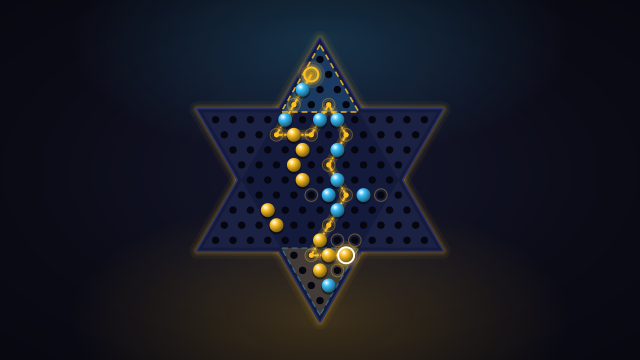
The classic race across a six-pointed star, the game Germans call Sternhalma. Your ten marbles start in one point of the star; bring all ten into the point opposite before the computer fills yours. Step into a neighbouring hole, or hop over any marble next to yours and keep hopping as far as the chain will take you. Play an easy, medium or hard computer, or three at the table against two of them, and every day brings a game that is the same for everyone.
- Category
- Cards & Board
- Modes
- Easy · Medium · Hard · 3 players · Daily
- Controls
- Mouse · Touch · Keyboard
Loading…
How to play
Tap one of your gold marbles and the holes it can reach light up; tap one of them to move there. A move is either a single step into an empty neighbouring hole, or a chain of hops: each hop jumps one marble next to yours, of any colour, onto the empty hole straight beyond it, and you can keep hopping in any direction and stop after any hop. Steps and hops never mix in one move, and nothing is ever taken. A marble may hop through the other points but only comes to rest in the middle, in your own point or in the point you are racing to, and once it reaches that point it stays inside it. The first to fill the point opposite wins, and marbles the other side leaves sitting there count for you, so nobody can block a point by sitting tight in it. After 150 moves each the game stops, and whoever has the most marbles in the far point wins. A win scores 100 plus two points for every move under 60; a loss scores five for each of your marbles in the far point.
What is Chinese Checkers?
Despite the name, Chinese checkers is neither Chinese nor a kind of checkers. It began in Germany in 1892 as Stern-Halma, a star-shaped version of Halma, the American jumping game of the 1880s ("halma" is Greek for a jump). In 1928 the Pressman brothers sold it in the United States as Hop Ching Checkers and then as Chinese Checkers, and that name stuck wherever English is spoken. Germans still call it Sternhalma, or simply Halma.
The board is a six-pointed star of 121 holes: a hexagon of 61 in the middle and a point of ten on each of its sides. Here you play the gold marbles against the computer at three strengths, or three at the table against two computers, and every day brings a Daily game that is the same for everyone.
How to play
- The goal. Your ten marbles start in the point nearest you. Fill the point opposite before the computer fills yours.
- Picking a move. Tap one of your marbles and the holes it can reach light up. Tap one of them and the marble goes there, hop by hop.
- Steps. A step moves a marble into an empty hole next to it, in any of six directions.
- Hops. A hop jumps over one marble next to yours, your own or the computer's, onto the empty hole straight beyond it. Nothing is ever captured.
- Chains. After a hop you may hop again, in any direction, as often as the board allows, and stop whenever you like. A step and a hop never go in the same move.
- The other points. A marble may hop through the empty points on either side, but it only comes to rest in the middle, in your own point or in the point you are racing to.
- Arrived is arrived. Once a marble reaches the far point it stays inside it, though it may still move around within the point.
- Winning. The first to fill the point opposite wins. A marble the computer leaves sitting in your target counts for you, so nobody can block a point by staying in it.
- The move limit. If nobody has won after 150 moves each, the game stops and the side with more marbles in its far point wins.
- Score. A win scores 100 plus two points for every move under 60. A loss scores five for each of your marbles in the far point.
Strategy tips
- Build ladders. A line of marbles with a gap after each one is a staircase: one marble can hop the whole way up it in a single move. A quiet move to set one up is often worth it.
- Bring the back marbles along. The marble left at the back is the one that costs you the game: with nothing to hop over, it crawls one hole at a time. Move your rear marbles forward with the group.
- Borrow the computer's marbles. Hops work over any colour, and in the middle of the board the computer's marbles make some of the longest ladders.
- Leave no ladders behind. A gap you open in the middle can be the computer's next long chain. Look at what your move leaves for the other side.
- Fill from the tip. Send your first marbles deep into the far point, so the later ones still have room to land.
FAQ
Is Chinese Checkers free to play?
Yes. Like every game on Play, it runs free in your browser, with no download and no account needed.
Is Chinese checkers really Chinese?
No. It was invented in Germany in 1892 as Stern-Halma, and the Chinese name was a marketing idea when it reached the United States in 1928. It is a cousin of Halma, not of checkers: nothing is ever captured.
Can I stop a marble in one of the empty points?
No. A marble may hop through the points on either side, but it only comes to rest in the middle of the board, in your own point or in the point you are racing to. That keeps the race in the middle, where the hopping is.
What if the computer leaves marbles in my target point?
They count for you. You win as soon as every hole of the far point is filled and at least one of the marbles there is yours, so nobody can block you by keeping marbles at home.
Can a game go on forever?
No. After 150 moves each the game stops, and the side with more marbles in its far point wins; level is a draw. In practice a game takes about 35 to 50 moves each.
What is the Daily game?
Every day everyone plays the same game against the medium computer: it answers the same moves the same way, so scores compare directly on the leaderboard.
How does the three-player game work?
You play gold from the bottom point, and two computers start from the points on either side of the top one, every other point round the star, so each of you races into an empty point. They move in turn after you, and the first to fill its far point wins.
More like this
Backgammon
Cards & Board
The dice say how far. You decide where.
Long Nardy
Cards & Board
Fifteen checkers each, one way round and no hitting: block, race and bear off.
Dominoes
Cards & Board
Match the ends and be first to play out.
Mexican Train
Cards & Board
Build the longest train from the station and empty your hand first.