Orbital Lock
Sixteen worlds. One lock. Find the alignment.
A precision timing campaign across four sectors of deep space. Lock rotating markers into luminous windows, one ring at a time, while every mission adds a new hazard: reversing sweeps, drifting arcs, pulsing seals, ghost windows and collapsing targets. Earn stars, open sector gates, then chase the leaderboard in the endless descent and the shared daily orbit.
- Category
- Reflex & Skill
- Modes
- Solo · Daily
- Controls
- Keyboard · Mouse · Touch

Loading…
How to play
Tap anywhere, click, or press Space or Enter when the active marker enters its bright target arc. The thin inner line is the perfect zone. Each lock releases the outer ring and pulls a fresh one in from the core, so a mission runs from twenty docks on First Light to ninety six on Singularity, getting faster and narrower as it goes. A miss costs a strike, and longer missions allow more of them. Clear a mission to earn stars: one for the clear, two for a nearly clean run, three for a clean and mostly perfect one. Stars open the next sectors, level 4 opens the endless descent, and the daily orbit gives everyone the same five phases once a day.
What is Orbital Lock?
Orbital Lock is a one-input precision campaign built around a celestial instrument. Each phase contains three to five concentric rings. Every ring carries a rotating marker and a luminous target window, and every ring moves differently from its neighbors. Lock the outer ring, then work inward until the whole instrument is stable.
The remake ships a full campaign: sixteen hand-designed missions across four sectors, each identical for every player. New hazards enter one at a time, so every sector teaches you something before it tests you. Beyond the campaign wait the endless descent and the shared daily orbit.
How to play
- Mobile: tap anywhere inside the game area. The full screen is one large control; there is no small timing button to find.
- Desktop: click anywhere in the game area or press Space or Enter.
- Follow the numbered rings from the outside toward the core. The active ring and marker glow in the sector color.
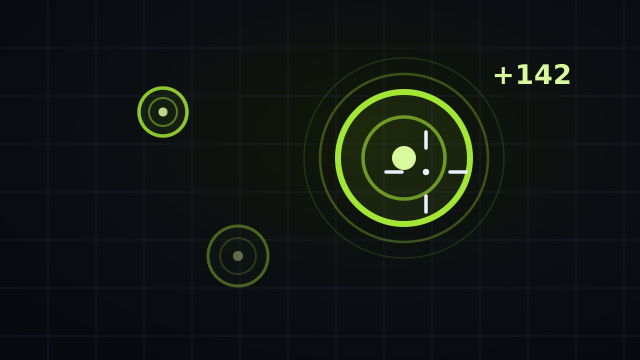
- Tap while the marker is inside the wide luminous arc for a Lock.
- Land inside the thin central line of that arc for a Perfect lock and a larger precision bonus.
- A successful lock freezes that ring and advances to the next one. A miss leaves the same ring active and consumes one strike.
- Three misses end the run.
The campaign
Sixteen missions in four sectors: Ember Reach, Cyan Drift, Violet Veil and Crimson Core. Every mission is fixed: the same rings, speeds and windows for every player, every time. Clearing a mission earns stars:
- 1 star for the clear.
- 2 stars for a clear with zero misses.
- 3 stars for a clear with zero misses where at least 60 percent of your locks are perfect.
Missions unlock in order. Sector gates ask for stars as well as clears, so a cleaner orbit through earlier missions opens deeper space sooner. Level 4 also opens the endless descent.
The hazards
Each mission can add new behavior to its rings. Every hazard debuts alone on a gentle layout before it appears in combinations:
- Reversal: the marker sweeps back and forth instead of orbiting one way. The chevrons flip when it turns.
- Drift: the target window itself orbits slowly. Lead the window, not the marker.
- Surge: marker speed swells and fades in waves. Lock on the slow beat.
- Pulse: the window blinks shut on a rhythm. A tap on a sealed arc is a miss, wherever the marker is.
- Twin markers: two markers ride the same ring, half a turn apart. Either one can take the lock.
- Ghost arcs: decoy arcs glow beside the real window. Only the true arc carries the center bearing tick and the thin perfect line.
- Collapse: the window narrows over time toward a floor. Hesitation costs width.
Scoring
Every successful lock combines four components:
- A base award for a good or perfect lock.
- An accuracy award that grows as the marker approaches the center of the window.
- A combo award for consecutive successful locks. Any miss resets the combo.
- A speed award for finding the next alignment without waiting through extra rotations.
Completing a phase adds a phase bonus. Clearing a campaign mission adds a time bonus plus a flawless bonus for zero misses. The daily orbit keeps its own clear bonus. In the endless descent the phase bonuses keep coming as long as your strikes hold.
Deep space and the daily orbit
The endless descent generates stages that keep tightening: faster markers, narrower windows, and hazards joining as you sink deeper. Depth is counted in cleared stages, and the leaderboard score has no ceiling. It unlocks after mission 4.
The daily orbit deals five phases from one shared seed, so every player faces the identical gauntlet that day, with one scored attempt on the board. Marker positions are calculated directly from the recorded logical input time rather than animation frames, so the same trace replays to the same score on fast and slow displays.
Accessibility and motion
The whole arena is keyboard and pointer accessible, with Space and Enter mapped to the same lock action as a tap. Locks, perfects, misses and sealed windows use distinct symbols, text announcements, shapes, audio and haptic patterns instead of color alone. Reduced-motion mode removes particles, screen shake, flicker and marker trails while preserving the core orbital movement needed to play. Music and effects have separate volume controls in the constellation hub.
FAQ
Does pausing change the alignment?
No. The game uses a pause-adjusted logical clock. Pausing freezes every marker and the scoring timer; resuming continues from that same instant.
Are campaign missions really the same for everyone?
Yes. Campaign layouts are fixed data, not random rolls. Daily and endless runs are generated from their session seed, which is shared for the daily orbit.
Is a target boundary valid?
Yes. Both the outer window boundary and the inner perfect boundary are inclusive. Targets that cross zero degrees use the same shortest-angle calculation as every other target.
Is Orbital Lock deterministic?
Yes. Movement is an exact angle calculation from logical time, and every accepted input is submitted with its timestamp and final-state hash for replay validation.