Golf
Nine full holes from above: pick a club, read the wind and time the two-tap swing.
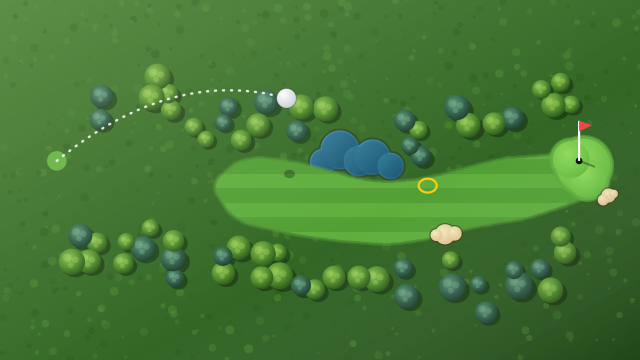
Real golf on nine full holes seen from above, par 36: tee shots down tree-lined fairways, approaches over water and sand, and putts on tilted greens. Pick from seven clubs, drag the landing spot where you want it, then stop the swing meter on its notch. The wind changes from hole to hole, the rough and the bunkers cost you distance, the water costs you a stroke. Three levels, from Easy with no wind and a putting guide to Hard with strong winds and narrow fairways, and every day a Daily round on the same nine holes for everyone.
- Category
- Arcade
- Modes
- Easy · Medium · Hard · Daily
- Controls
- Mouse · Touch · Keyboard
Loading…
How to play
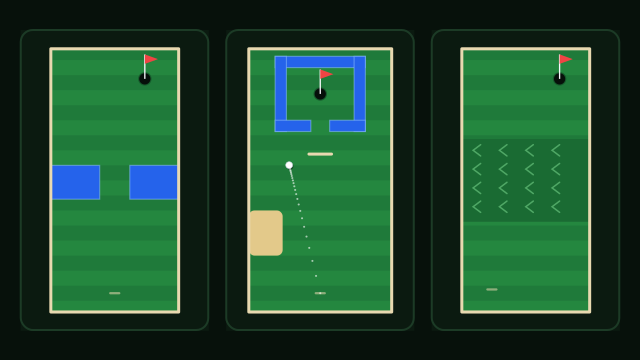
Play nine holes in as few strokes as you can. For each shot, pick a club with the arrows beside its name (the game offers a sensible one first), then drag anywhere on the course to move the landing spot: it follows your finger, up to as far as the club carries from where the ball lies. Then swing: tap Swing to start the meter and tap again to stop it. The white notch is where the ball lands on your spot in still air; the full bar (100 %) is the club's full carry; past it, in the red, you hit a little farther but the ball hooks left; let the meter fall back to the bottom and the swing is called off. The arrow at the top left shows the hole's wind, which carries the ball in flight. From the rough the ball flies shorter, from a bunker much shorter (the wedge copes best), and a tree it flies into drops it at its foot. Water costs a penalty stroke and a drop on the ball's line, before the edge it crossed; beyond the white stakes it is out of bounds: a penalty stroke, and you play again from the same spot. On the green, the putter's notch rolls the ball to your spot on a flat green, and the chevrons show which way the green tilts. A hole stops at five over par. On a keyboard: the left and right arrows turn the aim (Shift for bigger steps), up and down change the distance, Q and E change club, Space swings.
What is Golf?
Golf is played on a course of holes, each one a long stretch of grass from a teeing ground to a green with a flag and a small cup. You hit the ball from the tee toward the green and into the cup in as few strokes as you can. Each hole has a par, the number of strokes a good player needs: 3 for a short hole, 4 or 5 for the longer ones.
Here you play a round of nine full holes seen from above, par 36: two par 3s, five par 4s and two par 5s, built for each round with fairways that bend round trees, bunkers by the greens and the landing zones, ponds and creeks, and greens that tilt. There are three levels, and every day a Daily round, the same nine holes and winds for everyone.
How to play Golf
- Pick a club. The arrows beside the club's name step through Driver, 3 Wood, 5, 7 and 9 Irons, Wedge and Putter. The longer the club, the farther it carries and the more it rolls. The game offers a sensible club first.
- Aim. Drag anywhere on the course to move the landing spot. It follows your finger, as far as the club carries from where the ball lies, and the yellow ring shows how much the shot can stray at your level.
- Swing. Tap Swing to start the meter and tap again to stop it. Stop it on the white notch and the ball lands on your spot in still air. The full bar is the club's whole carry; past it, in the red, the ball goes a little farther but hooks to the left. Let the meter fall back to the bottom and the swing is called off.
- Read the wind. The arrow at the top left shows the hole's wind and its speed. It carries the ball while it flies, more on long, high shots.
- Mind the lie. From the rough the ball flies shorter, from a bunker much shorter (the Wedge copes best), and a tree in the way knocks it down.
- Penalties. Water costs a stroke, and you drop on the ball's line before the edge it crossed. Beyond the white stakes is out of bounds: a stroke, and you play again from the same spot.
- Putting. On the green the notch rolls the ball to your spot on a flat green. The chevrons point downhill, so aim a little to the high side. On Easy, yellow dots show how the putt starts to roll.
- Scoring. A hole is picked up at five over par. Your score is 100 points for every stroke under five over par on each hole: 4500 for a round at par, 100 more for each stroke under par, 100 fewer for each stroke over.
Tips and strategy
- Take the wind into the aim. A crosswind of a few metres a second moves a long iron several metres. Move your landing spot into the wind by about that much.
- Play to the fat part of the fairway. A drive in the rough costs you distance on the next shot; a slightly shorter club off the tee is often worth it on a narrow hole.
- Short is safer than long near water. If a pond guards the green, aim for the middle of the green or lay up short of the water.
- Use the notch, not the full bar. The notch is the distance you chose. Going for the red gives you a few metres more, but the ball starts left.
- Read the green before you putt. Follow the chevrons: a putt across the slope curls downhill, so start it on the high side and let it roll in slowly.
Frequently asked questions
Is Golf free?
Yes. Like every game on Play, it runs free in your browser, with no download and no account.
Is this minigolf?
No. Minigolf is putting round walls and ramps. This is golf on full holes of 120 to over 500 metres, with drivers, irons, wind and hazards.
Why does my ball not land exactly on the spot?
Three things move it: the wind, which you can read from the arrow; where you stop the meter; and on Medium and Hard a small stray in every swing, larger from the rough and the sand. The stray comes from the round's seed, so a replay of your round goes the same way.
What happens in the water?
You take a penalty stroke and drop on the ball's own line, on the last dry ground before it crossed the water's edge, and play on from there.
How is the score worked out?
Each hole gives 100 points for every stroke under five over par, so a par is worth 500 and a birdie 600. A round at par makes 4500, and nine holes in one would make 7200.
What is the Daily round?
Every day everyone plays the same nine holes with the same winds, at Medium, so the scores compare directly on the leaderboard.