Durak
Beat every attack, shed your cards, and don't be the fool.
The great card game of Russia and Eastern Europe, for two, against the computer. Thirty-six cards from six to ace, six in hand and a trump turned under the talon. Attack with any card, add more of the ranks already on the table, beat each card with a higher one of its suit or a trump, or pick the whole lot up. Both draw back to six after every bout; once the talon is gone, the first to run out of cards is safe, and whoever is left holding cards is the durak, the fool. First to three games wins the match. Play an easy, medium or hard computer, and every day brings new deals, the same for everyone.
- Category
- Cards & Board
- Modes
- Easy · Medium · Hard · Daily
- Controls
- Mouse · Touch · Keyboard
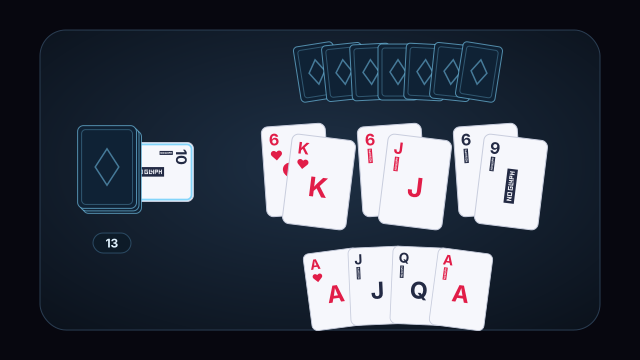
Loading…
How to play
You and the computer hold six cards each; the card turned under the talon sets trumps. The attacker leads any card. The defender beats it with a higher card of the same suit, or with any trump if it is not a trump itself, or takes it. Once every card on the table is beaten, the attacker may add a card of any rank already there, up to six attack cards in a bout and never more than the defender held when it began. If the defender beats everything and the attacker stops (Done), the cards go out of play and the defender attacks next. If the defender takes, the attacker may first throw in more cards of those ranks; then the defender picks up the lot and the attacker attacks again. After each bout both draw back to six, the attacker first, and the turned trump is the last card drawn. Holding the six of trumps, you may swap it for the turned trump while the talon lasts. Once the talon is empty, the first to run out of cards is out of the game, and the one still holding cards is the durak. In the first game the lowest trump attacks first; after that the winner attacks the durak. First to three games wins the match. Your score: 100 for each game you win, ten for each card the computer is left with (up to ten), and 200 for the match.
What is Durak?
Durak (Russian for "the fool") is the most popular card game in Russia and much of Eastern Europe, played for generations on trains, at kitchen tables and in courtyards; in Romania and Moldova it is also known as Prostul. Unlike most card games it has no winner as such: the aim is not to be the last player left holding cards, the one everyone teases as the durak. Here you play the classic podkidnoy, or throw-in, game for two, against the computer.
The pack has 36 cards, six to ace in four suits. Each player holds six, the next card is turned face up under the talon to set trumps, and the first to win three games wins the match. The computer comes in three strengths, and every day brings new deals, the same for everyone.
How to play
In the first game the holder of the lowest trump attacks first (if nobody holds a trump, the player who did not deal); after that the durak deals and the winner attacks first.
- Ranks. Ace high, then king, queen, jack, 10, 9, 8, 7 and 6. Any trump beats any card of another suit.
- Attack and defence. The attacker leads any card. The defender beats it with a higher card of the same suit or, if it is not a trump, with a trump. There is no need to follow suit.
- Adding cards (podkidnoy). Once every card on the table is beaten, the attacker may add another card of a rank already there, from an attack card or a beating one. A bout holds at most six attack cards, and never more than the defender held when it began.
- Beaten off. If the defender beats every card and the attacker stops (Done), the cards go out of play and the defender attacks next.
- Taking. The defender may pick up instead, whenever a card waits for an answer. The attacker may first throw in more cards of the ranks on the table; then the defender takes them all, and the same attacker attacks again.
- Drawing. After each bout both draw back up to six, the attacker first. The turned trump is the last card of the talon. If you were dealt or drew the six of trumps, you may swap it for the turned trump while the talon lasts.
- The end. Once the talon is empty, a player who runs out of cards is out. The one left holding cards is the durak; if both run out in the same bout, the game is a draw.
- Score. 100 for every game you win, ten for each card the computer is left holding (up to ten), and 200 for winning the match.
Strategy tips
- Lead low, keep your trumps. Get rid of sixes and sevens early, and save trumps and aces for the end, when they decide everything.
- Attack with pairs. A rank you hold twice lets you add the second card as soon as the first is beaten.
- Pick up small cards early. While the talon is still full, taking a six costs less than spending a big trump on it.
- Count the cards. Every card beaten off is gone for good; once the talon is empty, you can work out exactly what the computer holds.
- Watch the turned trump. It is the last card of the talon: whoever draws it has one more trump for the end.
FAQ
Is Durak free to play?
Yes. Like every game on Play, it runs free in your browser, with no download and no account needed.
Can the computer see my cards?
No. It plays only on what it can see from its seat: its own hand, the turned trump, the cards on the table and the ones beaten off, and any card it has seen you pick up, just as you see the cards it picks up.
Can I pass an attack on (perevodnoy)?
No. This is podkidnoy durak, the throw-in game: an attack can only be beaten or taken. Passing an attack on with a card of the same rank belongs to perevodnoy durak, a different variant.
What happens if we both run out of cards at once?
If the last bout leaves neither of you holding a card, the game is a draw: nobody is the durak, and it counts for no one.
What is the daily deal?
Every day everyone gets the same deals against the same computer, so scores compare directly on the leaderboard.
More like this
Macao
Cards & Board
The Romanian card game: stack the penalties, call Macao.
Cheat
Cards & Board
Lay your cards face down, say what they are, and catch the liars.
President
Cards & Board
Beat the play or pass, empty your hand first and take the top seat for the next deal.
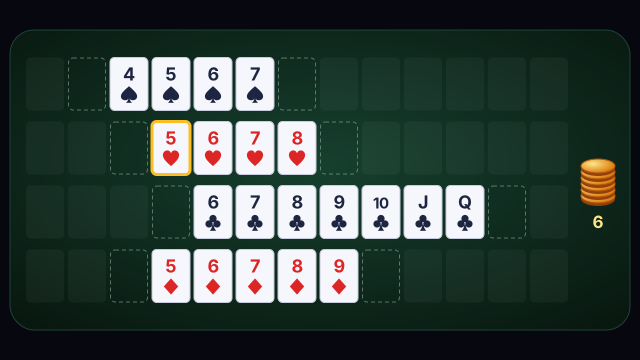
Sevens
Cards & Board
Build the rows out from the sevens and sit on the cards the others need.