Cheat
Lay your cards face down, say what they are, and catch the liars.
The bluffing card game known as Cheat in Britain and I Doubt It in the old rule books, for you and three computer players. The whole pack is dealt out, thirteen each. In turn, everyone lays one to four cards face down and says they are all of the rank whose turn it is: aces first, then twos, threes and up to kings, and round again. Nobody checks unless someone calls: when you have no card of the rank, you have to lie, and you may lie whenever you like. Call a claim and the cards are turned over. A liar takes the whole pile; if the claim was true, the caller takes it. The first to get rid of every card wins. Play an easy, medium or hard computer, and every day brings a new deal, the same for everyone.
- Category
- Cards & Board
- Modes
- Easy · Medium · Hard · Daily
- Controls
- Mouse · Touch · Keyboard
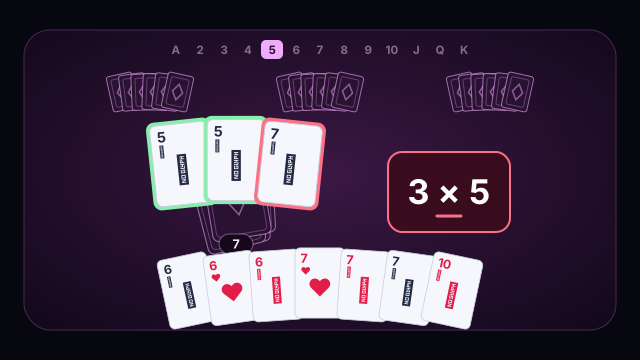
Loading…
How to play
All 52 cards are dealt out, thirteen to each of the four players, and the deal decides who lays first. The first claim is aces, the next twos, then threes and on up to kings, and then aces again: each turn says the next rank, whoever plays it. On your turn, pick one to four cards and lay them face down as the rank of the moment. They do not have to be what you say: when you hold none of the rank you must lie, and you may lie at any time. After each computer's claim you answer first, with no clock: Cheat! to call it, or Pass to let it stand. If you pass, the computers are asked in turn from the claimant's left, and the first that calls turns the cards over. Only the cards just laid are checked. If any of them is not of the rank said, the player who laid them takes the whole pile into their hand; if they all are, the caller takes it. Either way the next player says the next rank. The first player to lay their last cards and not have to take them back wins, and the game ends there: the others are placed by the cards they still hold. Your score: 300 for first place, 200 for second, 100 for third, and when you win, 3 more for each of your turns under 30.
What is Cheat?
Cheat is the bluffing card game that Britain calls Cheat and the old American rule books call I Doubt It (players at the table often call it something ruder). It needs nothing but a pack of cards and a straight face: everyone lays cards face down and says what they are, and the table decides whom to believe. Romanians know it as Trombon, the French as Le Menteur, the Spanish as Mentiroso, Italians as Dubito and Germans as Mogeln.
Here you play the classic version as Pagat gives it, with a 52-card pack and three computer players. The ranks are claimed in order, so you will often have to lie whether you want to or not. The computer comes in three strengths, and every day brings a new deal, the same for everyone.
How to play
- The deal. All 52 cards are dealt out, thirteen to each player, and the deal also decides who lays first.
- The ranks in order. The first claim is aces, the next twos, then threes and on up to kings, then aces again. Each turn says the next rank, whoever plays it. The strip along the top of the felt lights the rank of the moment and marks with a dot the ranks your next turns will ask for.
- Your claim. On your turn, pick one to four cards and lay them face down as the rank of the moment. They need not be what you say. When you hold none of the rank you must lie, and you may lie whenever you like.
- Calling. After a computer's claim you answer first, with no clock: Cheat! to call it, or Pass. If you pass, the computers are asked in turn from the claimant's left. Only the cards just laid are turned over.
- Who takes the pile. If any card turned over is not of the rank said, the player who laid it takes the whole pile into their hand. If they all are, the caller takes it. Either way, play goes on with the next player and the next rank.
- Going out. The first player to lay their last cards and not have to take them back wins, and the game ends there; the others are placed by the cards they still hold. If your last cards are a lie and someone calls it, you take the pile and play on.
- Score. 300 for first place, 200 for second, 100 for third, and when you win, 3 more for each of your turns under 30.
Strategy tips
- Lie with one card. A one-card lie is the hardest to catch; claiming three or four of a rank invites a call.
- Count the rank. If you hold three sevens, nobody can truly lay two. Your own cards in the pile count as well.
- Plan your last cards. The strip shows which ranks your next turns ask for. Keep cards of those ranks and lie with the ones you will need last, so that your final claim can be true.
- Call only what you can prove. A wrong call hands you the whole pile, and most calls on a hunch cost more than they win.
- Stop a player going out. When someone lays their last cards, a call is the last chance to stop them; but if the claim is true, you take the pile just as the game ends.
FAQ
Is Cheat free to play?
Yes. Like every game on Play, it runs free in your browser, with no download and no account needed.
Can the computer see my cards?
No. It knows only its own hand, how many cards everyone holds, the claims, its own cards in the pile, and what it saw turned over or go into a hand with a pile it took. It never sees a card laid face down by anyone else.
Who gets to call first?
The rule books leave it open, and at a real table the quickest voice wins. Here, after a computer's claim, you are always asked first and take as long as you like; if you pass, the computers answer in turn from the claimant's left, and the first to call turns the cards over.
Is this the same game as Bluff?
No. Bluff is a dice game, also known as Liar's Dice. Some tables play this card game with one rank for the whole pile, chosen by whoever starts it, or let you claim the rank above or below; here the ranks go up in order, as in Pagat's Cheat, one to four cards at a time.
Why does the game end when the first player goes out?
The first player out is the winner, and playing on for the other places would take as long again. Everyone else is placed by how many cards they still hold.
What is the daily deal?
Every day everyone gets the same deal against the same computer, so scores compare directly on the leaderboard.
More like this
Macao
Cards & Board
The Romanian card game: stack the penalties, call Macao.
Durak
Cards & Board
Beat every attack, shed your cards, and don't be the fool.
President
Cards & Board
Beat the play or pass, empty your hand first and take the top seat for the next deal.
Sevens
Cards & Board
Build the rows out from the sevens and sit on the cards the others need.