Canfield
Thirteen cards in the reserve, four piles in alternating colours, and foundations that start wherever the deal says.
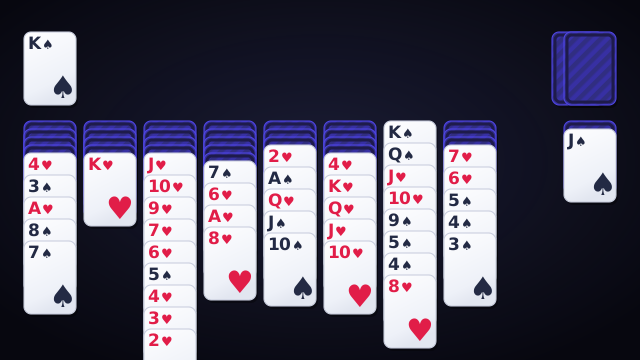
Canfield, called Demon at British card tables, is the patience of Richard Canfield's gambling house. Thirteen cards wait face down in the reserve with only the top one showing, four piles build down in alternating colours, and the foundations start from the rank of the first card dealt to them, building up in suit and turning the corner from king to ace. Free the reserve, keep the piles moving and work the stock. Three levels and, every day, a new deal that is the same for everyone.
- Category
- Cards & Board
- Modes
- Easy · Medium · Hard · Daily
- Controls
- Mouse · Touch
Loading…
How to play
Tap a card and it goes where it fits best: up to its foundation if it can, else onto a pile. Or drag it. The piles build down in alternating colours, a king going on an ace; a pile's top card moves on its own, and a whole pile moves as one, never part of it. The foundations start from the rank of the card dealt to the first one and build up in suit, the ace following the king. A pile left empty is filled at once from the reserve; once the reserve is out, a space takes the top card of the waste. Tap the stock to turn it: one card at a time on Easy, three on Medium and Hard, where only the top one plays. Turn the waste over as often as you like on Easy and Medium; Hard gives three passes and no undo. Every card home scores 5 points and a cleared table 240 more; an undo costs 5. End the game when you like to bank the cards home.
What is Canfield?
Canfield is the patience of the gambling house. It takes its American name from Richard Canfield, who ran a casino in Saratoga Springs, where, the story goes, a player bought a pack for about $50 and was paid $5 for every card that reached the foundations. In Britain the same game has long been called Demon, and it earns the name: it is one of the hardest of the classic one-pack patiences.
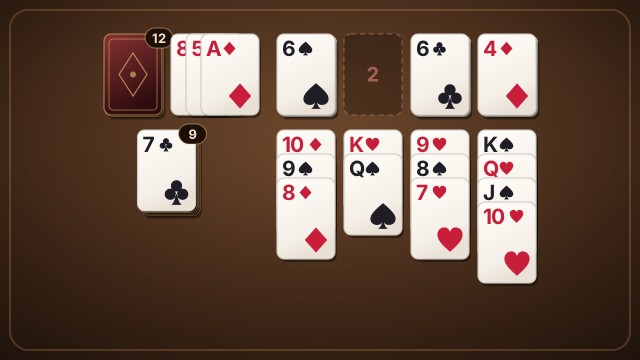
Thirteen cards are dealt face down into the reserve, and only the top one is turned up. The next card goes to the foundations, and its rank becomes the base: every foundation starts from that rank and builds up in suit, turning the corner from king to ace. Four cards start the four piles of the tableau, and the other 34 wait in the stock.
How to play
Tap a card and it goes where it fits best: up to its foundation if it can, else onto a pile. You can also drag it.
- The piles. They build down in alternating colours: a red 6 on a black 7. The ranks wrap round, so a king goes on an ace.
- What moves. The top card of a pile moves on its own, and a whole pile moves as one onto another pile. Part of a pile never moves. Nothing comes back from a foundation.
- The foundations. Each one starts with a card of the base rank and builds up in suit, the ace following the king.
- The reserve. Only its top card plays, onto a foundation or a pile. A pile left empty is filled at once from the reserve.
- Spaces. Once the reserve is out, an empty pile waits for you and takes the top card of the waste.
- The stock. Tap it to turn cards onto the waste; only the top card of the waste plays. Tap the empty stock to turn the waste over for another pass.
- Levels. Easy turns one card at a time, with as many passes and undos as you like. Medium turns three at a time, with as many passes as you like and undo: the book rules, and the daily deal plays by them. Hard turns three at a time, gives three passes in all and no undo.
- The end. Once every card left can go home by turning the stock and sending cards up, they fly home on their own. The game also ends when no move is left, or when you end it yourself.
Strategy tips
- Empty the reserve first. The reserve is where games are lost: every card it gives up is a card that was blocking you. Play its top card whenever it can go somewhere.
- Make spaces on purpose. Moving a whole pile onto another one leaves a space that the reserve fills at once, which is the quickest way to dig into it.
- Do not rush to build the foundations from the piles. A card on a pile can still take a card from the reserve; once it is home it cannot. Send cards up when they free something.
- Learn the stock. With three cards a turn, the same cards come up on every pass until you play one. Playing a waste card shifts every group of three behind it, so one play can bring a whole new set of cards within reach.
- Count your passes on Hard. With three passes, plan which waste cards you need before you turn the stock for the last time.
FAQ
Is Canfield free to play?
Yes. Like every game on Play, it runs free in your browser, with no download and no account needed.
Can every deal be won?
No, and many cannot. With three cards a turn even strong players win only a minority of deals, which is why every card home scores on its own. Easy, with one card a turn, is far kinder.
Why do the foundations not start with the aces?
That is Canfield's twist: the first card dealt to the foundations sets the base, and the other three foundations start with the other cards of that rank. A deal whose base is a 9 builds 9, 10, jack, queen, king, ace, 2 and so on up to 8.
What is the daily deal?
Every day everyone gets the same deal, played by the Medium rules, so scores compare directly on the leaderboard.
How is my score counted?
Every card on the foundations is worth 5 points, the base card included, and clearing the table adds 240, for 500 in all. Each undo costs 5 points. Higher is better.