Word Grid
Trace fast. Spark a lexicon.
Race a 60-second neon word hunt. Link neighboring letters in any direction, uncover exact dictionary words and keep the streak alive for escalating combo points.
- Category
- Puzzle & Brain
- Modes
- Solo · Daily
- Controls
- Touch · Mouse · Keyboard

Loading…
How to play
Drag across adjacent letters horizontally, vertically or diagonally without using a cell twice. Release to submit a word of three or more letters. Exact dictionary words score by length and rare letters; every new word builds a combo. Find as many as you can before the one-minute timer ends.
What is Word Grid?
Word Grid is a fast word-hunt puzzle played on a 4×4 field of neon letters. Every round lasts exactly 60 seconds. Trace through neighboring cells to build words, then release to submit. Letters may connect horizontally, vertically or diagonally, but a single path can never reuse the same cell.
The board is generated deterministically from the session seed. Solo runs stay varied, while everyone receives the same layout in the daily challenge. Every generated layout is drawn from a curated set with multiple guaranteed words, then rotated or reflected without changing which paths remain possible.
How to play
- Touch: press a letter, drag through adjacent cells and lift your finger to submit.
- Mouse: click and hold, trace the path, then release.
- Keyboard: move focus with the arrow keys, press Space to add a cell, Backspace to undo and Enter to submit. Escape clears the current path.
- Words must contain at least three letters and match the embedded English dictionary exactly.
- You can move in all eight directions, including diagonals.
- A cell can appear only once in the same word. Dragging back to the previous cell cleanly undoes the last step.
- Duplicate words do not score. The round ends when the one-minute timer reaches zero.
Scoring
Longer words are worth substantially more than short ones: three-letter finds start at 100 points, while six-, seven- and eight-letter paths climb sharply. Rare letters such as Q, Z, J and X add an extra bonus.
Every accepted new word also advances the live combo, up to five steps. Each step adds another 15% to that word's value, so a steady stream of valid finds is the fastest route to a high score. Invalid and duplicate attempts never enter the replay trace and never change the score.
Strategy tips
- Scan for endings first. Common endings such as -ING, -ER and -ED can turn one visible stem into several finds.
- Use diagonals deliberately. The strongest words often zigzag rather than following a straight row.
- Bank obvious words early. A quick opening chain raises the combo before you attempt longer searches.
- Backtrack instead of restarting. Sliding back over the previous letter removes it, which makes correcting the final turn much faster on touch screens.
- Watch rare letters. A short word containing Q or Z can rival a much longer common word.
Daily challenge
Daily mode uses the platform's shared seed, so the board, orientation transform and available words are identical for every player that day. The pure rules engine validates every submitted path and reconstructs the final score from the seed and timestamped input trace.
FAQ
Does any traceable letter sequence count?
No. Word Grid validates the complete sequence against its curated embedded dictionary. Random substrings and partial words are rejected even when the letters are adjacent.
Can I cross my own path?
The line may cross visually, but each cell can be used only once per submitted word. Re-entering an older cell is ignored; returning to the immediately previous cell acts as undo.
Does the layout work in landscape?
Yes. Phones in portrait use a stacked board and compact discovery log. Landscape and desktop layouts place the log beside the board, and every interactive cell remains at least 44 pixels across.
Is pausing fair?
Yes. The game uses the platform's pause-adjusted logical clock. Host modals and tab pauses freeze both the countdown and input until play resumes.
More like this

Aetherward
Puzzle & Brain
Six realms. Thirty roads. One last light.
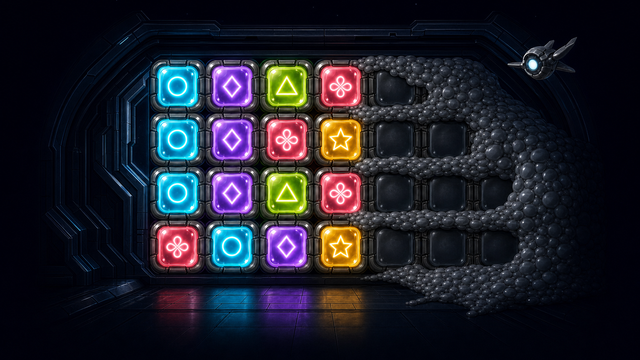
Trilume
Puzzle & Brain
The repair swarm finishes every room it touches. Finished means gray. Three lights in a line burn it back.

Clavis
Puzzle & Brain
Painted rooms, real locks, one way out.
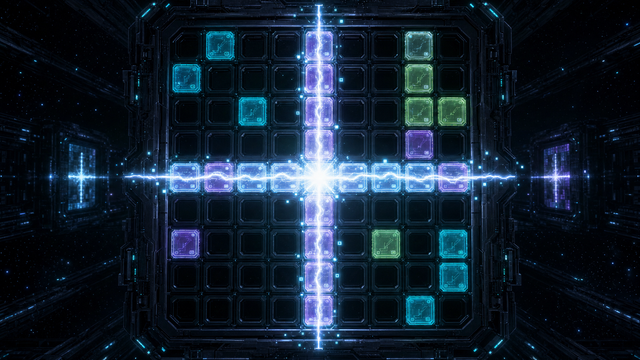
Blackstart Block Puzzle
Puzzle & Brain
Seat three modules, close a circuit, relight the corridor.