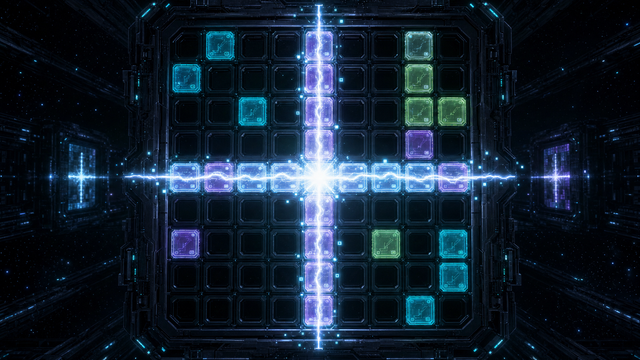
Trilume
The repair swarm finishes every room it touches. Finished means gray. Three lights in a line burn it back.
A swap match-3 campaign aboard a ship being repaired to death. Resonate three light-cells, forge lances, nodes, seekers and prisms, and reclaim the ship deck by deck from its own maintenance swarm.
- Category
- Puzzle & Brain
- Modes
- Campaign · Surge · Daily
- Controls
- Mouse · Touch

Loading…
How to play
Swap two neighbouring cells to line up three of the same light. Four in a line forges a lance, a 2x2 square wakes a seeker, an L or T builds a node, five in a line makes a prism. Swap two specials together for their combined discharge. Clear the goal before the moves run out.
What is Trilume?
A long-haul ship's repair swarm was given one last order by its dying keeper: preserve everything, forever. It obeyed. To a swarm, preserved means permanent, and permanent means inert: deck by deck it has been finishing the ship into smooth gray silence. You are the keeper who woke up to what is left. Your instrument is the light lattice, the ship's power grid: a board of glass cells in five spectral lines. Three cells of one line brought together resonate and discharge, feeding the reclamation systems and burning the gray back. Trilume is a swap match-3 in the tradition Candy Crush made famous, rebuilt for the browser around a harder story: forty authored sections across five decks, a daily board shared by every player, and a score-attack lane where nothing matters but the cascade.
How to play
- Swap: drag or tap two neighbouring cells to trade places. The swap must resonate (line up three) or wake a special, or it politely refuses.
- Forge: four in a line makes a lance that clears its row or column; a 2x2 square wakes a seeker that hunts your objective; an L or T of five builds a node that detonates twice; five in a line folds into a prism that consumes a whole spectral line.
- Combine: swap two specials into each other for their coupled discharge. Every pair has one, and every pair is worth more than its parts. Two prisms clear the entire board.
- Clear the goal: burn the film, collect the lines, carry the stasis cores home, contain the bloom. The moves counter is the only clock; when the goal closes with moves to spare, the lattice converts every one of them into fireworks and score.
The lattice
- Five lines: cyan ring, violet diamond, lime triangle, rose flower, gold star. Every cell wears its glyph, so no two lines can be confused, whatever your eyes make of the colors.
- The film is the swarm's thinnest work: a membrane over live cells. Resonate on top of it to peel it, twice where it is doubled.
- Plates are finished surfaces: gray, layered, deaf. Matches beside them crack a layer at a time.
- The bloom grows two cells for every move that does not wound it, and its rooted sources reseed a cleaned board. Burn it first or budget for the loss.
- Quarantine shells cage a cell that can still resonate: the cage breaks, the light survives. Overload cells count down your moves and fail the deck at zero. Conduits teleport falling light between board regions, and the capacitor rings of the last deck pay a full-board discharge for eight patient hits.
Strategy tips
- Work low. Matches at the bottom of the board tumble everything above them, and the cascades that follow are where the score lives.
- Read the refill. The lattice leans toward the lines already on the board. A board rich in gold wants to give you more gold: set your traps accordingly.
- Park your specials. Two specials fired apart are two small moments. Spend the extra move to bring them side by side and the coupled discharge repays it three times over.
- Point your lances. A four-match made by a sideways swap fires along the row; made by a vertical swap, along the column. Aim before you forge.
- Save nothing on the last move. A win on the exact final move is an Overload: every special left on the board detonates at double value. The tightest clears are the loudest.
FAQ
Is Trilume free?
Yes. Every game on Play is free in the browser, no download, no install, no lives, no timers, no purchases.
Does the Daily Lattice use the same board for everyone?
Yes. The daily board is minted from the day's seed, so every player faces the identical section with the identical refills. The leaderboard compares nothing but play.
What counts as a good score?
Clearing a campaign section with two stars means you are keeping pace. Three stars on the late decks, or a Surge run past fifty thousand, is keeper's work.
How do the stars work?
Stars are score thresholds measured per section: the deeper your cascades and the tighter your clears, the more of the ship lights up on the deck map. Three stars on all forty sections relights every deck.