Pentominoes
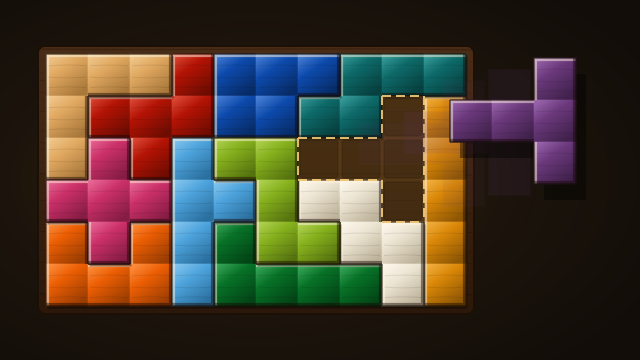
Twelve wooden pieces of five squares. Fill the board, every square, no gaps.
The classic pentomino puzzle: the twelve shapes made of five squares joined edge to edge, named after the letters they look like, F, I, L, N, P, T, U, V, W, X, Y and Z, and a board to fill with them exactly, each piece used once and none on top of another. Easy hands you a small board and four to six pieces. Medium gives you eight to ten pieces for a board they fill in only one way, or one of the big twelve-piece boards with a few pieces already pinned in place. Hard is the real thing: all twelve pieces on the 6 by 10 rectangle, the 5 by 12, the 4 by 15, the 3 by 20 (only two solutions) and the 8 by 8 square with four squares left out, in the centre or elsewhere. A new medium board every day, the same for everyone.
- Category
- Puzzle & Brain
- Modes
- Easy · Medium · Hard · Daily
- Controls
- Mouse · Touch · Keyboard
Loading…
How to play
Drag a piece from the tray onto the board: the squares where it would land light up, and it snaps into the grid when you let go. You can also tap a piece in the tray to pick it and then tap a square on the board to lay it over that square. Turn gives the piece you picked a quarter turn clockwise and Flip mirrors it, in the tray or on the board. Tap a piece on the board to take it back to the tray. The board is done when every square is covered. Clear sends every piece back to the tray, and a hint (three per board) lays one piece where it belongs. Your score is your time from the first move plus 30 seconds for every hint. Lower is better.
What are Pentominoes?
A pentomino is a shape made of five squares joined edge to edge. There are exactly twelve of them, if a shape turned over or turned round counts as the same one, and each is named after the letter it looks like: F, I, L, N, P, T, U, V, W, X, Y and Z. Together they cover sixty squares, and the puzzle is always the same: fill a board exactly, every square covered, each piece used once, none on top of another.
The name comes from the American mathematician Solomon W. Golomb, who began writing about these shapes in 1953 and made up the word from the Greek pente, five, and domino. Martin Gardner's Mathematical Games column in Scientific American brought them to a wide public, but the pieces are older than their name: the earliest full set of twelve appeared in Henry Dudeney's book The Canterbury Puzzles in 1907.
The big rectangles are the classics. The 6 by 10 can be filled in 2,339 different ways, the 5 by 12 in 1,010, the 4 by 15 in 368, and the long 3 by 20 in only two, not counting a solution turned or mirrored as a new one. The 8 by 8 square with a 2 by 2 hole in the centre has 65 solutions; Dana Scott solved it by computer as early as 1958.
How to play
Fill every square of the board with the pieces in the tray.
- Drag a piece from the tray onto the board. The squares where it would land light up, and it snaps into the grid when you let go. Dropped where it does not fit, it goes back.
- Tap to lay. Tap a piece in the tray to pick it, then tap a square on the board: the piece is laid over that square, in the nearest place it fits.
- Turn and Flip. Turn gives the piece you picked a quarter turn clockwise; Flip mirrors it. Both work in the tray and on the board.
- Take a piece back. Tap a piece on the board to send it back to the tray, still picked, or drag it onto the tray.
- Pinned pieces. Some medium boards start with a few pieces pinned in place. They cannot move; fill the rest with the others.
- On a keyboard, move to a piece with Tab: Enter picks it (or takes it off the board), R turns it, F flips it, the arrow keys lay it and move it, and Delete sends it back.
- Levels. Easy is a small board with four to six pieces. Medium is eight to ten pieces that fill their board in only one way, or a twelve-piece board with some pieces pinned. Hard is all twelve pieces on the classic boards.
- Clear and Hint. Clear sends every piece back to the tray. A hint lays one piece where it belongs, three per board, for 30 seconds each on your score.
- Score. Your time from the first move, plus 30 seconds for every hint. Lower is better.
Strategy tips
- Mind the corners. Every corner of the board must be covered, and the X is the one piece that never can. Settle the corners early with pieces that sit well there, such as the L, the V, the U and the P.
- Place the X early. It has only one shape, it cannot fill a corner, and it leaves awkward notches beside it. Find its spot first and the other pieces follow.
- Count the gaps. A closed-off space whose number of squares is not a multiple of five can never be filled. When a gap of 4, 6 or 7 squares appears, something is already wrong, so move a piece now rather than later.
- Keep the long pieces for the edges. The I and the L run neatly along a side; in the middle of the board they tend to cut it into pieces no other shape can fill.
- On the big boards, build from one end. Fill the board column by column from one short side, keeping the edge of what is left as straight as you can.
FAQ
Is Pentominoes free to play?
Yes. Like every game on Play, it runs free in your browser, with no download and no account needed.
Can every board be solved?
Yes. Every board here was made from a known solution and checked by a computer search. Many boards can be filled in more than one way, and any way that covers every square counts.
What does a hint do?
It lays one piece where it belongs. The game first looks for a way to finish the board that keeps every piece you have laid; if there is none, it lays the next piece of its stored solution and sends back any piece in the way. You get three hints per board, and each adds 30 seconds to your score.
What is the daily board?
Every day everyone gets the same medium board, so times compare directly on the daily leaderboard.
More like this
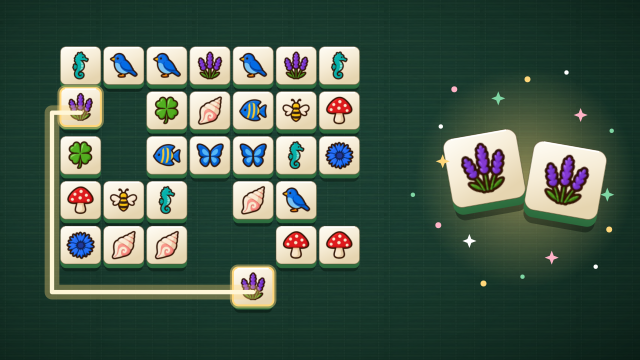
Linked Pairs
Puzzle & Brain
Link two alike tiles with a path of up to two turns, and clear the board.
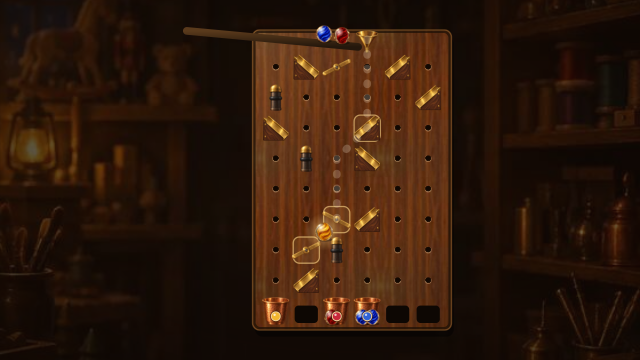
Marble Gates
Puzzle & Brain
Set ramps and flip gates so every glass marble rolls into a cup of its own colour.

Maze Sprint
Puzzle & Brain
Read the grid. Break the clock.
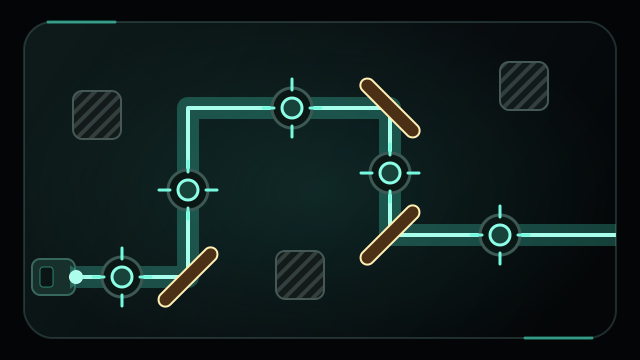
Laser Mirrors
Puzzle & Brain
Bend the beam. Wake every node.