Marble Gates
Set ramps and flip gates so every glass marble rolls into a cup of its own colour.
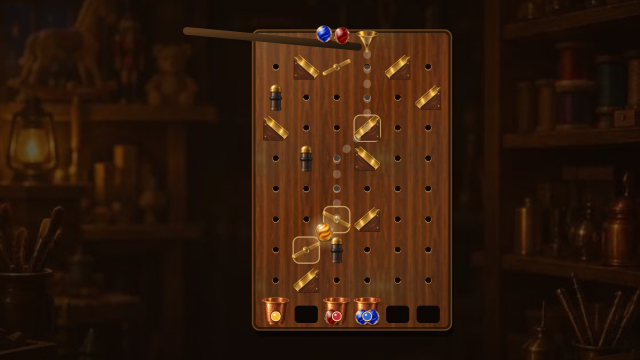
A marble machine puzzle on a walnut pegboard. Glass marbles fall a row at a time through brass ramps, flip gates that tip over after every marble, and iron stops, down into a row of copper cups. Set the pieces from your tray into the free holes, choose which way every gate starts, and run the machine until each marble lands in a cup of its colour. Every board is generated and checked by a solver, which proves it needs every piece in the tray except the one spare on Hard and Daily boards. Three levels, from 5 by 6 to 7 by 9 holes, plus a Daily board that is the same for everyone.
- Category
- Puzzle & Brain
- Modes
- Easy · Medium · Hard · Daily
- Controls
- Mouse · Touch · Keyboard
Loading…
How to play
Tap a ramp or gate in the tray, then tap a free hole to set it there; it starts pointing left. Tap a piece of yours to turn it right, and tap it again to take it back. Tap a gate on the board to choose which way it starts. Press Run: the marbles drop in order, one row at a time, and every gate flips after each marble passes. If a marble lands in the wrong cup, falls where there is no cup or jams, the run stops on it; change the board and run again. Your score is the time from your first move to the run that works, plus 20 seconds for every run that missed and 30 seconds for every hint. Lower is better.
What is Marble Gates?
Marble Gates is a marble machine puzzle. It takes its idea from the mechanical marble computers sold as teaching toys in the 1960s, where balls rolling down a sloping board flip little levers and so count, sort and add. Here the board is a walnut pegboard standing upright, and the job is simpler to say than to do: every glass marble has to end up in a copper cup of its own colour.
The marbles wait on a rail above the board and drop through a brass funnel one at a time, falling a row at each step. In every hole a marble meets one of four things. An empty hole lets it fall straight down. A brass ramp sends it one column over, the way the ramp slants. A flip gate also sends it one column over, the way the gate points, and then tips over, so the next marble through it goes the other way. An iron stop blocks the hole: a marble sent into it jams there, and so does a marble sent off the side of the board.
Every board is original and is generated for the game you start. A generator builds a whole machine, runs the marbles through it and paints each cup the colour of the marbles that land there, then takes a few pieces out and puts them in your tray. A solver then searches every way of setting those pieces and the gates, and keeps the board only if it needs every piece taken out. Easy boards are 5 columns by 6 rows with two colours, four marbles and two pieces in the tray. Medium boards are 6 by 8 with three colours, six marbles and three pieces. Hard boards are 7 by 9 with three or four colours, eight marbles, four pieces and one spare that the solution does not need. The Daily board, the same for everyone, is 6 by 8 with three colours, seven marbles, three pieces and a spare.
How to play
Get every marble into a cup of its colour.
- Set a piece. Tap a ramp or a gate in the tray, then tap a free hole. The piece starts pointing left.
- Turn or take back. Tap a piece you set to turn it to the right. Tap it again to take it back to the tray.
- Set the gates. Tap any gate on the board to choose which way it starts. Ramps and stops that came with the board stay as they are.
- Run. Press Run and the marbles drop in order, the gates flipping as each one passes. If every marble lands in its own colour, the board is solved.
- A miss. If a marble lands in a cup of another colour, falls where there is no cup or jams, the run stops on it. The marble is ringed in red and its path stays drawn on the board, so you can see where it went. Change something and run again; the same board cannot be run twice in a row.
- Hint. A hint sets one piece or gate of a solution and rings it in blue. That piece stays. Each hint adds 30 seconds to your score.
- On a keyboard, the arrow keys pick a hole, Enter sets or turns a piece and R runs the machine.
- Score. Your time from the first move to the run that works, plus 20 seconds for every run that missed and 30 seconds for every hint. Lower is better.
Strategy tips
- Read the queue first. The order of the colours on the rail is everything. A gate at the inlet deals marbles out left and right in turns, so two colours that alternate on the rail want a gate near the top.
- Work backwards from the cups. Find the cup each colour must reach and trace which holes can still lead there. A marble moves at most one column per row, so a cup far to the side has to be steered towards early.
- Count the passes through each gate. A gate flips after every marble that goes through it, not after every marble in the run. Follow the marbles one by one and note which way each gate points when the next one arrives.
- Use the failed run. The red path shows exactly where the lost marble went wrong, and every marble before it landed well. Fix the first wrong turn, not the last.
- Not every piece has to be used on Hard. Hard and Daily boards come with one spare piece. Solving without it earns an achievement.
FAQ
Is Marble Gates free to play?
Yes. Like every game on Play, it runs free in your browser, with no download and no account needed.
Can every board be solved?
Yes. Every board was built from a working machine, and a solver checks each one and proves that it can be solved with the pieces in the tray, and that it needs every one of them except the spare.
Why did my run stop?
A run stops on the first marble that misses: one that lands in a cup of another colour, falls into a column with no cup, runs into a stop or rolls off the side of the board. The marbles after it are not dropped.
Do the gates keep their flips after a run?
No. After every run the gates go back to the way you set them, so each run starts from the same machine.
What is the Daily board?
Every day everyone gets the same board, 6 columns by 8 rows with three colours, seven marbles and a spare piece, so times compare directly on the daily leaderboard.