Laser Mirrors
Bend the beam. Wake every node.
Rotate warm-glass mirrors inside a dark optical lab and route one electric beam through every target. Six deterministic circuits grow from a clean two-turn lesson into a dense six-mirror switchback.
- Category
- Puzzle & Brain
- Modes
- Solo · Daily
- Controls
- Mouse · Touch · Keyboard
Loading…
How to play
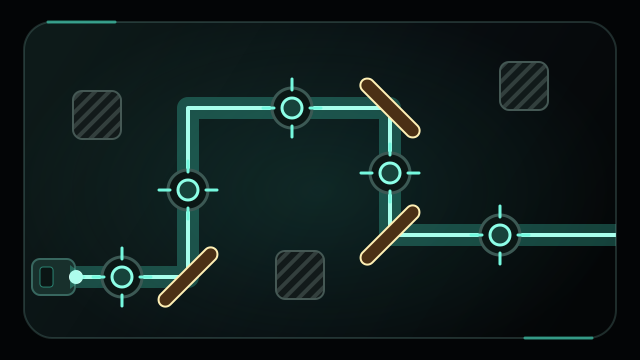
Tap or click a mirror to rotate it between slash and backslash. The beam redraws instantly. Light every circular target and send the beam safely out of the grid to lock the circuit. Complete all six stages; extra rotations and time reduce your score. Keyboard players can Tab between mirrors and press Enter or Space.
What is Laser Mirrors?
Laser Mirrors is a compact optical-routing puzzle played inside a neon-dark beam lab. One laser source fires continuously across the board. Your job is to rotate the amber mirrors until that single beam passes through every circular target and leaves the grid safely. A slash mirror and a backslash mirror bend light in different directions, so one rotation can redirect the entire downstream circuit.
The campaign contains six deterministic stages. The opening board teaches the two mirror angles; later circuits layer longer switchbacks, more targets and beam absorbers into seven-by-seven labs. The same actions always produce the same route, and the submitted input trace is replayed by the score server. Daily mode therefore gives everyone the same optical problem and the same scoring rules.
How to play
- Mobile: tap any amber mirror tile to rotate it between
/and\. Every mirror has a full-cell touch target, and the laser redraws immediately. - Desktop: click a mirror, or use Tab to move focus between mirrors and Enter or Space to rotate the focused one.
- A circular node glows mint when the beam reaches it. Light every node and make sure the beam exits the board; a path ending in an absorber or an optical loop does not solve the circuit.
- Complete all six stages to submit a score. Each stage is worth up to 4,200 points. Extra rotations cost efficiency points, while a fast alignment earns a speed bonus.
Strategy tips
- Work backward from the exit. The final mirror has only one angle that can send the beam toward the open edge. Lock that angle mentally, then solve the segment before it.
- Read one turn at a time. For a beam travelling right,
/sends it up and\sends it down. Rotate the board in your head instead of memorizing all eight cases. - Watch the lit-node count. A longer beam is not automatically better. The node counter tells you whether a new route added useful coverage or only wandered through empty cells.
- Break loops at their earliest corner. If the status reports an optical loop, change the first mirror where the route revisits an old corridor. Downstream rotations may never receive light.
- Solve before optimizing. Your first campaign teaches the route. On the next run, reproduce it with one rotation per misaligned mirror and chase the speed bonus.
FAQ
Why did the beam touch every node but not clear the stage?
The circuit must also terminate safely. A beam caught in a closed loop or swallowed by an absorber is unstable, even if it passed through the targets first. Reorient the final section so the line leaves the grid.
How is the score calculated?
Every stage starts with 3,000 efficiency points and up to 1,200 speed points. Rotations beyond the shortest alignment reduce the efficiency portion, and time gradually consumes the speed bonus. Six perfect stages total 25,200 points.
Is the puzzle deterministic?
Yes. Board layouts, starting mirror angles, tracing, collisions, loop detection and scoring are pure deterministic logic. A replay with the same actions and logical timestamps produces the same final state hash and score.
Does the game work in landscape?
Yes. The lab measures the available game viewport and scales the circuit to fit without document scrolling. Portrait phones, landscape phones and desktop takeover mode all use the same readable controls.
More like this

Aetherward
Puzzle & Brain
Six realms. Thirty roads. One last light.
Trilume
Puzzle & Brain
The repair swarm finishes every room it touches. Finished means gray. Three lights in a line burn it back.
Clavis
Puzzle & Brain
Painted rooms, real locks, one way out.
Blackstart Block Puzzle
Puzzle & Brain
Seat three modules, close a circuit, relight the corridor.