French Tarot
France's great 78-card game: bid against three computers, take the dog and bring the petit home.
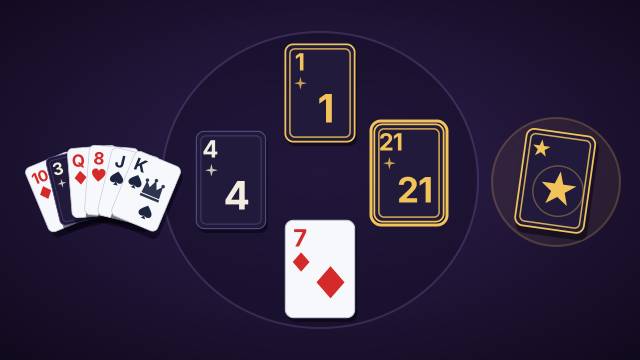
French Tarot as the Fédération Française de Tarot plays it: four players, a pack of 78 cards with 21 numbered trumps and the Excuse, and on every deal one player alone against the other three. Everyone bids in turn for the right to play alone, from a petite to a garde contre le chien; on a petite or a garde the taker turns the dog over, takes it, puts six cards aside and must then reach a target set by the oudlers they win: the 1 and the 21 of trumps and the Excuse. Eight deals against three computer players on three levels, each for themselves, and every day a Daily Tarot with the same deals for everyone.
- Category
- Cards & Board
- Modes
- Easy · Medium · Hard · Daily
- Controls
- Mouse · Touch · Keyboard
Loading…
How to play
Each player gets 18 cards and six go to the dog. Starting on the dealer's right, everyone bids once, higher than before or not at all: petite (×1), garde (×2), garde sans le chien (×4) or garde contre le chien (×6). If all four pass, the next player deals. On a petite or a garde the dog is shown and taken, and the taker puts six cards aside, never a king or an oudler; on a garde sans the dog counts for the taker unseen, on a garde contre for the defence. Follow suit; if you cannot, you must trump, going over the highest trump already played if you can, and when trumps are led you must play higher if you can. The Excuse can be played at any time and stays with its side. Kings and oudlers count 4.5, queens 3.5, knights 2.5, jacks 1.5 and every other card 0.5: 91 in all. The taker needs 56 points with no oudler, 51 with one, 41 with two and 36 with all three. A deal scores 25 plus the points over or under, plus or minus 10 for the petit au bout (the 1 in the last trick), times the contract, and the taker wins or pays that to each defender. After eight deals the highest total wins; your score is 2000 plus your total.
What is French Tarot?
French Tarot is the great card game of France, played in clubs and tournaments and around kitchen tables from Brittany to Provence. Four players share a pack of 78 cards: four suits of fourteen, with a knight between the queen and the jack, 21 trumps numbered from 1 to 21, and the Excuse, a card that excuses you from following suit. On every deal one player bids to play alone against the other three, and the three oudlers, the 1 of trumps (the petit), the 21 and the Excuse, decide how many points that player needs.
Here you play the four-player game of the Fédération Française de Tarot against three computer players on three levels, each player for themselves. A game is eight deals, so everyone deals twice, and every day brings a Daily Tarot with the same deals for everyone.
How to play French Tarot
Each player gets 18 cards, three at a time, and six cards go face down to the dog. Bidding, dealing and play go anticlockwise, starting on the dealer's right.
- Bidding. Each player speaks once, in turn: pass, or bid higher than anyone before. The contracts, from the lowest, are petite (×1), garde (×2), garde sans le chien (×4) and garde contre le chien (×6). If all four pass, the next player deals again. A player dealt the 1 of trumps as their only trump, without the Excuse, holds the petit sec, and the deal is cancelled.
- The dog. On a petite or a garde the dog is turned over for everyone to see and the taker takes it, then puts six cards aside: never a king or an oudler, and trumps only when there is no other way, shown to all. On a garde sans the dog stays face down and counts for the taker; on a garde contre it counts for the defence.
- Following. You must follow the suit led. If you cannot, you must trump, and go over the highest trump already in the trick if you can, even your partner's; if you cannot go over, you still play a trump. When trumps are led, play a higher trump if you can. With neither the suit nor a trump, play anything.
- The Excuse. You may play it at any time; it never takes the trick, but it stays with your side, which gives the winners a half-point card for it. Played to the last trick it changes sides, unless it is led to the last trick by a side that has taken all the others: then it takes that trick.
- Counting. Kings and oudlers count 4.5, queens 3.5, knights 2.5, jacks 1.5 and every other card 0.5: 91 points in the pack. The discard counts for the taker. The taker needs 56 points with no oudler, 51 with one, 41 with two and 36 with all three.
- Scoring. A deal is worth 25 plus the points over or under the target, plus 10 for the side that wins the last trick with the petit in it (the petit au bout), all times the contract. The taker wins that from each defender or pays it to each, so the taker scores three times as much. A side that takes every trick adds a chelem, 200.
After eight deals the highest total wins. Your score for the leaderboard is 2000 plus your total. Poignées (showing ten trumps or more) and announced chelems are left out here.
Tips and strategy
- Count the oudlers before you bid. The 21 and the Excuse are sure points and lower your target; a petit without trumps around it is a liability. Five or six trumps are the least you want to take on.
- Make voids with your discard. Putting a short suit aside lets you ruff it with small trumps; queens and knights you would lose are worth discarding too, since the discard counts for you.
- Save your petit. Play it when it can take the trick, typically trumping last when nobody behind you has a trump, or under a partner's high trump the taker cannot beat. Kept to the end, it is usually caught by the 21.
- Load your partners' tricks. In defence, when a partner is sure to win a trick, throw your kings and queens on it. When the taker wins, give as little as you can.
- Use the Excuse to save a king. On a trick you are going to lose, the Excuse keeps your king or your petit at home. Never hold it for the last trick.
Frequently asked questions
Is French Tarot free?
Yes. Like every game on Play, it runs free in your browser, with no download and no account.
Which rules does this French Tarot follow?
The rules of the Fédération Française de Tarot for four players: one bid each, the petite, garde, garde sans and garde contre, the dog and the discard, compulsory trumping and over-trumping, the Excuse, the petit au bout, the petit sec and the unannounced chelem. Poignées and announced chelems are left out to keep the game quick on a phone.
What are the oudlers?
The 1 of trumps (the petit), the 21 and the Excuse. Each counts 4.5 points, and the more of them the taker wins, the fewer points they need: 56 with none, 51 with one, 41 with two, 36 with all three.
What is the petit au bout?
Winning the last trick with the 1 of trumps in it. The side that does scores 10 more, multiplied by the contract, whether or not the contract is made. As the taker it is the bravest finish in the game.
What happens to the Excuse?
It can be played at any time and never wins a trick, except when a side that has taken every other trick leads it to the last one. It goes back to its own side, which gives the winners a low card in exchange, so the Excuse almost always keeps its 4.5 points. Played to the last trick, it goes to the other side.
How do the levels differ?
On Easy the computer bids on a rough count, overbids now and then and often plays whatever comes to hand. On Medium it counts its hand and plays by the rules club players know. On Hard it also tries its bids, its discard and its cards out in imagined deals of the cards it has not seen. The computer never looks at your cards, at another hand or at a hidden dog.
What is the Daily Tarot?
Every day everyone plays the same deals on Medium, so scores compare directly on the leaderboard.
More like this
Septica
Cards & Board
Cut with a seven, collect the aces and tens.
Sixty-Six
Cards & Board
Meld king and queen, close the talon, reach 66 first.
Pinochle
Cards & Board
Two-handed Pinochle: meld marriages, runs and the pinochle, then play out the tricks to 1000.
Cruce
Cards & Board
Bid your points, name trumps with your first card, show 20 and 40.