Spades
Bid your tricks with your partner and make them: spades are always trumps, and the first side to 500 wins.
Spades, the great American partnership card game, with a computer partner against two computer opponents. Everyone bids how many tricks they will take, the two bids of a side add up to its contract, and spades always trump. Make the contract to score, but every ten overtricks cost a hundred; bid nil and take no tricks at all for a hundred more. The first side to 500 wins. Every day brings a Daily Spades, the same deals for everyone.
- Category
- Cards & Board
- Modes
- Easy · Medium · Hard · Daily
- Controls
- Mouse · Touch · Keyboard
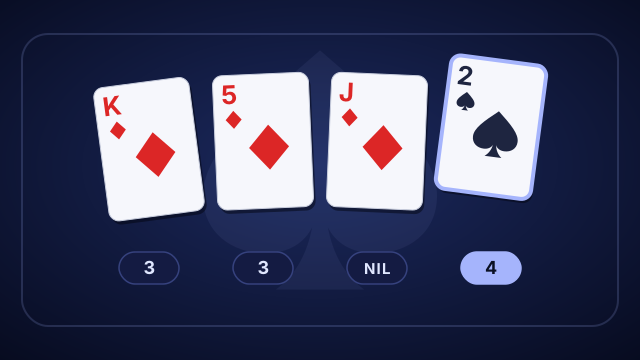
Loading…
How to play
You and your partner sit across from each other against the two computers on your left and right, and everyone gets thirteen cards from the full pack. Starting left of the dealer, each player bids how many tricks they will take, from nil (no tricks at all) to thirteen, and a side's two bids add up to its contract. The player left of the dealer leads. Follow the suit led if you can; if you cannot, play anything. Spades are always trumps: the highest spade takes the trick, or with no spade in it the highest card of the suit led, and the winner leads next. You may not lead a spade until one has been played on another suit, unless you hold nothing but spades. Make your contract and your side scores 10 for each trick bid plus 1 for each trick over, called a bag; fall short and it loses 10 for each trick bid. Every ten bags cost 100. A nil scores 100 on its own, or loses 100 if the nil bidder takes a trick. The first side to 500 wins, and a side that falls to −200 loses.
What is Spades?
Spades is the great American partnership card game: four players, two sides of two, partners sitting across from each other, and spades always trumps. It grew up in the United States in the 1930s, spread with the soldiers of the Second World War, and is still played everywhere from kitchen tables to college dorms. What sets it apart is the bid: before a card is played, everyone says how many tricks they will take, and your side must then take at least that many together.
Here you play with a computer partner against two computer opponents, on three levels. The game runs deal after deal until a side reaches 500 points. Every day brings a Daily Spades, with the same deals for everyone.
How to play Spades
The full pack of 52 cards is dealt, thirteen each, and the deal passes to the left every hand.
- Bidding. Starting left of the dealer, everyone bids how many tricks they will take, from one to thirteen, or nil: no tricks at all. Your bid and your partner's add up to your side's contract.
- Tricks. The player left of the dealer leads. Follow the suit led if you can; if you cannot, play anything. The highest spade takes the trick, or with no spade in it the highest card of the suit led, and the winner leads next.
- Breaking spades. You may not lead a spade until one has been played on a trick led in another suit, unless you hold nothing but spades.
- The contract. Make it and your side scores 10 for each trick bid plus 1 for each trick over. Fall short and it loses 10 for each trick bid.
- Bags. Every trick over the contract is a bag. Bags add up from deal to deal, and every ten of them cost 100 points.
- Nil. A nil scores 100 if the nil bidder takes no trick and loses 100 if they take one. The partner's bid is scored on its own; the nil bidder's tricks do not count toward it but do count as bags.
- The end. The first side to 500 wins. A side that falls to −200 loses. If both sides pass 500 on the same deal, the higher score wins; a tie plays another deal. Your score is your side's total when the game ends.
This game follows the standard rules on pagat.com. It leaves out blind nil, lets both partners bid nil (each scored on its own), and adds the common −200 rule so a game cannot run away.
Tips and strategy
- Count your sure tricks. Aces, kings with a small card beside them, the top spades and long spades take tricks; a short side suit lets your spades ruff. Bid what you count: a bag costs far less than a contract that fails.
- Duck once you have made it. With the contract in, play under the trick and throw your high cards when you are out of a suit, or the bags pile up.
- Go for the set. When the other side needs nearly every trick that is left, take every trick you can: their contract is worth more to them than your bags cost you.
- Pick a nil hand with care. No high spades, few spades and low cards in every suit make a good nil. When your partner bids nil, play high so they can play under you.
- Break the other side's nil. Lead low cards in a suit the nil bidder still holds, and never take a trick off a nil bidder who is winning it.
Frequently asked questions
Is Spades free?
Yes. Like every game on Play, it runs free in your browser, with no download and no account.
Why can I not lead a spade?
Spades are not broken yet: no one has played a spade on a trick led in another suit. Until then you must lead another suit, unless you hold only spades.
What are bags?
Bags are the tricks your side takes over its contract. Each one is worth a point, but every ten your side collects cost 100, so bidding too low is not free.
How does nil work with my partner's bid?
They are scored separately. A nil wins or loses 100 on its own, and your partner's bid must be made with your partner's own tricks. If the nil bidder takes tricks, they count as bags for the side.
Which rules does this version use?
The standard rules on pagat.com: the player left of the dealer leads any card but a spade, spades are broken by the first spade played on another suit, a contract pays 10 a trick and 1 a bag, ten bags cost 100, and nil is worth 100. Blind nil is left out, and a side at −200 loses.
How do the levels differ?
On Easy the computer often plays whatever comes to hand and bids its count give or take one, never nil; your partner there plays at Medium. On Medium the computers play by the rules a club player knows: they cash their winners, ruff when they need the trick, duck once the contract is made, cover a partner's nil and go after the other side's. On Hard they also imagine the cards they cannot see dealt in many ways that fit the bids and the play so far, and try each card in those deals before they play.
What is the Daily Spades?
Every day everyone plays the same deals on Medium, so scores compare directly on the leaderboard.
More like this
Septica
Cards & Board
Cut with a seven, collect the aces and tens.
Sixty-Six
Cards & Board
Meld king and queen, close the talon, reach 66 first.
Pinochle
Cards & Board
Two-handed Pinochle: meld marriages, runs and the pinochle, then play out the tricks to 1000.
Cruce
Cards & Board
Bid your points, name trumps with your first card, show 20 and 40.