Skat
Germany's national card game: bid what your hand is worth, take up the skat or play from the hand, and outscore two computers over twelve deals.
Skat, the game Germany plays in pubs, in clubs and on long train journeys, by the International Skat Order. You play two computers with a pack of 32: ten cards each and two face down in the skat. The bidding finds the declarer, who takes up the skat and puts two cards back, or plays from the hand, and names the game: a suit game with the four jacks on top of the trumps, a grand with the jacks alone, or a null that must not take a single trick. The declarer needs 61 of the 120 card points against the other two together, and the game has to be worth at least the bid. Twelve deals make a game, scored by Seeger-Fabian as in the tournaments, and every day brings a Daily Skat with the same deals for everyone.
- Category
- Cards & Board
- Modes
- Easy · Medium · Hard · Daily
- Controls
- Mouse · Touch · Keyboard
Loading…
How to play
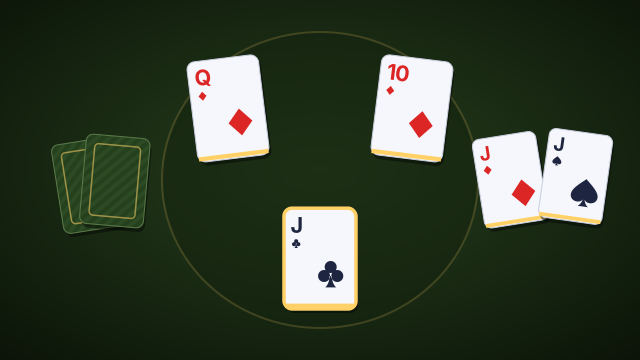
Ten cards each, two in the skat. Middlehand bids to forehand in game values, 18, 20, 22, 23, 24, 27 and up, and forehand says yes to hold a value or passes; then rearhand bids to whoever is left. The last bidder standing is the declarer: take up the skat and put two cards away, or play from the hand, then declare clubs, spades, hearts or diamonds, grand or null. In a suit game the jacks (clubs, spades, hearts, diamonds) and the trump suit's ace, ten, king, queen, nine, eight and seven are trumps; in grand only the jacks are; in null there are none and every suit runs ace, king, queen, jack, ten, nine, eight, seven. Forehand leads; follow suit if you can, otherwise play anything. Aces count 11, tens 10, kings 4, queens 3 and jacks 2: the declarer needs 61, and 90 is schneider. A suit game or grand is worth its base value (diamonds 9, hearts 10, spades 11, clubs 12, grand 24) times the matadors with or without, plus one for the game and one each for hand, schneider and schwarz. Null is worth 23, from the hand 35, open 46, open from the hand 59. A game worth less than the bid is lost, and a lost game counts double. Seeger-Fabian adds 50 for every game won, takes 50 off for every game lost and gives the other two players 40 each time the declarer loses. Your score is 1000 plus your total after twelve deals.
What is Skat?
Skat is Germany's national card game, born in Altenburg in Thuringia around 1810 and played ever since in pubs, clubs, living rooms and on long train journeys. Three players share a pack of 32 cards from seven to ace. Each deal one of them becomes the declarer and plays alone against the other two, who join forces for that deal and split up again for the next. What makes Skat special is the bidding: you bid the value of the game you mean to play, so you have to know what your hand is worth before the first card is led.
Here you play Skat by the International Skat Order, the rules German clubs and tournaments use, as pagat.com sets them out. You sit with two computer players, Ana on your left and Mihai on your right, on three levels. A game is twelve deals, so everyone deals four times, and it is scored by Seeger-Fabian, the tournament system. Every day brings a Daily Skat with the same deals for everyone.
How to play Skat
The dealer gives three cards to each player, two face down to the skat, then four each and three each. The player on the dealer's left is forehand, the next is middlehand, and the dealer is rearhand.
- Bidding. Middlehand bids to forehand in game values: 18, 20, 22, 23, 24, 27, 30 and up. Forehand says yes to hold a value, or passes. Then rearhand bids to whoever is left. The last one standing is the declarer, and the value reached is the bid. If middlehand and rearhand both pass without a bid, forehand may play at 18 or pass, and the cards go in.
- The skat. The declarer takes up the skat and puts any two cards back face down, or plays from the hand without looking at it. The two cards in the skat count for the declarer at the end.
- The game. The declarer names clubs, spades, hearts or diamonds as trumps, grand, or null. In a suit game the four jacks are the highest trumps, clubs, spades, hearts, diamonds, followed by the trump suit's ace, ten, king, queen, nine, eight and seven. In grand only the jacks are trumps. In null there are no trumps, every suit runs ace, king, queen, jack, ten, nine, eight, seven, and the declarer must take no trick at all.
- Play. Forehand leads to the first trick. Follow suit if you can (a jack follows as a trump, not as its suit), otherwise play anything. The highest trump, or else the highest card of the suit led, takes the trick, and its winner leads next.
- Card points. Ace 11, ten 10, king 4, queen 3, jack 2, the rest nothing: 120 in the pack. The declarer needs 61 to win. With 90 or more the defenders are schneider; with every trick they are schwarz.
- The value of a game. A suit game or grand is worth its base value (diamonds 9, hearts 10, spades 11, clubs 12, grand 24) times a multiplier: the matadors, then one for the game and one more for each of hand, schneider, schneider announced, schwarz, schwarz announced and open. The matadors are the unbroken run of top trumps from the jack of clubs that the declarer holds (with) or misses (without), the skat counted in. Null is worth 23, 35 from the hand, 46 open and 59 open from the hand.
- The bid must stand. A game worth less than the bid is lost, at the least multiple of its base value that reaches the bid. A lost game counts double.
Seeger-Fabian scoring gives the declarer the game's value plus 50 for a win, and takes twice the value plus 50 off for a loss, when each defender also gets 40. Your score for the leaderboard is 1000 plus your total after twelve deals.
Tips and strategy
- Count your matadors before you bid. With the jack of clubs and the jack of spades in a heart game you are "with 2": game 3, times 10, so you can bid to 30. Without any of the top jacks you can bid just as high, but you need a long trump suit to win.
- Bid a suit game on five trumps. Five trumps with two jacks and a side ace is a fair game; six trumps make it strong. Side aces with their tens are worth almost a trick each.
- Put points away. When you take up the skat, put back a lone ten or a king you might lose. Its points are yours anyway, and an empty suit lets you trump later.
- Draw trumps as declarer. Lead your top jacks early so the defenders cannot trump your aces, then cash the aces and tens.
- Smear your partner's tricks. As a defender, when your partner is sure to win a trick, throw your ace or ten on it. When the declarer wins, give the least you can.
- Short way, long suit. With the declarer playing right after you, lead your long suit; with the declarer playing last, lead your short one, and lead back the suit your partner has shown.
Frequently asked questions
Is Skat free?
Yes. Like every game on Play, it runs free in your browser, with no download and no account.
Which rules does this Skat follow?
The International Skat Order: bidding by game values with listener and talker, the skat taken up or played from the hand, suit games, grand, null in all four forms, matadors with and without, schneider and schwarz, announcements from the hand, open games, overbidding and lost games counted double. Kontra, re and bock rounds are left out, as is ramsch.
What happens when nobody bids?
If all three pass, the cards go in and nothing is scored. The deal still counts as one of the twelve, as in a tournament series, and the next player deals.
Can I declare null after bidding 24?
Not a plain null, which is worth 23. A null may only be declared when its value reaches the bid, so after 24 you can still play null from the hand (35), null open (46) or open from the hand (59).
How is the score counted?
With Seeger-Fabian, the tournament system. A won game scores its value plus 50. A lost game costs twice its value plus 50, and each of the two defenders scores 40. The player with the highest total after twelve deals wins.
How do the levels differ?
On Easy the computers bid on their trumps alone, sometimes rashly, and often play the first card that comes to hand. On Medium they count their hands the way club players do and play by the rules good players know: drawing trumps, cashing aces, smearing their partner's tricks and showing their aces. On Hard they also try every bid, game and card in imagined deals of the cards they have not seen. The computers never look at your cards or at the skat.
What is the Daily Skat?
Every day everyone plays the same twelve deals on Medium, so scores compare directly on the leaderboard.
More like this
Septica
Cards & Board
Cut with a seven, collect the aces and tens.
Sixty-Six
Cards & Board
Meld king and queen, close the talon, reach 66 first.
Pinochle
Cards & Board
Two-handed Pinochle: meld marriages, runs and the pinochle, then play out the tricks to 1000.
Cruce
Cards & Board
Bid your points, name trumps with your first card, show 20 and 40.