Regions
Fill the grid with numbers so every region holds its own size.
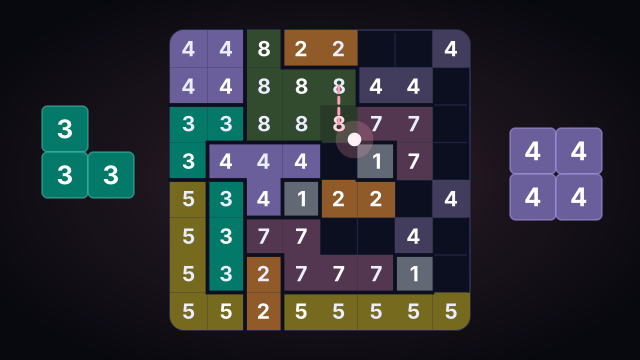
A logic puzzle of numbers and regions. Write a number from 1 to 9 in every square so that the grid splits into regions: squares with the same number that touch along a side make one region, and every region has exactly as many squares as its number. A 4 lives in a region of four 4s, a 1 stands alone, and two regions of the same size never touch. Some numbers are given. Every board has exactly one answer you can reach by reasoning alone, on 6 by 6, 8 by 8 or 10 by 10 squares, and every day brings a new board, the same for everyone.
- Category
- Puzzle & Brain
- Modes
- Small 6×6 · Medium 8×8 · Large 10×10 · Daily
- Controls
- Mouse · Touch · Keyboard
Loading…
How to play
Tap a square, then a number on the pad below the board to write it in; the last key clears the square. Or drag from a number across the board to paint that number along your path. Fill every square so that each region, the squares with the same number joined side to side, has exactly as many squares as its number: three 3s together, five 5s together, a 1 on its own. Two regions of the same size can never touch, since they would make one region too big. A finished region shows its full colour, and a region that grows too big, or is walled in too small, turns red. Undo takes back your last move. Your score is your time, and a hint puts a wrong square right or fills the next square logic finds, and says why, for 30 seconds on the clock.
What is Regions?
Regions is a logic puzzle about filling a grid with numbers. A few squares hold numbers to start with, and you write a number from 1 to 9 in every other square so that the grid splits into regions. Squares with the same number that touch along a side form one region, and every region has exactly as many squares as its number: a 3 sits in a region of three 3s, a 1 stands on its own. Two regions of the same size may never touch, because together they would be one region twice too big. Around the world the puzzle is also known as Fillomino.
Every board has exactly one answer, and it can always be reached by reasoning, never by guessing. Boards come in three sizes, 6 by 6, 8 by 8 and 10 by 10, and a new board, the same for everyone, arrives every day.
How to play
Tap a square to pick it, then tap a number on the pad below the board. On a computer you can also move with the arrow keys and type the numbers.
- Writing. The number you tap goes into the picked square. Tap another number to change it, or the last key on the pad to clear the square.
- Painting. Put your finger on any number and drag across the board: every square you pass takes that number, all in one move. The line under the board counts the region as it grows. The numbers given at the start never change.
- Regions. Squares with the same number that touch along a side are one region. A region is finished when it has exactly as many squares as its number, and then it shows its full colour.
- Red regions. A region turns red when it has more squares than its number, or when other numbers wall it in before it reaches its size.
- Undo. Undo takes back your last move, a whole painted path included.
- Score. Your score is the time to fill the whole board, plus 30 seconds for every hint. Every board size has its own leaderboard.
Strategy tips
- Close the finished regions. Once a region has all its squares, no square beside it may hold the same number. That often leaves a neighbouring square only one choice.
- Follow the only way out. A region that still needs squares and has a single empty square beside it must grow into that square. Small numbers next to the edge are a good place to start.
- Find the bottleneck. Count how far a region can still spread. If every way to reach its size runs through one square, that square belongs to it.
- Mind the lonely squares. An empty square walled in by finished regions of other sizes is a 1. Two empty squares walled in together are usually a 2 and a 2, since two 1s may not touch.
- Keep equal sizes apart. A square between two regions of the same number cannot join them if together they would be too big, so it needs another number.
FAQ
Is Regions free to play?
Yes. Like every game on Play, it runs free in your browser, with no download and no account needed.
Can two regions with the same number touch?
No. Squares with the same number that touch always belong to one region, so two regions of 3 side by side would make a region of six 3s, which is too big. Regions of the same size are always kept apart by other numbers.
Do I have to use every number from 1 to 9?
No. Use whatever numbers the regions need. Small boards rarely need a 9, and every number you write must match the size of its region.
What does a hint do?
It first puts right a number you wrote that is not part of the answer, if there is one; otherwise it fills the next square that follows by logic from the board, and the line under the board says why. Each hint adds 30 seconds to your time.
What is today's grid?
Every day everyone plays the same medium 8 by 8 board, so times compare directly on the leaderboard.
How is my score counted?
Your score is the time from the first look at the board to the last square that completes it, plus 30 seconds for every hint. Lower is better.
More like this
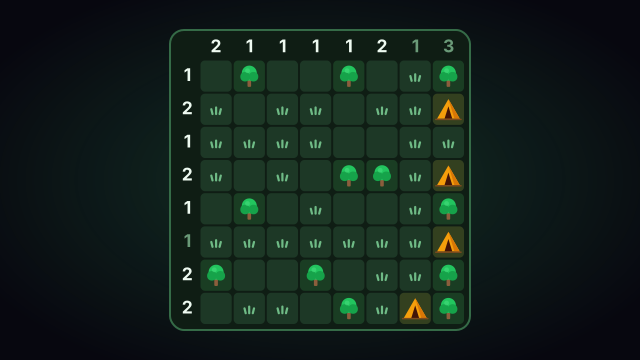
Tents
Puzzle & Brain
Pitch a tent beside every tree.
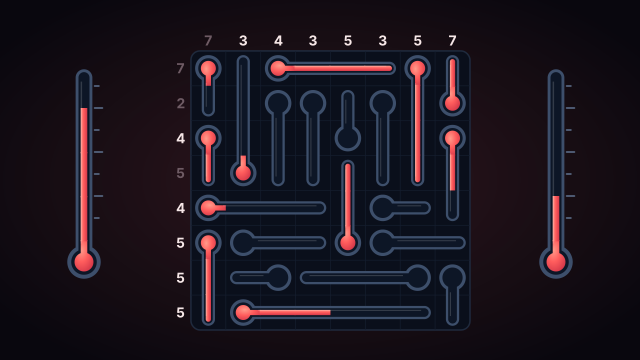
Thermometers
Puzzle & Brain
Fill every thermometer from its bulb so each row and column holds its number.
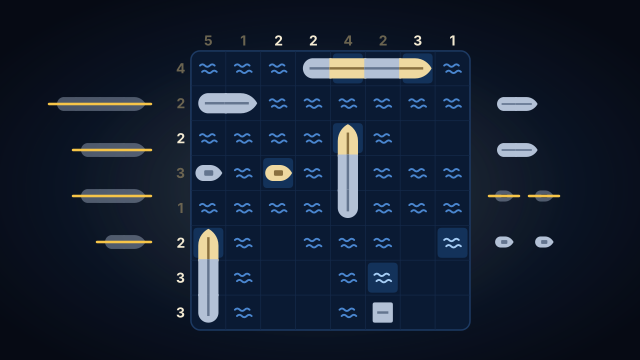
Hidden Fleet
Puzzle & Brain
Find the hidden fleet from the numbers along the edge of the sea.
Aquarium
Puzzle & Brain
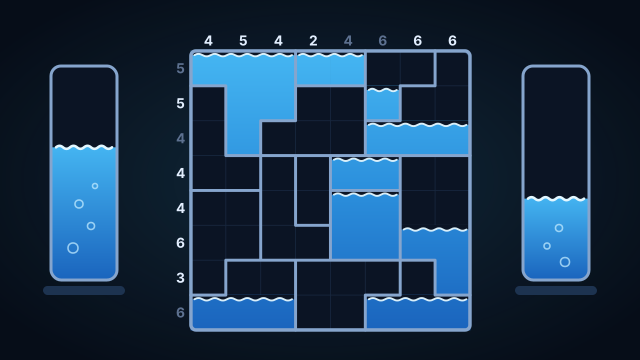
Fill the tanks with water from the bottom up so every row and column holds its number.