Kakurasu
Shade cells so every row and column adds up to its clue.
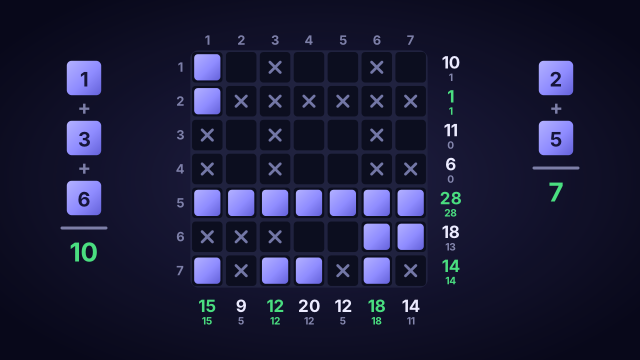
A logic puzzle of sums on a square grid. Every cell you shade counts its column's number in its row and its row's number in its column: a cell in row 2, column 5 adds 5 to row 2 and 2 to column 5. The clue at the end of every row and every column gives the sum it must reach. Every board has exactly one answer you can reach by reasoning alone, on 5 by 5, 7 by 7 or 9 by 9 cells, and every day brings a new board, the same for everyone.
- Category
- Puzzle & Brain
- Modes
- Small 5×5 · Medium 7×7 · Large 9×9 · Daily
- Controls
- Mouse · Touch · Keyboard
Loading…
How to play
Tap a cell to shade it, tap again to cross it out, and once more to clear it. A cross is only your note that a cell stays empty. Drag across cells to give them all the mark the first one takes. The numbers along the top and the left say what each cell is worth: its column's number to its row, its row's number to its column. Under every clue you see what its line adds up to now; the clue turns green when the two match, and red when the line goes past it or can no longer reach it. Once a line adds up, tap its clue to cross out the rest. Your score is your time, and a hint fixes a wrong mark or shades what the next step of logic finds, and says why, for 30 seconds on the clock.
What is Kakurasu?
Kakurasu is a logic puzzle of sums on a square grid. Every cell is worth its place: in its row it is worth the number of its column, counting 1 from the left, and in its column it is worth the number of its row, counting 1 from the top. Those numbers run along the top and down the left of the board. The clue at the end of each row and at the foot of each column says what the shaded cells of that line must add up to. A cell in row 2 and column 5 adds 5 to row 2 and 2 to column 5.
Every board has exactly one answer, and it can always be reached by reasoning, never by guessing. Boards come in three sizes, 5 by 5, 7 by 7 and 9 by 9, and a new board, the same for everyone, arrives every day.
How to play
Tap cells to shade them until every row and column adds up to its clue.
- Shading. A tap on an empty cell shades it. Tap it again to cross it out, and once more to clear it.
- Crosses. A cross is only your note that a cell stays empty; it never counts in a sum.
- Dragging. Drag across cells to give them all the mark the first one takes: shade a run of cells, cross out a run, or clear one.
- Clues. Under every clue you see what its line adds up to now. The clue turns green when the two match, and red when the line goes past it or can no longer reach it. Once a line adds up, tap its clue to cross out the rest of it.
- Undo. Undo takes back your last change, a whole drag at a time.
- Score. Your score is the time to solve the board, plus 30 seconds for every hint. Every board size has its own leaderboard.
Strategy tips
- Start with the tight clues. A 0 leaves its whole line empty, a 1 can only be the first cell, a 2 only the second, and a clue as big as the line's whole total shades every cell of it.
- Count down from the top. A line of 7 cells is worth 28 in all, so a clue of 26 leaves out exactly 2: the cell worth 2 stays empty and every other cell is shaded.
- Too much, and too little. A cell worth more than its line still needs stays empty. A cell the line cannot do without, because the other open cells add up to less than it still needs, is shaded.
- List the ways. When a line still needs 4 from cells worth 1, 2, 3 and 4, it can be 4 or 1 + 3, never anything with the 2 in it: the cell worth 2 stays empty. Whatever every way agrees on is settled.
- Go back and forth. Each cell you settle changes what its column still needs, so work the rows and the columns in turn. On the large boards, read two rows and two columns together at their four crossings: often only one way of marking those four cells fits all four sums.
FAQ
Is Kakurasu free to play?
Yes. Like every game on Play, it runs free in your browser, with no download and no account needed.
Why is a cell worth different amounts in its row and its column?
Because it counts its column's number in its row and its row's number in its column. A cell in row 3 and column 6 adds 6 to row 3 and 3 to column 6. The numbers along the top and the left of the board show those worths.
What does a hint do?
It fixes a wrong mark first if there is one; otherwise it makes the next step of logic from the marks on the board, crosses out the cells that step knows stay empty, and the line under the board says which rule it used. Each hint adds 30 seconds to your time.
What is today's Kakurasu?
Every day everyone plays the same medium 7 by 7 board, so times compare directly on the leaderboard.
How is my score counted?
Your score is the time from the first look at the board to the last cell that makes every sum add up, plus 30 seconds for every hint. Lower is better.
More like this
Target Number
Puzzle & Brain
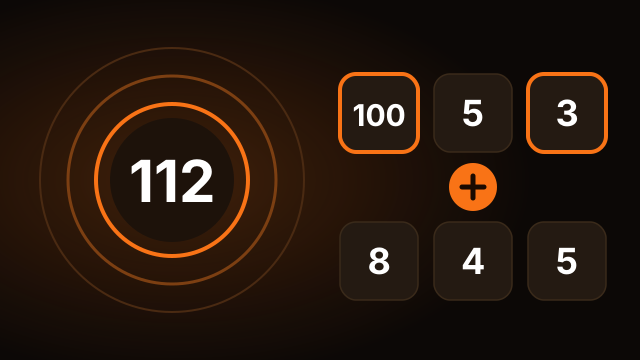
Can you hit the target with six numbers and four operations?
Hidden Code
Puzzle & Brain
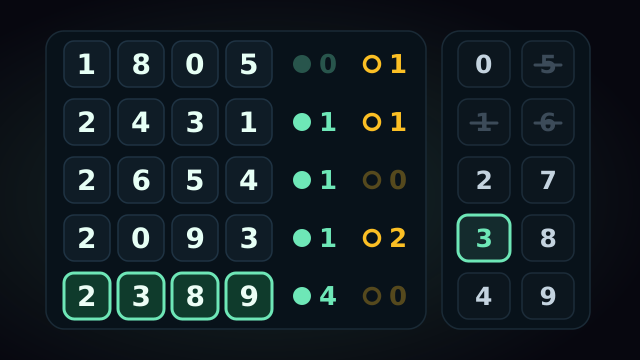
Find the hidden digits and their places, one guess at a time.

Sudoku
Puzzle & Brain
Nine digits. One logical path.
Killer Sudoku
Puzzle & Brain
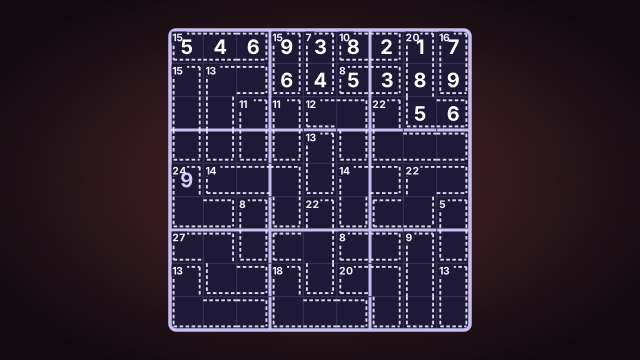
Sudoku with no numbers given: only cages and their sums.