Galaxies
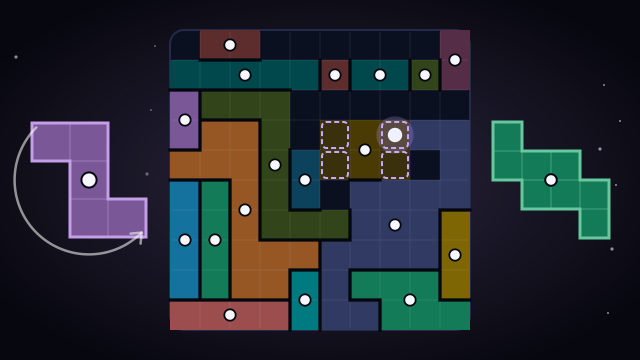
Split the grid into galaxies, each one the same after half a turn about its own dot.
A logic puzzle about symmetry. Dots sit on the grid: in the middle of a square, on the line between two squares, or where four squares meet. Divide the whole grid along its lines into galaxies so that every galaxy holds exactly one dot and looks exactly the same after half a turn about it: every square has a twin on the far side of the dot, just as far away, in the same galaxy. Every board has exactly one answer you can reach by reasoning alone, on 7 by 7, 10 by 10 or 13 by 13 squares, and every day brings a new board, the same for everyone.
- Category
- Puzzle & Brain
- Modes
- Small 7×7 · Medium 10×10 · Large 13×13 · Daily
- Controls
- Mouse · Touch
Loading…
How to play
Put your finger on a dot, or on any coloured square of its galaxy, and drag across the board: every square you pass joins that galaxy, and its twin across the dot joins with it. A square whose twin would fall off the board, or on another dot, cannot join, and the line under the board says so. Tap a painted square to clear it and its twin. Every square belongs to one galaxy, every galaxy holds one dot and is all in one piece, and half a turn about its dot leaves it unchanged. A galaxy shows its full colour once it is whole and walled in, and a piece cut off from its dot turns red. Undo takes back your last move. Your score is your time, and a hint clears a square in the wrong galaxy or paints the next square logic finds, and says why, for 30 seconds on the clock.
What is Galaxies?
Galaxies is a logic puzzle about symmetry. Dots sit on the grid, some in the middle of a square, some on the line between two squares, some on the corner where four squares meet. You split the whole grid along its lines into galaxies, so that every galaxy holds exactly one dot and looks exactly the same after half a turn about that dot. Turned halfway round, every square of a galaxy lands on another square of the same galaxy: its twin, on the far side of the dot and just as far from it. Around the world the puzzle is also known as Spiral Galaxies, after the winding shapes the galaxies often take.
Every board has exactly one answer, and it can always be reached by reasoning, never by guessing. Boards come in three sizes, 7 by 7, 10 by 10 and 13 by 13, and a new board, the same for everyone, arrives every day.
How to play
Put your finger on a dot and drag across the board: every square you pass joins that dot's galaxy.
- Painting. Start on a dot, or on any coloured square of a galaxy, and drag. Each square you cross joins the galaxy, and its twin across the dot joins with it, so a galaxy is always symmetric. The line under the board counts the galaxy's squares as it grows. Letting go well off the board paints nothing.
- Squares that cannot join. A square whose twin would fall off the board, or on another dot's square, cannot join that galaxy, and the line under the board says why. The squares touching a dot always belong to that dot.
- Clearing. Tap a painted square to clear it, together with its twin. Painting over a square of another galaxy moves it into yours and clears its old twin.
- Colours. A galaxy still growing shows a darker shade of its colour. Once it is in one piece and walled in by other galaxies and the edge, it shows its full colour. A piece cut off from its dot turns red.
- Undo. Undo takes back your last move, a whole painted stroke included.
- Score. Your score is the time to fill the whole board, plus 30 seconds for every hint. Every board size has its own leaderboard.
Strategy tips
- Start at the edges and corners. A square near the edge has few twins that stay on the board, so often only one dot can claim it. The corners are the best place to begin.
- Mirror every step. Whenever a square belongs to a galaxy, its twin across the dot belongs to it too. The game paints the twin for you: let it show you where the galaxy has to go next.
- Look for walled-off squares. A galaxy is all in one piece, so a square it cannot reach without crossing another galaxy is not its. When only one dot can still reach a square, the square is that dot's.
- Find the bottleneck. When a galaxy holds a square far from its dot and every way back to the dot runs through one square, that square belongs to the galaxy as well.
- Think one move ahead. On the larger boards, ask what would happen if a square joined a certain galaxy. If its twin would leave some other square with no galaxy that can take it, that choice is wrong.
FAQ
Is Galaxies free to play?
Yes. Like every game on Play, it runs free in your browser, with no download and no account needed.
Must every galaxy be in one piece?
Yes. Every galaxy is a single connected shape, and two squares that touch only at a corner are not connected. A galaxy may wind and curl, but it never falls apart.
Can a dot sit on a line?
Yes. A dot in the middle of a square, on the line between two squares or on the corner where four meet is still the centre of its galaxy. A dot on a line always takes both squares beside it, and a dot on a corner takes all four.
What does a hint do?
It first clears a square you painted into the wrong galaxy, if there is one; otherwise it paints the next square that follows by logic from the board, with its twin, and the line under the board says why. Each hint adds 30 seconds to your time.
What is today's sky?
Every day everyone plays the same medium 10 by 10 board, so times compare directly on the leaderboard.
How is my score counted?
Your score is the time from the first look at the board to the last square that completes it, plus 30 seconds for every hint. Lower is better.
More like this
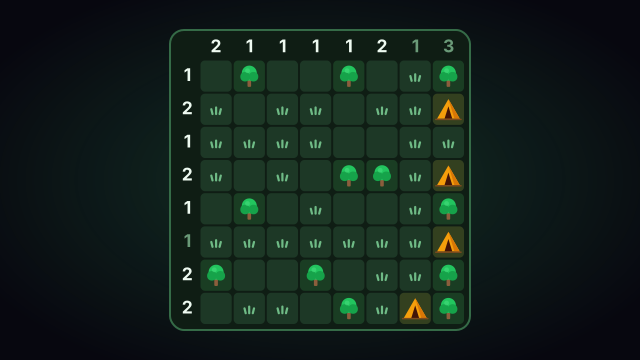
Tents
Puzzle & Brain
Pitch a tent beside every tree.
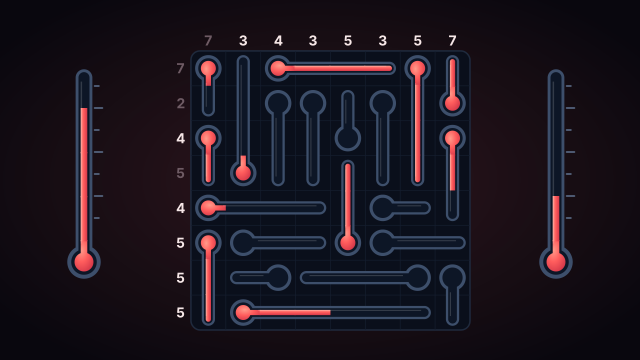
Thermometers
Puzzle & Brain
Fill every thermometer from its bulb so each row and column holds its number.
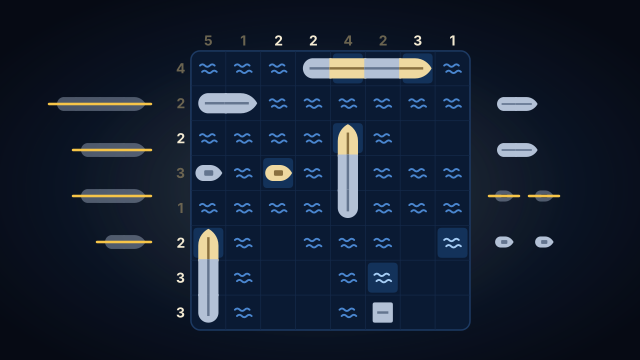
Hidden Fleet
Puzzle & Brain
Find the hidden fleet from the numbers along the edge of the sea.
Aquarium
Puzzle & Brain
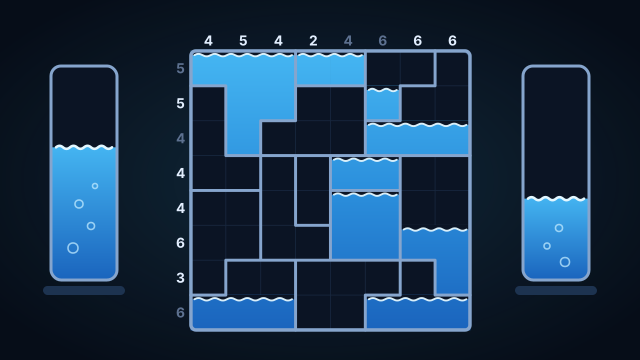
Fill the tanks with water from the bottom up so every row and column holds its number.