Futoshiki
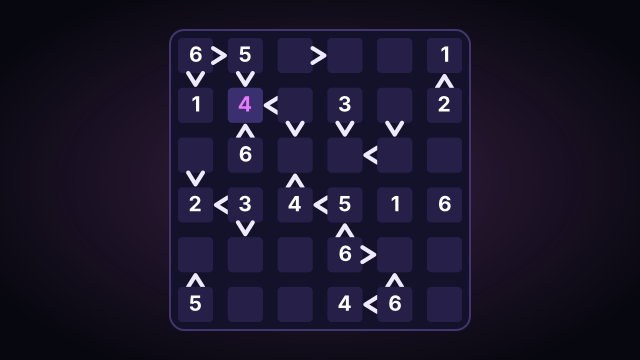
Fill the square, keeping every sign between the numbers true.
A Japanese logic puzzle of numbers and inequality signs. Each row and each column of the square holds every number from 1 up to the size of the square, once each. Signs between some neighbouring cells tell which of the two is smaller, and a few cells may be filled in from the start. Every square has exactly one answer you can reach by reasoning alone, on 5 by 5, 6 by 6 or 7 by 7, and every day brings a new square, the same for everyone.
- Category
- Puzzle & Brain
- Modes
- Small 5×5 · Medium 6×6 · Large 7×7 · Daily
- Controls
- Mouse · Touch · Keyboard
Loading…
How to play
Tap a cell, then a number on the pad below. Each number appears once in every row and every column. The sign between two neighbouring cells opens toward the larger number: in 2 < 4 it opens toward the 4. With Notes on, digits go in as small notes. A sign turns red when its cells are filled the wrong way round, and two equal numbers in one line turn red. Your score is your time, and a hint fixes a wrong number or places a right one for 30 seconds on the clock.
What is Futoshiki?
Futoshiki is a Japanese logic puzzle of numbers and inequality signs; the name itself means "inequality". Each row and each column of the square holds every number from 1 up to the size of the square, once each, and signs between some neighbouring cells tell which of the two is smaller.
Every square has exactly one answer, and it can always be reached by reasoning, never by guessing. Squares come in three sizes, 5 by 5, 6 by 6 and 7 by 7, and a new square, the same for everyone, arrives every day.
How to play
Tap a cell to pick it, then tap a number on the pad; tap the same number again to take it off.
- Numbers. Every row and every column holds each number exactly once.
- Signs. The sign between two cells opens toward the larger number, like "less than" in maths. A sign turns red when its cells are filled the wrong way round.
- Notes. Turn on Notes to jot small digits in a cell; placing a number rubs it out of the notes in its row and column. On a computer keyboard, digits, arrow keys and N for notes all work.
- Score. Your score is the time to solve the square, plus 30 seconds for every hint. Every size has its own leaderboard.
Strategy tips
- The ends of chains. In a chain of signs such as a < b < c, the first cell cannot hold either of the two largest numbers, and the last cannot hold either of the two smallest.
- One and the top number. A cell larger than a neighbour cannot be 1, and a cell smaller than a neighbour cannot be the top number.
- Note what is still possible. Write each cell's possible numbers in its notes and strike them as signs and lines rule them out.
- One place left. When a number has only one free place left in a row or column, it goes there.
- Pairs. Two cells of the same line that can only be the same two numbers keep them to themselves; strike those numbers from the line's other cells.
FAQ
Is Futoshiki free to play?
Yes. Like every game on Play, it runs free in your browser, with no download and no account needed.
How do I read the signs?
A sign always opens toward the larger number. Vertical signs work the same way: the point faces the smaller cell.
What does a hint do?
It fixes a wrong number first if there is one, otherwise it places the number that reasoning reaches soonest. Each hint adds 30 seconds to your time.
What is the daily square?
Every day everyone gets the same medium 6 by 6 square, so times compare directly on the leaderboard.
How is my score counted?
Your score is the time from the first look to the last number placed, plus 30 seconds for every hint. Lower is better.
More like this
Target Number
Puzzle & Brain
Can you hit the target with six numbers and four operations?
Hidden Code
Puzzle & Brain
Find the hidden digits and their places, one guess at a time.

Sudoku
Puzzle & Brain
Nine digits. One logical path.
Killer Sudoku
Puzzle & Brain
Sudoku with no numbers given: only cages and their sums.