Euchre
The Midwest's partnership card game: order up the trumps, mind both bowers and beat the other team to 10.
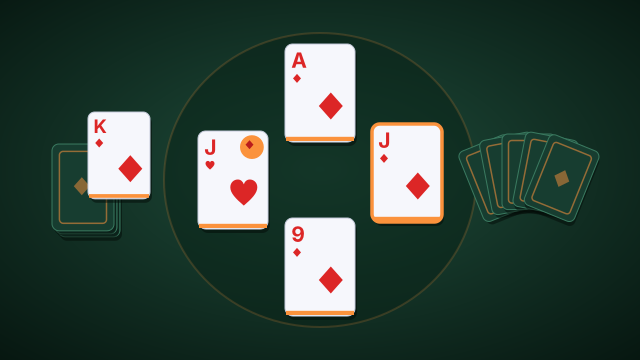
Euchre, the fast trump game of the American Midwest and Canada, played at kitchen tables, in bars and at church socials. You and a computer partner sitting opposite play two computer opponents with a pack of 24, nine to ace. Five cards each, one card turned up: order it up to make its suit trumps, or pass, and if nobody wants it, name another suit in a second round. The jack of trumps, the right bower, is the top card, and the other jack of the same colour, the left bower, becomes a trump right behind it. Your team needs three of the five tricks, or it is euchred and the other team scores 2. Take all five for a march, go alone for 4, and reach 10 first. Every day brings a Daily Euchre, the same deals for everyone.
- Category
- Cards & Board
- Modes
- Easy · Medium · Hard · Daily
- Controls
- Mouse · Touch · Keyboard
Loading…
How to play
The dealer gives everyone five cards and turns the next one up. Starting on the dealer's left, each player may order it up, making its suit trumps, or pass; the dealer then picks the card up and lays another away. If all four pass, each may name another suit in a second round, and if all pass again the cards are thrown in. Whoever makes trumps may go alone, and their partner sits the deal out. The jack of trumps, the right bower, beats everything; the other jack of the same colour, the left bower, counts as a trump and comes next, then ace, king, queen, ten and nine. Follow the suit led if you can, or play anything. The makers score 1 point for three or four tricks and 2 for all five, a march; a march alone scores 4. If they take fewer than three they are euchred and the other team scores 2. The first team to 10 wins. Your score: ten per point your team ends on, ten per point the other team lacks of 10, and 100 for the win.
What is Euchre?
Euchre is the card game of the American Midwest and of Ontario, the one families play at the kitchen table, students in their dorms and regulars at the bar, with tournaments in church halls on Friday nights. Four players in two teams, partners sitting opposite, share a short pack of 24 cards, nine to ace. Every deal is a quick fight over the trumps: one card is turned up, and someone has to decide whether to make its suit trumps, knowing their team must then take three of the five tricks.
What sets euchre apart from every other trump game is its two bowers. Once a suit is trumps, its jack, the right bower, becomes the highest card of all, and the other jack of the same colour, the left bower, joins the trumps right behind it. Here you play the standard four-handed game as pagat.com describes it in its North American form. Your partner, sitting across, and your two opponents are played by the computer, on three levels. The first team to 10 points wins, and every day brings a Daily Euchre with the same deals for everyone.
How to play Euchre
The dealer gives each player five cards, in batches of three and two, and turns up the top card of the four left over, the kitty. The deal, the making of trumps and the play all go clockwise, starting with the player on the dealer's left.
- First round. In turn, each player may order up the turned card, making its suit trumps, or pass; the dealer may pick it up. Whoever orders it up, the dealer adds the card to their hand and lays one of the other five away face down.
- Second round. If all four pass, the card is turned down and each player in turn may name any other suit as trumps, or pass again. If nobody does, the cards are thrown in and the next player deals.
- Going alone. Whoever makes trumps may go alone, said with the call: their partner lays their cards down and sits the deal out.
- The bowers. The jack of trumps, the right bower, is the highest card; the other jack of the same colour, the left bower, is a trump and the second highest. Then come the ace, king, queen, ten and nine of trumps. The other suits run ace, king, queen, jack, ten and nine.
- Following. The player on the dealer's left leads, or the player on the left of a lone maker. You must follow the suit led if you can; the left bower counts as a trump, so it follows trumps and not its own suit. If you cannot follow, play anything. The highest trump wins the trick, or else the highest card of the suit led.
- Scoring. The team that made trumps scores 1 point for three or four tricks and 2 for all five, a march. A march alone scores 4. If the makers take fewer than three tricks they are euchred, and the other team scores 2.
The first team to 10 points wins the game. Your score for the leaderboard is ten for each point your team ends on, ten for each point the other team is short of 10, and 100 when you win.
Tips and strategy
- Count your trumps and your bowers. Three trumps with a bower, or both bowers with an ace, usually take three tricks. Two small trumps and nothing else rarely do.
- Think about who gets the turned card. Ordering it up when your partner deals gives your team an extra trump; ordering it up when an opponent deals hands it to them.
- Lead the right bower when you made trumps. Drawing the opponents' trumps early keeps your side aces safe. When your partner made trumps, lead a trump to help.
- Leave your partner's winner alone. When your partner holds the trick for sure, throw your lowest card and keep your trumps for later.
- Cash your aces on defence, and make a void. Lead your side aces before they can be trumped, and throw away a lone small card so you can ruff that suit later.
- Go alone with a sure hand. The right bower, the left bower and the ace of trumps, or four trumps with a side ace, can often take all five tricks for 4 points.
Frequently asked questions
Is Euchre free?
Yes. Like every game on Play, it runs free in your browser, with no download and no account.
Which rules does this Euchre follow?
The standard four-handed game with 24 cards and a game to 10, as pagat.com gives it for North America. Where rule books differ: when everyone passes twice the deal is thrown in and the next player deals (no "stick the dealer"); the dealer keeps the turned card and lays away one of the other five; only the player who makes trumps may go alone, and the player on their left leads; the dealer's partner may order the card up and still play with the dealer. Defending alone, the farmer's hand, super euchre and other house rules are left out.
What are the right and left bowers?
They are the two jacks of the trumps' colour. The jack of the trump suit is the right bower, the highest card. The other jack of the same colour is the left bower, the second highest: it leaves its own suit and counts as a trump in every way. If hearts are trumps, the jack of hearts is the right bower and the jack of diamonds the left. In the game every trump has an orange bar along its foot, and the left bower also wears the trump suit's sign in its corner.
What does euchred mean?
It is what happens when the team that made trumps takes fewer than three tricks: it is euchred, and the other team scores 2 points. The word gave the game its name, and euchring the makers is the defence's finest moment.
When should I go alone?
When your hand can take every trick by itself, or nearly: a march alone scores 4 instead of 2. With three or four sure tricks, keep your partner, since a lone hand that takes three or four tricks still scores only 1.
How do the levels differ?
The level sets how well your two opponents play; your partner always plays its best game. On Easy the opponents make trumps on the number of trumps they hold and often play whatever comes to hand. On Medium they count their hands the way club players do and play by their rules. On Hard they also try their cards and their calls out in many imagined deals of the cards they have not seen. The computer never looks at your cards or anyone else's.
What is the Daily Euchre?
Every day everyone plays the same deals on Medium, so scores compare directly on the leaderboard.
More like this
Septica
Cards & Board
Cut with a seven, collect the aces and tens.
Sixty-Six
Cards & Board
Meld king and queen, close the talon, reach 66 first.
Pinochle
Cards & Board
Two-handed Pinochle: meld marriages, runs and the pinochle, then play out the tricks to 1000.
Cruce
Cards & Board
Bid your points, name trumps with your first card, show 20 and 40.