Driftfold
Fold, launch and ride warm air over a painted countryside, one touch at a time.
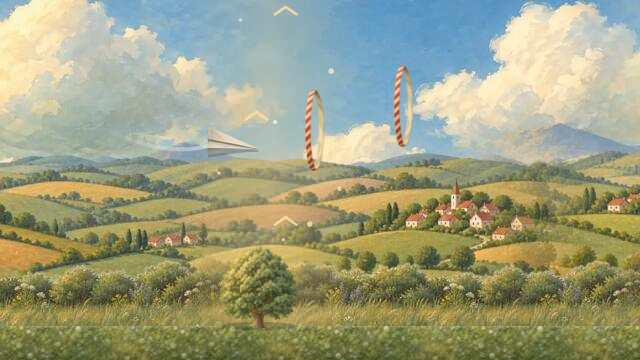
A paper plane, a summer countryside and one finger. Hold to lift the nose, let go to let it fall, and that is all the control you have. Energy is honest: a dive builds speed, a climb spends it, and if you climb too long the plane stalls, wobbles and drops until it has dived back to speed. Shimmering columns of warm air carry you up; gusts push you around; on breezy and stormy days cold sinking air presses you down. Fly through paper rings for points, with a small bonus for every ring in an unbroken chain, and keep clear of oaks, poplars, windmills, power lines, flocks of birds and the hills. The flight ends where the plane touches anything, ground included. Every meter is a point. Three skies, calm, breezy and stormy, plus a Daily flight that is the same course for everyone.
- Category
- Arcade
- Modes
- Calm · Breezy · Stormy · Daily
- Controls
- Touch · Mouse · Keyboard
Loading…
How to play
Press and hold anywhere to lift the plane's nose; let go and the nose drops. The plane flies right on its own. On a keyboard, hold Space, Enter, W or the up arrow. Your first press launches the plane. A dive gains speed and a climb spends it, so trade one for the other: dive a little to build speed, then use it to climb over a tree or up into a ring. Climb too long and the speed runs out: the plane stalls, its nose drops and it sinks; let go and dive until it answers again. The airspeed bar in the top corner turns red at the stall. Shimmering golden columns are warm air: fly through them slowly, nose a touch up, to climb as high as you can. Grey columns sink, and streaks of wind push you along, back, up or down. Fly through a paper ring for 10 points, plus 2 more for each ring before it in your chain (up to 30 a ring); miss one and the chain starts again. Every meter flown is a point. Touching the ground, a hill, a tree, the windmill or its sails, a power line or a bird ends the flight.
What is Driftfold?
Driftfold is a one-touch gliding game. You fly a folded paper plane over a painted summer countryside of meadows, hedgerows, villages and far blue mountains, and the only control you have is your finger: hold to lift the nose, let go to let it fall. The plane always flies to the right, and how far it gets is up to how well you manage its energy.
The flight is honest about energy. A dive turns height into speed, a climb turns speed back into height, and the air takes a little of both all the time. Climb for too long and the plane runs out of speed and stalls. To fly far, you read the sky: warm air to climb in, sinking air to avoid, rings to thread and obstacles to clear.
How to play Driftfold
- Hold to climb. Press and hold anywhere: the plane's nose rises. Your first press launches the plane.
- Let go to dive. Release and the nose drops. A short dive builds speed; a long one takes you down fast.
- Keyboard. Hold Space, Enter, W or the up arrow.
- Watch the airspeed bar. The bar in the top corner shows your speed. Its red end is the stall.
- Stalls. Too slow and the wing lets go: the nose drops, the paper wobbles and the plane sinks. Let go, dive and it answers again a moment later, a little lower.
- Warm air. Shimmering golden columns lift you. Fly through them slowly, nose slightly up, to climb as high as they reach.
- Sinking air and gusts. Grey columns push you down, and streaks of wind push you forward, back, up or down.
- Obstacles. Oaks, poplars, windmills (keep clear of the whole circle the sails sweep), power lines (over or under the wire, never through it), flocks of birds flying toward you, and hills. Touch anything, ground included, and the flight is over.
Scoring
- Distance: every meter flown is a point.
- Rings: each paper ring you fly through scores 10 points, plus 2 for each ring before it in your current chain, up to 30 a ring.
- Chains: miss a ring and the chain starts again from one.
Tips and strategy
- Trade, do not waste. Every climb costs speed and every dive costs height. Small, early corrections are cheaper than big late ones.
- Slow down in warm air. The longer you stay inside a rising column, the more height you take out of it. Ease the nose up as you enter, but not so far that you stall.
- Keep some speed in hand. Speed is height you can still use. Arriving at a tree fast lets you zoom over it; arriving slow leaves you nowhere to go.
- Look for the next column. Rings often rise through warm air or glide down after it, so they also show you the way.
- Fly over birds, not into them. A flock flies toward you and bobs as it comes. Decide early whether to pass above or below it.
Frequently asked questions
Is Driftfold free?
Yes. Like every game on Play, it runs free in your browser, with no download and no account.
What changes between calm, breezy and stormy?
On a calm day warm columns are wide, strong and frequent, the rings are wide and the wind is gentle. A breezy day brings narrower rings, stronger gusts, fewer columns and now and then a column of sinking air. A stormy day has the narrowest rings, frequent strong gusts, sinking air more often and obstacles closer together, under rain. On every day the warm air weakens slowly the farther you fly.
What is the Daily flight?
Every day everyone flies the same breezy course, column for column and ring for ring, so the scores compare directly on the leaderboard.
Why does my plane suddenly drop?
That is a stall. A paper plane needs airspeed to fly; climb for too long and the speed runs out. Let go and dive: once it is back to speed, the plane answers again.
Does it work on a phone held sideways?
Yes, and that is the roomiest way to fly: the sky fills the screen and the score sits beside it. Upright works too, with the camera showing a little less sky ahead.