Calcudoku
Fill the square so the numbers in every cage make its target.
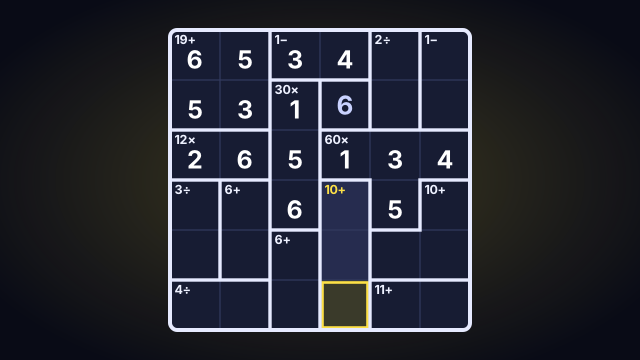
Calcudoku is a square of numbers cut into cages. Every row and every column holds each number from 1 up to the size of the square once, and the numbers in each cage make the target in its corner with the operation shown there: added, subtracted, multiplied or divided. A cage of one cell simply holds its number. Every square has exactly one answer you reach by reasoning, never by guessing, in three sizes from 4 by 4 to 7 by 7, and every day brings a new square, the same for everyone.
- Category
- Puzzle & Brain
- Modes
- Small 4×4 · Medium 6×6 · Large 7×7 · Daily
- Controls
- Mouse · Touch · Keyboard
Loading…
How to play
Tap a cell, then a number on the pad below. Each number appears once in every row and every column. The numbers in a cage make the target in its corner with its sign: + adds them, × multiplies them, − takes the smaller of two from the larger, ÷ divides the larger by the smaller. A number may repeat inside a cage, but never in a row or a column. With Notes on, numbers go in as small notes. A repeated number turns red, and so does the target of a cage that can no longer make it; a target its cage makes fades. Undo takes back your last change, for free. Your score is your time, and a hint fixes a wrong number or places a right one, and tells you why, for 30 seconds on the clock.
What is Calcudoku?
Calcudoku is a square of numbers with a little arithmetic in every corner. As in a sudoku, every row and every column holds each number from 1 up to the size of the square exactly once. The square is also cut into cages, groups of cells inside thick walls, and each cage shows a target and a sign: its numbers, in some order, must make that target by adding, subtracting, multiplying or dividing.
Every square has exactly one answer, reached by reasoning and never by guessing. There are three sizes, from 4 by 4 to 7 by 7, and every day brings a new square, the same for everyone.
How to play Calcudoku
Tap a cell to select it, then tap a number on the pad; tap the same number again to take it out.
- Rows and columns. Each number appears once in every row and once in every column.
- Cages. The numbers in a cage make the target in its corner with its sign. + adds them and × multiplies them. In a cage of two cells, − is the larger number minus the smaller, and ÷ is the larger divided by the smaller.
- Repeats. A number may appear twice in one cage, as long as the two cells are not in the same row or column.
- Single cells. A cage of one cell simply holds its number, and it is written in for you.
- Mistakes. A number repeated in a row or column turns red, and so does the target of a cage that can no longer make it. A target its cage makes fades.
- Notes. Turn on Notes to write small numbers in a cell; a number you place disappears from the notes of its row and column. On a computer keyboard, the number keys, arrow keys and N for notes all work.
- Undo. Undo takes back your last change, a number or a note, as often as you like and at no cost.
- Score. Your score is the time to solve the square, plus 30 seconds per hint. Each size has its own leaderboard.
Tips and strategy
- Cages with one answer. Some targets leave no choice. In two cells, 3+ is always 1 and 2. On a 6 by 6 square, 11+ in two cells is 5 and 6, and so are 30×, while 5− and 6÷ are 1 and 6. Start there.
- Products give a lot away. A product splits into few numbers: 15× in two cells is 3 and 5, and on a 7 by 7 square any product that 7 goes into needs a 7.
- Pairs. When two cells of a row can only hold 2 and 5 between them, no other cell of that row can be a 2 or a 5.
- Whole rows add up. A row of a 6 by 6 square always adds up to 21 and multiplies to 720; on a 7 by 7 square it is 28 and 5040. When most of a row is covered by sum cages lying wholly inside it, the cells left over make the rest.
- Note the options. On the bigger squares, write each cell's possible numbers as notes and strike them out as rows, columns and cages settle.
Frequently asked questions
Is Calcudoku free?
Yes. Like every game on Play, it runs free in your browser, with no download and no account.
Where does the name come from?
Calcudoku joins "calculation" to the "doku" of sudoku, its close cousin. The puzzle itself was invented in 2004 by Tetsuya Miyamoto, a Japanese mathematics teacher, and it is also known as Mathdoku.
What does a hint do?
It first fixes a wrong number if there is one. Otherwise it fills in the cell that reasoning reaches next, and the line under the square says why: the cage, the row or the column that settles it. Each hint adds 30 seconds to your time.
What do the sizes mean?
Small is a 4 by 4 square that cage arithmetic and plain steps solve. Medium is 6 by 6 and always needs at least one pair. Large is 7 by 7 and always needs a step beyond pairs: a cage that must put a number in one row, three cells holding three numbers between them, or the total of a whole row or column.
What is today's square?
Every day everyone gets the same medium square, so times compare directly on the leaderboard.
More like this
Target Number
Puzzle & Brain
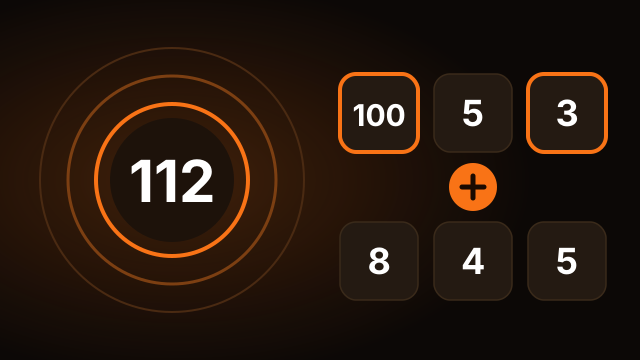
Can you hit the target with six numbers and four operations?
Hidden Code
Puzzle & Brain
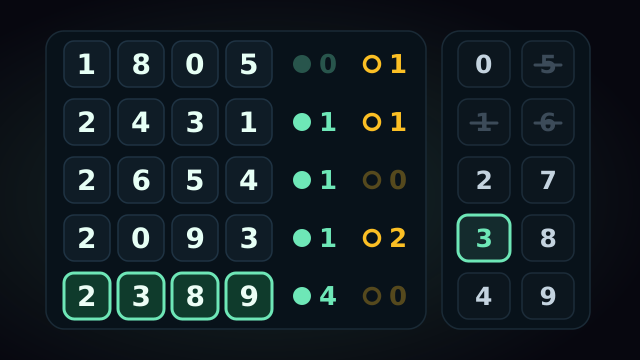
Find the hidden digits and their places, one guess at a time.

Sudoku
Puzzle & Brain
Nine digits. One logical path.
Killer Sudoku
Puzzle & Brain
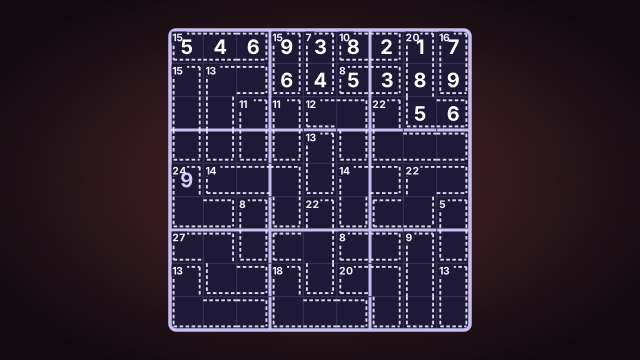
Sudoku with no numbers given: only cages and their sums.