Unscrew
Pull the screw. Watch the plate swing.
A board of one material, plates of the same stuff screwed onto it, and a handful of chrome screws holding them. Pull one and the plates answer at once: two screws keep a plate fixed, one lets it swing under its own weight, none drops it off the board. Every screw you pull has to go back into a free hole, and free holes are the whole problem. 4 materials, each with its own board, along a journey of 200 puzzles.
- Category
- Puzzle & Brain
- Modes
- Materials · Daily
- Controls
- Mouse · Touch · Keyboard

Loading…
How to play
Tap a screw to pull it, then tap a lit hole to place it through every plate whose holes line up. A plate with one screw can swing; with none, it comes loose and may fall or rest on an obstacle. Keep a free hole for the screw in your hand. If the board has stopped and no hole is available, try an available tool or restart. In campaign levels, each pull uses a move immediately. Putting the screw back does not use another move. Clear every plate and seat the last screw within the limit shown at the top right. Finish at par or below for three stars.
What is Unscrew?
Unscrew is a physics puzzle on a board of one material. Plates of the same material, on one or more layers, are screwed to it with chrome screws. Pull a screw and the plate tells you at once what holds it. Two screws keep it fixed. One screw lets it swing under its own weight until it hangs straight down or lands on a screw, a stud or another plate on the same layer. Without screws, a plate comes loose and falls, but it may rest on an obstacle. Plates on different layers move independently; screws can hold several layers. The board is cleared when every plate has left it and the last screw has been placed in a hole. The catch is that without the Pliers bonus, a pulled screw stays in play: it goes back into a free hole, and free holes are exactly what the board does not have enough of.
Each material has its own board and four tones. The journey contains 200 original puzzles across 4 materials. Start with five levels in each material, in the order wood, ice, metal, leather, then return for longer chapters. A chapter opens when you reach it, and every board in it is playable. Continue takes you to the first uncleared board on the road. From Materials you can choose an open board or replay a cleared one. The plates come in forty shapes, from a two-cell bar to a nine-cell plate, with discs, triangles and a diamond among them, and each shape swings the way its weight says.
How to play
Tap a screw to pull it. The board reacts immediately, before you decide where the screw goes. A plate left with one screw swings, a plate left with none drops, and the holes those plates were covering open up as they leave.
The screw stays in your hand and every hole that can take it lights up. A hole is legal when nothing solid covers it: the screw has to pass through a hole in every plate lying over that spot. Tap a lit hole to put the screw there, or drag the screw onto it. If it passes through plates, they are pinned again. Putting a screw back where it came from is allowed, and it still counts as a move.
Every campaign level has a solution verified with its material’s physics. Par is a target based on that solution. Finish at or below par for three stars, within two moves above it for two, and any completed level earns one. There is no timer. The top right shows your remaining moves; each pull uses a move immediately. Putting the screw back does not use another move. If you exhaust the allowance or the board becomes blocked, you can use an available tool or restart the level.
The Undo button at the bottom right reverses the last move and restores the move you spent. You can step back through your decisions to the start of the board, without coins or a usage limit. The button appears after the first action that can be undone. Reversing a tool’s effect does not refund its spent use.
Strategy tips
Read the swing before you pull. A plate on one screw turns toward its heavy side, and where it stops decides which holes it covers next. A swing that lands over your only free hole is the classic trap.
Pull for cascades. A shared screw can release several plates if it was the last screw holding them. Two or more plates leaving the board from one pull earn a cascade bonus. Holes beneath moving plates may open up and give you somewhere to place the screw.
Count free holes before every pull, not after. If the board has one free hole, the screw you pull must either go back there or open a new one on its way down. Re-pinning a plate on purpose costs a move but keeps the run alive.
FAQ
How is my score calculated?
Every plate that leaves the board pays 100 points plus 40 per cell. Two plates dropped by one pull add 150, three or more add 400. Clearing the board adds a bonus that starts at par plus three moves and shrinks by 60 points for every move you spend, so a clean line is worth real points. If you get stuck, the points for the plates you dropped stay, but there is no clear bonus and no stars.
Can the puzzle become unsolvable?
Yes. Every campaign level starts with a verified solution, but a wrong choice can cover empty holes or wedge a plate. Once the board stops, the game shows what caused the blockage. You can use an available tool or restart the level.
Do the materials play differently?
Yes. The material affects how easily plates slide and bounce, and how quickly their swinging settles. Each material has distinct levels with its own arrangements of plates, holes and layers.
More like this

Aetherward
Puzzle & Brain
Six realms. Thirty roads. One last light.
Trilume
Puzzle & Brain
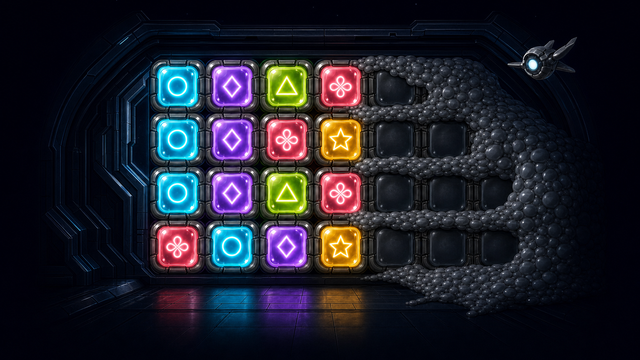
The repair swarm finishes every room it touches. Finished means gray. Three lights in a line burn it back.
Clavis
Puzzle & Brain
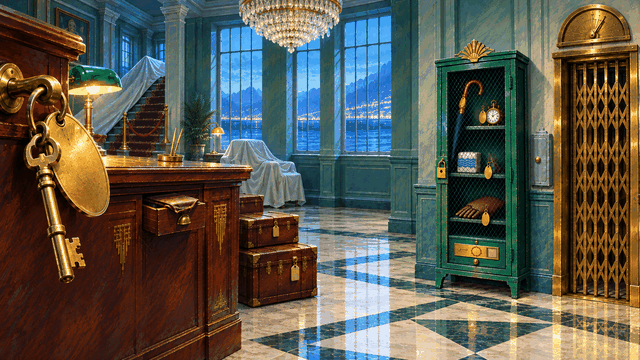
Painted rooms, real locks, one way out.
Blackstart Block Puzzle
Puzzle & Brain
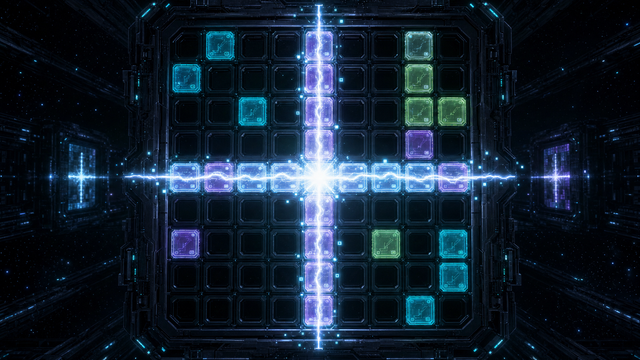
Seat three modules, close a circuit, relight the corridor.