Reaction Time
Wait for green. Tap. How fast are you?
How to play
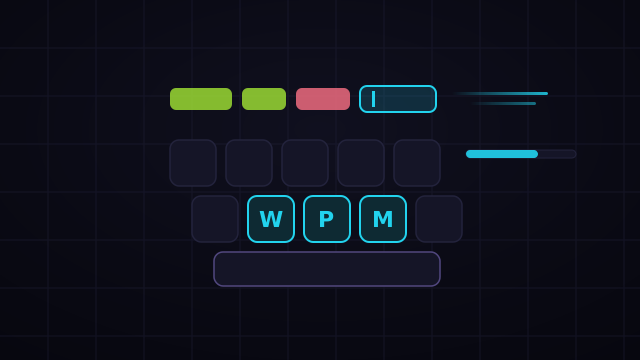
Tap the panel to start. Hold steady while it glows red, and the instant it turns green, tap, click, or press Space. Tapping too soon is a false start and restarts the round. After five measured rounds, your average reaction time becomes your score.
What is Reaction Time?
Reaction Time is the classic reflex benchmark, distilled to its purest form. The panel glows red while you wait; at a random moment it snaps to green, and your only job is to tap the instant it does. The game measures the gap between the color change and your tap in milliseconds, runs the test five times, and averages the results into a single score — the lower, the better.
Because the delays are unpredictable (anywhere from 1.2 to 3.5 seconds), you can't cheat the test by rhythm or anticipation. It's a raw measurement of how quickly your eyes, brain, and finger work together, which is exactly what makes it so addictive: every run is a chance to shave off a few more milliseconds. Play it solo to track your personal best, take on the daily challenge where everyone reacts to the identical sequence of delays, or go head-to-head in a live 1v1 duel where the faster average wins.
How to play
- Desktop: click anywhere on the panel with your mouse, or press the Space bar. Most players find a relaxed hand resting on the mouse is faster than hovering a finger over the keyboard — try both and keep whichever measures quicker.
- Mobile: tap the panel with your finger. Keep your fingertip close to the screen; travel distance costs real milliseconds.
- Tap once to start. The panel turns red — wait. The moment it flips to green and shows "TAP!", hit it as fast as you can.
- Tapping while the panel is still red is a false start: nothing is recorded and that round restarts with a fresh delay. False starts don't add time to your score, but they don't get you to the finish any faster either.
- After five measured rounds, your score is the rounded average of the five reactions.
Strategy tips
- React, don't predict. The delay is random every round, so gambling on timing just produces false starts. Fix your eyes on the panel and respond to the color change itself.
- Stay loose but ready. Keep light tension in your tapping finger — enough to fire instantly, not so much that you twitch early. Think of a sprinter in the blocks.
- Watch the center of the panel. Your visual reaction is fastest in the middle of your field of view. Staring at the score readout or the round dots adds precious milliseconds.
- Play a warm-up run. Reaction times reliably improve after one or two runs as your nervous system tunes in. Treat your first run as practice, not a record attempt.
- Mind your environment. Fatigue, distractions, and even a low-refresh-rate screen all slow your measured time. A quiet moment on a good display is worth 10–20 ms.
FAQ
What is a good reaction time?
For a visual stimulus, most people average between 250 and 300 ms with a mouse click. Under 240 ms is genuinely quick, and a sustained average below 200 ms puts you in rare company — competitive esports territory.
Why are my results different on my phone?
Touchscreens add their own input latency, and displays refresh at different rates, so the same human can measure 20–40 ms slower on one device than another. For fair comparisons — like the daily leaderboard — try to stick to one device.
Do false starts hurt my score?
Not directly. A false start simply restarts the round with a new random delay, and no time is recorded. They're tracked as a stat, though, so a clean run is still the mark of a disciplined trigger finger.
Is the daily challenge the same for everyone?
Yes. In daily mode every player gets the identical seeded sequence of delays, so the leaderboard measures pure reaction speed rather than luck with short waits.
How does the 1v1 duel work?
You and your opponent play the exact same seeded run at the same time, and you can watch their progress live. When both of you finish, the lower average reaction time wins the match.