Checkers
Jump, chain, crown. Repeat.
Classic 8×8 English draughts with glowing neon pieces: outmaneuver a calculating AI or duel a real opponent online, where every capture is forced and every crowned king changes the board.
- Category
- Cards & Board
- Modes
- Solo · 1v1
- Controls
- Mouse · Touch
Loading…
How to play
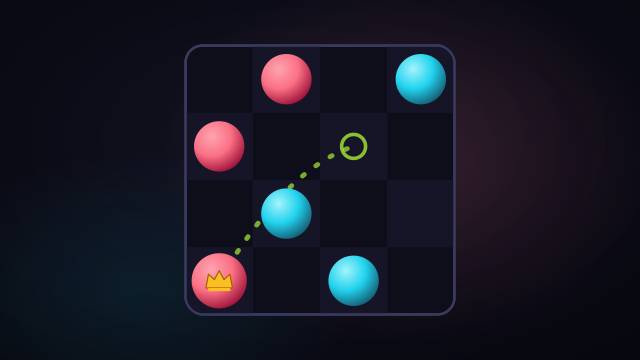
You play the rose pieces at the bottom and always move first. Tap or click one of your pieces to see its legal squares glow, then tap a glowing square to move diagonally forward. If a jump is available you must take it, and multi-jumps continue automatically with the same piece. Reach the far row to crown a king that moves and captures in all four diagonal directions. Capture everything, or block your opponent completely, to win 100 points.
What is Checkers?
Checkers, known as draughts across much of the world, is one of the oldest strategy board games still played today, and this is the classic English version on the traditional 8×8 board. You command twelve rose pieces on the dark squares; your opponent commands twelve cyan ones. Pieces slide diagonally forward, jump over enemy pieces to capture them, and earn a golden crown when they reach the far side of the board. It looks simple for about three moves, and then the forced-capture rule turns every exchange into a small tactical puzzle.
You can play solo against a calculating AI that thinks two moves ahead, or challenge a real opponent in a turn-based online match. Winning scores 100 points, a draw 40, and a loss 0. And the platform tracks your captures, crowned kings, and total moves for every game.
How to play
On desktop, click one of your rose pieces: every square it can legally reach starts to glow. Click a glowing square to move there. On mobile, the same flow works with taps: every square is a comfortable touch target, and nothing depends on hovering.
The rules that matter most:
- Men move diagonally forward one square onto an empty dark square.
- Captures are forced. If any of your pieces can jump an adjacent enemy piece into an empty square beyond it, you must take a capture: quiet moves are locked until you do.
- Multi-jumps chain automatically. When your jumping piece can immediately jump again, the chain continues with the same piece; if there is a choice of directions, you pick the branch.
- Kings rule both directions. A man that reaches the far row is crowned and may move and capture forward and backward.
- Winning and drawing. You win by capturing every enemy piece or leaving your opponent with no legal move. If 40 consecutive moves pass without a single capture, the game is declared a draw.
Strategy tips
- Count every exchange before you offer it. Because captures are forced, moving a piece next to an enemy man hands your opponent a jump: make sure the trade ends in your favor, or use it as bait.
- Control the center. Central pieces reach more squares and create more double-jump threats than pieces stuck on the edges, which can only ever move in one direction.
- Keep your back row intact early. Every piece you leave on your first row denies your opponent an easy coronation; move those defenders only once you know where the enemy breakthrough is coming.
- Build phalanxes, not loners. Pieces supporting each other diagonally cannot be jumped without consequence. A lone advanced man is usually a free capture waiting to happen.
- Race for the first king. A king is worth roughly two and a half men in practice. Once you're crowned, harass stragglers from behind while your opponent's men can still only run forward.
FAQ
Is Checkers free to play?
Yes, like every game on Play, Checkers is completely free in your browser, with no download, install, or sign-up required. You can jump straight into a solo game against the AI.
Do I have to capture if a jump is available?
Yes. This game uses the standard English draughts rule: if any capture exists for the side to move, a capture must be played, and a multi-jump must be played to the end of the chain. The interface makes this easy: only legal pieces and squares light up.
How does the online multiplayer work?
Matches are 1v1 and turn-based. The rose player always moves first, both boards stay perfectly in sync move by move, and if your opponent disconnects and doesn't return within the grace period, you win by forfeit.
Can a king be captured?
Absolutely, a crown grants backward movement, not immunity. Kings are jumped exactly like ordinary men, so even a crowned piece needs support from its own side.
What happens if nobody can win?
If 40 consecutive moves are played without a capture, the game ends in a draw worth 40 points, so endless king-shuffling won't save a lost position forever.