2048
Merge your way to the golden tile.
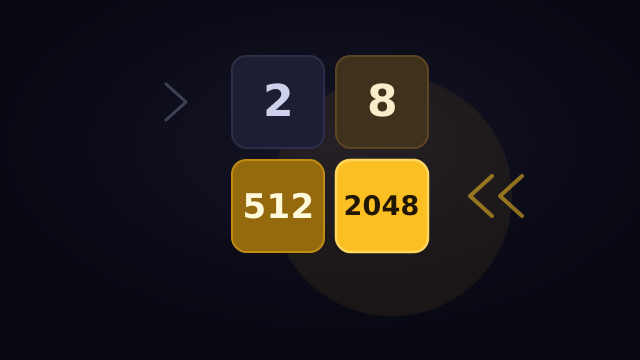
Slide numbered tiles across a 4×4 grid and merge equal pairs into ever-bigger powers of two. Reach 2048, then keep going for a monster score.
- Category
- Arcade
- Modes
- Solo · Daily
- Controls
- Keyboard · Touch · Mouse
Loading…
How to play
Press the arrow keys (or WASD) on desktop, or swipe anywhere on the board on mobile, to slide every tile in one direction. When two equal tiles collide they merge into one and add their sum to your score. Every move drops a new tile onto the board, so plan ahead: the run ends when the grid is full and nothing can merge.
What is 2048?
2048 is the sliding-tile puzzle that took over the internet in 2014 and never really let go. The idea fits in one sentence: slide numbered tiles around a 4×4 grid, and when two tiles with the same number touch, they merge into one tile worth their sum. Two 2s become a 4, two 4s become an 8, and so on up the powers of two until, with enough foresight, you forge the famous golden 2048 tile. Every merge adds its value to your score, and the game keeps going past 2048 for as long as you can keep the board alive. What makes it so compulsive is the tension between short-term relief and long-term structure: any single swipe is easy, but every swipe also drops a brand-new tile onto the board, slowly squeezing your space until only disciplined players survive.
How to play
On desktop, use the arrow keys or WASD. Each press slides every tile on the board as far as it can go in that direction. On mobile, swipe anywhere on the board (up, down, left or right) and the tiles follow your finger's direction.
The rules in full:
- All tiles slide together in the chosen direction until they hit the wall or another tile.
- Two tiles with equal numbers merge into one when they collide, scoring the merged value. A tile can only merge once per move, so a row of 2-2-2-2 becomes 4-4, never a single 8.
- After every move that actually changes the board, a new tile appears in a random empty cell: a 2 most of the time, occasionally a 4. Swipes that change nothing are simply ignored.
- The run ends when the grid is full and no neighboring tiles match. Reaching 2048 doesn't stop the game: the real high scores live far beyond it.
In daily mode, everyone plays the exact same seeded sequence of spawns, so the leaderboard is a pure test of strategy.
Strategy tips
- Pick a corner and swear loyalty to it. Keep your biggest tile locked in one corner (bottom-left is a classic) and build descending values along that edge. Most losses trace back to a big tile drifting into the middle.
- Use only three directions. If your anchor corner is bottom-left, avoid swiping up unless you literally have no other move. Every "forbidden" swipe risks tearing your structure apart.
- Build snake-like chains. Arrange values in a zig-zag (512, 256, 128 along the bottom row, then continuing back along the row above) so each new merge cascades into the next.
- Don't chase every small merge. A tempting 4+4 in the wrong spot can block the lane your 256 needs. Think one merge ahead, minimum.
- Keep an escape lane open. Try to always have one row or column that can absorb a bad spawn. When the board gets tight, prioritize moves that create empty cells over moves that score.
FAQ
Is reaching 2048 the end of the game?
No. Hitting the 2048 tile is the traditional "win," but here the run continues for as long as you have legal moves. Players chase 4096, 8192 and beyond: your score keeps climbing with every merge.
How is the score calculated?
Every merge adds the value of the newly created tile to your score. Merging two 64s gives you 128 points, merging two 1024s gives you 2048 points. Big late-game merges are worth vastly more than early ones, which is why survival matters more than speed.
Is the daily challenge the same for everyone?
Yes. Daily mode uses a shared seed, so every player faces the identical sequence of tile spawns. Same luck for everyone: only the strategy differs.
What's a good score in 2048?
Reaching the 2048 tile usually lands around 20,000 points. Anything above 5,000 already beats a casual run, and seasoned corner-strategists push six figures.
Can I play 2048 for free on mobile?
Yes, the game runs right in your browser, works with touch swipes, and needs no download or install.
More like this
Gemfang
Arcade
A beacon fell into the black hole and still repeats all clear. The convoys believe it. Tear them free, three arks at a time.

Emberfall
Arcade
One light. An endless dark.
Caranx
Arcade
You start as a thumb-length trevally and eat everything well under your own number, until the reef has to make room for you.

Block Fall
Arcade
Stack the signal. Enter Neon Flow.